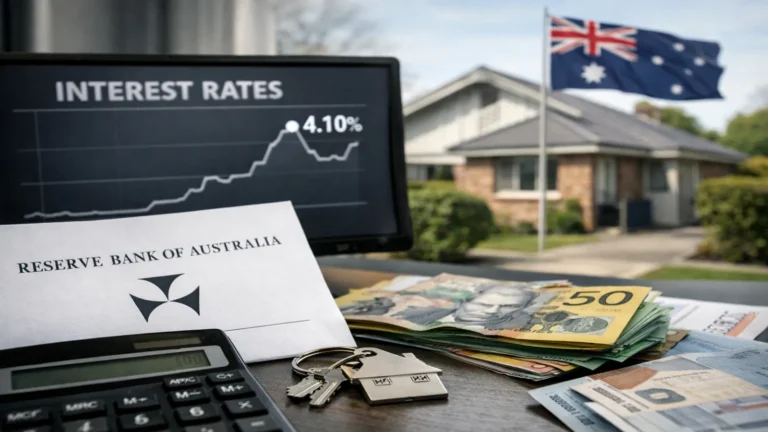
The Reserve Bank has delivered its clearest signal yet that current settings are doing the job of slowing demand, but stopped well short of declaring the inflation fight over. In a speech this week, a senior central bank official described monetary policy as “somewhat restrictive” while acknowledging housing markets have weakened by more than rate rises alone would explain.
That matters because it tells us two things at once: the RBA believes its work is having an effect, but it’s not confident enough in the trajectory to shift course.
Housing doing more heavy lifting than expected
Housing has become the clearest transmission channel for tighter policy. National housing values have fallen for four consecutive months, with the downturn no longer confined to Sydney and Melbourne. Auction clearance rates are running below long-term averages, and new lending growth has slowed sharply.
The Reserve Bank’s assessment is that some of this weakness was expected after three rate rises earlier this year. Higher borrowing costs reduce what buyers can pay, increase repayment burdens, and shift the calculation toward saving rather than spending.
But other forces are at work. The central bank noted that housing investors are pulling back after changes to federal tax treatment lowered after-tax returns from property. That policy shift is doing some of the demand-dampening work monetary policy would otherwise need to do.
More importantly, the housing market appears to have softened by more than the recent rate increases would typically produce on their own. That’s pushing financial conditions into “a bit more restrictive” territory than the cash rate alone suggests.
The case against another immediate rise
If the housing downturn is already doing more work than expected, the argument for another rate increase weakens. The central bank’s own data shows scheduled mortgage payments are back near their 2024 peak as a share of household income, housing credit growth has slowed, and the Australian dollar has appreciated by around 5 per cent this year, another inflation brake.
The current cash rate of 4.35 per cent sits around the top of the RBA’s estimate for the neutral rate, the level that neither stimulates nor restricts activity. That estimate carries uncertainty, but the direction is clear: policy is already in restrictive territory.
Here’s the catch. Not every measure is tightening. Market expectations for future rate cuts have eased borrowing costs for some wholesale borrowers, funding remains readily available, and risk pricing across financial markets is close to historical lows. The RBA is watching those offsets closely.
Key numbers
- Cash rate: 4.35%, described as “somewhat restrictive” by the RBA
- National housing prices: negative growth for four consecutive months
- Auction clearance rates: below long-run averages across all capital cities
- Australian dollar: up ~5% on a trade-weighted basis since January
- Market-implied probability of a rate rise by March 2027: just over 50%
What’s really keeping cuts off the table
The problem isn’t that the RBA wants to raise rates again. It’s that it can’t yet commit to cutting them. Inflation remains above the 2-3 per cent target band, global uncertainty is elevated, and several forces beyond the central bank’s control are shaping financial conditions in unpredictable ways.
The recent housing downturn is less severe than the corrections seen in 2018-19 or 2022, and part of it reflects a natural pullback after a long run of strong price growth. The RBA needs to see whether the slowdown is temporary or the start of a sustained adjustment.
That leaves borrowers in an awkward spot. The central bank thinks policy is restrictive enough to deliver the slow demand growth needed to bring inflation down, but it’s not confident enough to signal relief is coming. Markets are pricing roughly even odds of another 25 basis point increase by early next year, with cuts not expected until the second half of 2027 at the earliest.
Scenarios for borrowers over the next 12 months
Base case: the cash rate stays at 4.35 per cent through mid-2027 as the RBA watches housing, employment and inflation data. Housing markets stabilise at lower levels, credit growth stays subdued, and scheduled mortgage payments remain near current levels as a share of income. No relief, but no further pressure either.
Upside scenario: inflation falls faster than expected, housing weakness spreads more broadly, and the RBA starts signalling cuts by late 2027. Borrowers on variable rates see some relief, though fixed-rate refinancers who locked in lower rates in 2024-25 still face a step-up.
Downside scenario: global shocks or domestic wage pressures keep inflation sticky, the RBA delivers one more 25 basis point increase in early 2027, and the cash rate peaks at 4.6 per cent. Housing markets weaken further, default risk climbs, and the spring selling season disappoints.
Red flags for the next six months
Watch auction clearance rates through the spring selling season. If they stay below long-run averages despite normal seasonal uplift, it confirms the slowdown is broader than Sydney and Melbourne alone. A sustained drop in new lending approvals would signal tighter credit conditions are biting harder than the cash rate suggests.
The other pressure point is household repayment capacity. Mortgage default risk is already up 18 per cent as borrowers hit financial limits. If that trend accelerates while the cash rate stays on hold, it tells you restrictive settings are doing more damage than the RBA’s forecasts assume.
Global forces matter too. If the Australian dollar weakens sharply or offshore funding costs spike, financial conditions could tighten even without another domestic rate rise. The RBA’s forward guidance is deliberate: “finely balanced” means don’t assume the pause is permanent.
What this means for property decisions right now
If you’re borrowing or refinancing, price in the risk that the cash rate stays at 4.35 per cent through 2027. Stress-test your repayments at 5 per cent to see how much buffer you really have. Variable-rate borrowers face no immediate relief, and fixed-rate options are pricing in a long hold rather than cuts.
For investors, the combination of higher rates, softer housing markets and lower after-tax returns from recent policy changes has shifted the risk-return equation. New purchases need to stack up on yield and cashflow, not capital growth assumptions. If you’re relying on price appreciation to make the numbers work, you’re betting against the RBA’s stated intention to keep demand slow.
For sellers, the spring season will clarify whether recent auction weakness is a blip or the start of a longer correction. If you’re in Sydney or Melbourne and waiting for conditions to improve, the central bank’s assessment suggests you’re waiting for something that isn’t coming soon.
The RBA’s communication policy now drives property decisions as much as the rate moves themselves. When a senior official says policy is “somewhat restrictive” and housing has weakened “by somewhat more than the recent increase in interest rates would imply,” that’s not an accident. It’s forward guidance designed to manage expectations.
Start here: assume the cash rate doesn’t move for at least another 12 months, and build your property decisions around that baseline. If you want the full RBA signal versus market noise breakdown each week, subscribe to Australian Property Review.
General info, not financial advice.