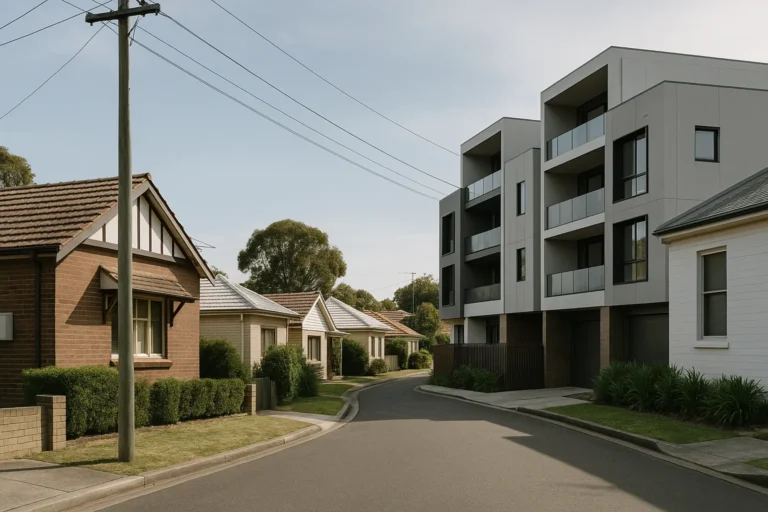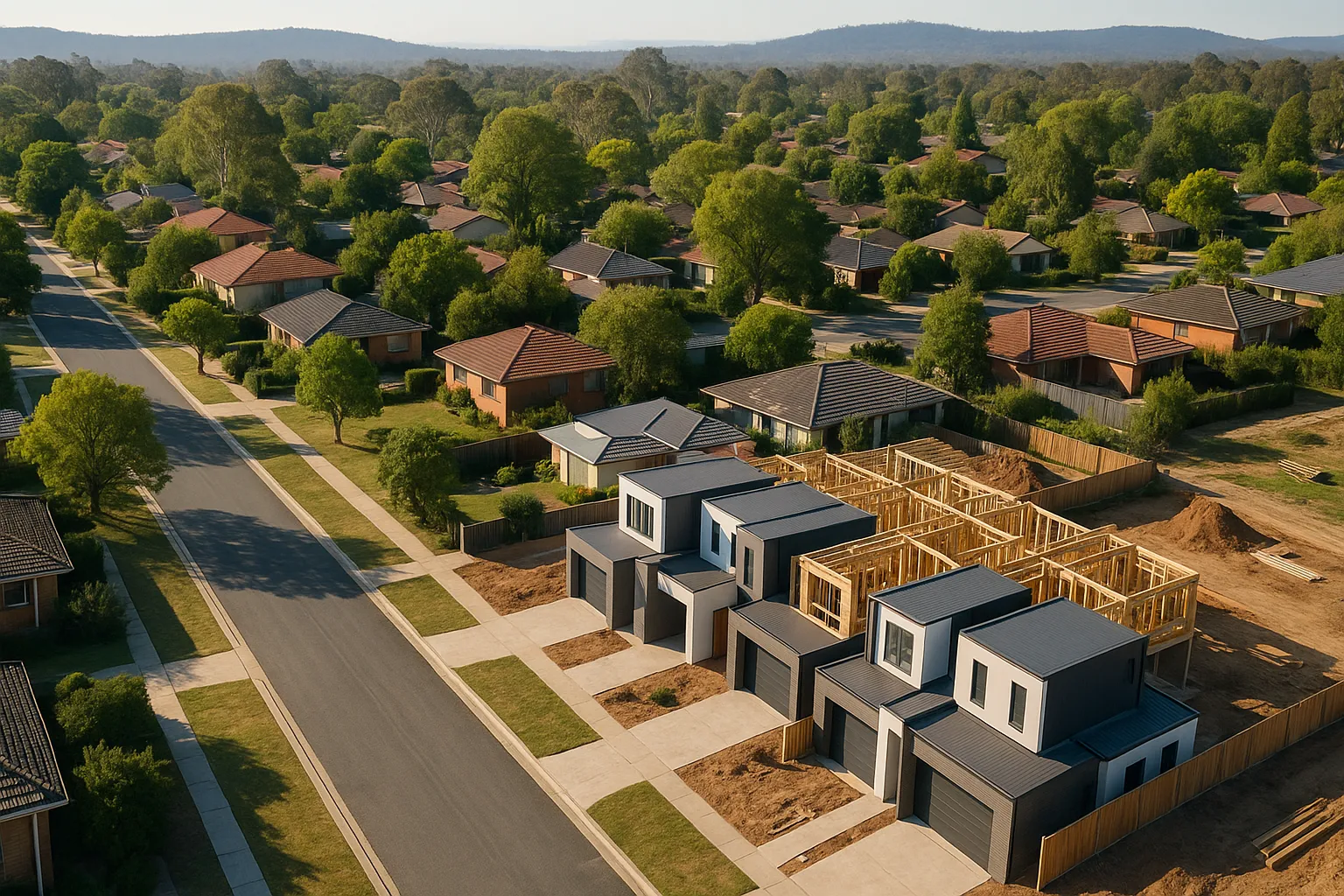
Canberra’s planning system just changed the legal envelope for thousands of suburban properties in a single stroke, rezoning blocks from single-dwelling to medium-density overnight. The question investors actually care about is simpler than the policy rhetoric suggests: does a piece of paper giving you the right to build more units translate into a higher sale price for your land, or do the build economics still not stack up?
The ACT government framed this as an affordability play, more homes, more supply, downward pressure on prices. Property owners and developers are running different math: what’s the uplift on an established house that can now legally become four townhouses, and does that margin survive the gap between feasibility and finance?
What changed and what didn’t
The rezoning affects single-dwelling blocks in inner and middle-ring suburbs, shifting them into a medium-density category that permits townhouses, duplexes and low-rise apartments without the previous consent hurdles. Land that was legally frozen at one dwelling can now support three, four or more, depending on setbacks and site coverage rules.
What didn’t change: construction costs, serviceability tests for build-to-rent finance, infrastructure capacity (schools, roads, water), and buyer appetite for medium-density in streets where the existing stock is detached houses. Rezoning removes a planning constraint, but it doesn’t remove the financial and market constraints that determine whether someone actually builds.
The ACT is the experiment because it moved fast and wide, NSW and Victoria are both debating similar reforms, but Canberra went first and covered more ground in one hit.
Development feasibility and the value question
Rezoning creates theoretical value: if you can build four townhouses where the law previously allowed one, the site should be worth more to a developer than to an owner-occupier. The size of that uplift depends on whether the end product, those four townhouses, can sell or rent for enough to cover land cost, build cost, finance cost, holding cost and a developer margin.
In Sydney’s middle ring, townhouse feasibility has tightened over the past 18 months as construction costs rose faster than sale prices, and serviceability squeezed the buyer pool. Canberra’s market is smaller and less liquid, so the margin for error is narrower. A block that pencils at $600,000 as a house might be worth $750,000 as a development site if the four townhouses sell for $650,000 each and build costs sit at $400,000 per dwelling, but if build costs are $450,000 or end values drop to $600,000, the uplift disappears and the site stays a house.
The ACT rezoning doesn’t guarantee uplift, it permits it. The market will price in that optionality, but selectively: well-located blocks near employment and transport will see stronger interest, while edge-of-suburb sites with longer commutes and thinner buyer demand won’t.
Key numbers
- Construction cost for a townhouse in Canberra’s middle ring typically runs $2,200–$2,600 per square metre, putting a 180-square-metre dwelling at $400,000–$470,000 excluding land
- Median house price in inner-south Canberra sat at $1.1 million as of late 2024, inner-north at $1.2 million, with middle-ring suburbs $200,000–$400,000 lower
- Feasibility threshold for townhouse development generally requires end sale price to sit 60–70 per cent above build cost to cover land, finance, holding and margin
- Rezoning affects an estimated several thousand blocks across inner and middle-ring areas, though the ACT government has not released a final count
- NSW’s housing supply plan targets 800,000 homes across three CBDs, with rezoning a key mechanism
Who wins and who loses
Established owners in well-located areas gain optionality: even if they don’t develop, the site is worth more to the next buyer if that buyer can. Owners in marginal locations might see no uplift at all if the development math doesn’t work, leaving them with a zoning change that delivers policy credit but no market premium.
Developers and build-to-rent players get more sites to assess, but also more competition for those sites, which can bid up land faster than end prices rise. The feasibility window is narrow, rezoning opens it wider, but rising land prices can close it again if buyers can’t stretch further.
Renters and first-home buyers face a trade-off: more supply should ease price pressure over time, but the new stock will be medium-density (smaller lots, shared walls, less private open space) rather than detached houses, and it won’t arrive for 18–36 months even if every rezoned site started construction tomorrow. In the short term, land prices may rise faster than new completions.
Risks and what could stall it
Three things could derail the value-unlock thesis. First, if construction costs keep rising or lending for small-scale development tightens further, feasibility breaks and rezoning becomes theoretical. Second, if buyer appetite for townhouses in traditionally detached-house streets proves weaker than projections, end values sag and margins evaporate. Third, if infrastructure (particularly schools and traffic capacity) can’t keep pace, council or community pushback could slow approvals even where zoning permits development.
Canberra’s market is also thinner than Sydney or Melbourne, so price discovery is slower and liquidity lower. A rezoned block might sit for months waiting for a developer who can make the numbers work, and that holding period erodes returns.
The ACT rezoning is a live case study for NSW and Victoria, both watching to see whether planning liberalisation delivers the supply and affordability outcomes governments promise, or just shifts value from one cohort of owners to another without changing the housing stock materially.
Practical next step for investors
If you own in an ACT area affected by rezoning, get a development feasibility assessment from a quantity surveyor and a buyer’s agent before assuming your site is worth more. The uplift is real for some blocks, absent for others, and the difference comes down to location, size, topography and whether four townhouses can sell for enough to justify the risk.
If you’re looking at Sydney or Melbourne and waiting to see how rezoning plays out, track Canberra’s approvals and settlement data over the next 12 months, it will show whether rezoning translates into construction starts or just planning permissions that never get used.
Subscribe to the newsletter for weekly policy and development updates.
General info, not financial advice.