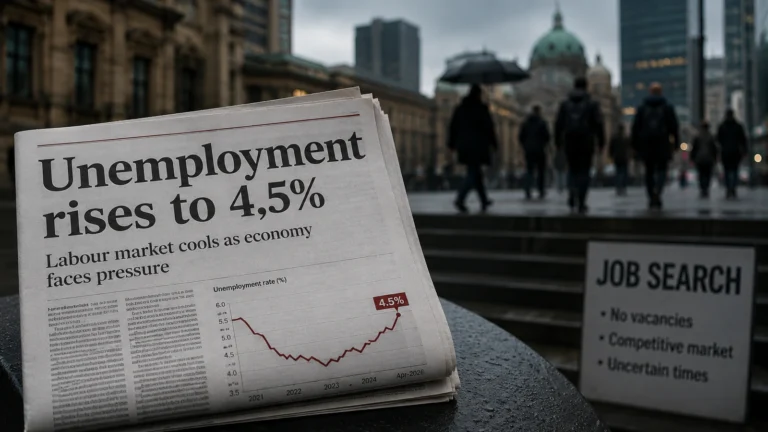
Australia’s unemployment rate climbed to 4.5 per cent in July, up from 4.4 per cent the month prior, according to Australian Bureau of Statistics data released this week. The shift is small in isolation but marks a four-year trend: joblessness has risen steadily from the 3.4 per cent low recorded in mid-2022, and 691,500 people are now unemployed. Hours worked have also fallen since the start of the year, signalling cooling demand for labour as the economy slows.
The question now is whether this gives the central bank enough cover to hold rates, or whether it needs to see more labour market slack before declaring victory on inflation.
What the numbers mean for the next decision
The unemployment rate rise to 4.5 per cent does two things. First, it confirms that previous rate hikes are filtering through the real economy, higher borrowing costs have slowed business investment, household spending has softened, and GDP growth has decelerated. Second, it gives the central bank more evidence that current settings are restrictive enough to keep inflation on a downward path without needing another move.
But here’s the catch: inflation remains above the 2–3 per cent target band, and senior monetary policy figures have previously stated that unemployment may need to climb further to lock price growth inside that range. The next inflation print, due within days, will clarify whether the recent cooling is enough, or whether officials still see upside risk.
Most economists now expect the cash rate to stay put in the near term. The combination of falling house prices, rising rents, weak consumer and business confidence, and a softer jobs outlook makes another hike harder to justify. But a cut this year remains unlikely. Until inflation is firmly anchored within target, relief for borrowers is months away at best.
The mortgage stress reality
New survey data shows just how thin the margin has become for many households. More than one in four mortgage holders, an estimated 891,000 borrowers, report either just scraping by or already approaching the point where they can’t meet repayments. Another 38 per cent say they can afford the mortgage but have almost no financial buffer left.
This is the result of cumulative rate rises compounding with cost-of-living increases over the past two years. For households who refinanced or bought near the peak, monthly repayments have climbed by hundreds of dollars, and there’s little room to absorb further shocks. One unexpected expense, a car repair, medical bill, or loss of overtime hours, can tip a manageable situation into crisis.
The stress is structural, not cyclical. Even if rates hold steady from here, many borrowers face months or years of constrained spending as they work through elevated debt servicing costs. Private lending demand has already jumped 68 per cent as banks tighten serviceability tests and some households seek alternative finance to stay afloat.
Key numbers
- Unemployment rate: 4.5% (July 2026), up from 3.4% in July 2022
- Estimated mortgage holders in financial stress: 891,000
- Proportion of borrowers with little or no buffer: 65%
- Hours worked: down since January 2026
The policy bind
The central bank now faces competing pressures. On one side, a weakening labour market and falling house prices argue for caution, further tightening risks tipping the economy into a sharper downturn and amplifying mortgage defaults. Melbourne auction clearance rates have already fallen below 50 per cent as buyer appetite weakens, and vendors are starting to recalibrate expectations.
On the other side, inflation above target means the institution’s credibility depends on staying the course until price growth normalises. Officials have been explicit: a slowing economy and rising unemployment do not automatically trigger a reversal. The institution will wait until inflation is locked inside the target band before considering cuts, and that timeline currently points to 2027 at the earliest.
This creates a painful middle period for borrowers. Rates stay high to contain inflation, but the real economy continues to soften, eroding income security and making it harder for households to service existing debt. The base case is a long plateau, not a swift resolution.
Scenarios that could shift the path
Three factors could alter the trajectory over the next six to twelve months:
-
Inflation falls faster than expected. If the next few prints show sustained progress back toward the 2–3 per cent band, the institution gains room to ease earlier than currently priced. This would depend on goods prices continuing to deflate and services inflation, still elevated, rolling over as wage growth moderates.
-
Labour market deteriorates more sharply. If unemployment climbs above 5 per cent or job losses accelerate in key sectors, the risk-reward calculus flips. At that point, the institution may judge that holding rates high does more harm than leaving inflation slightly above target for longer.
-
Housing market correction deepens. Prestige property has already repriced significantly, and if the downturn spreads to mainstream suburbs with forced sales, wealth effects and construction activity could contract faster, feeding back into weaker demand and lower inflation.
None of these scenarios is certain. The base case remains a protracted hold, with cuts pushed into next year.
What to do if you’re exposed
If you’re in the 65 per cent of borrowers with little or no buffer, the priority is building a cashflow cushion before the next unexpected cost arrives. That means:
- Switching to a lower-rate loan if you haven’t already. Even a 0.2 percentage point reduction saves meaningful dollars over a year.
- Redirecting any discretionary spending into an offset account. Every dollar in offset reduces interest charged daily, lowering your effective repayment.
- Stress-testing your budget against a six-month income disruption. If you can’t cover three months of mortgage payments from savings, you’re one job loss or health issue away from serious trouble.
- Avoiding new debt. Home equity withdrawal for discretionary spending locks in higher servicing costs at exactly the wrong time.
If you’re already struggling, contact your lender before you miss a payment. Hardship provisions exist, and early engagement gives you more options than waiting until arrears accumulate.
General info, not financial advice.