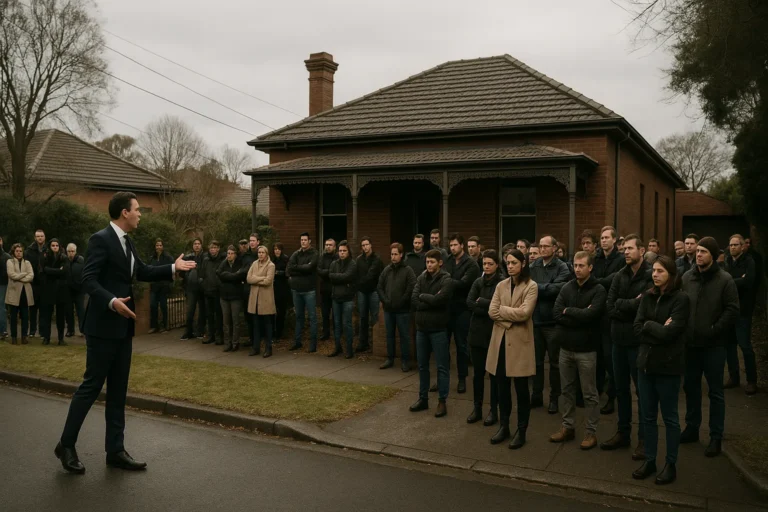
Melbourne’s auction market is hitting a wall. Clearance rates have dropped below 50%, meaning more homes are passing in than selling under the hammer or beforehand. The friction point is clear: vendors are pricing to last year’s peak, while buyers are constrained by today’s serviceability.
The gap isn’t uniform. Mid-tier family homes in outer and middle-ring suburbs are passing in at higher rates than premium properties or apartments. The reason is structural. These properties sit in the price bracket where mortgage serviceability bites hardest, and the buyer pool has shrunk as rates have stayed elevated.
Which properties are stalling
Family homes priced between $900,000 and $1.5 million in suburbs 15-30km from the CBD are seeing the most auction failures. A buyer borrowing $1 million at today’s rates needs household income around $200,000 to pass serviceability at a 3% buffer. That’s above median household income in most of these suburbs.
Premium properties above $2 million are clearing at higher rates because the buyer pool is less rate-sensitive, more equity, higher incomes, less reliance on maximum borrowing capacity. At the other end, apartments and units under $700,000 are moving because first-home buyers and downsizers can still service the debt, and stamp duty concessions apply in some states.
The problem zone is the middle. Vendors who bought or refinanced in 2021-2022 are anchored to those prices. Buyers are anchored to what they can borrow now. The two numbers don’t meet.
Why vendors are holding out
Sellers have two rational reasons to dig in. First, if they bought in the past 18 months, selling below purchase price crystallises a loss they’re not forced to take yet. Second, many are watching quarterly data that shows prices haven’t collapsed, small declines or flat movement can feel like vindication that holding firm will work.
But auction pass-ins carry a cost. Properties that don’t sell first time get tagged as stale. Buyers assume there’s something wrong or that the vendor will eventually capitulate. Each failed auction erodes negotiating position.
The other issue is carrying cost. If a vendor is holding an investment property or an empty upgrade, every month of holding costs rates, insurance, maintenance, and opportunity cost. For family homes where the owner has already moved, there’s also the emotional toll of managing two properties.
The buyer angle
For buyers, a sub-50% clearance rate is a green light to negotiate post-auction. Passing in doesn’t mean the property is off the market, it means the vendor will now consider offers below reserve. The negotiating window is typically 2-4 weeks after auction before the property either re-lists or gets withdrawn.
Private lending demand has jumped 68% as bank credit tightens, which tells you some buyers are finding ways around serviceability. But that’s expensive money, and it doesn’t change the underlying constraint: most buyers are still working with bank credit, and banks are assessing at rates 3% above the actual rate.
The tactical move for buyers in this market is to track properties that pass in, wait a week, then approach with a clean offer at the price serviceability actually supports. Vendors who’ve now failed to sell twice, once at the quoted range, once at auction, are materially more likely to accept a realistic number.
Key numbers
- Clearance rate: below 50%, meaning more homes passing in than selling
- Serviceability constraint: $1 million loan requires ~$200,000 household income at current rates
- Problem price bracket: $900,000–$1.5 million family homes in middle/outer suburbs
- Premium segment: properties above $2 million clearing at higher rates due to less rate sensitivity
- Negotiating window: 2-4 weeks post-auction before vendor strategy shifts
Scenarios that change the dynamic
Base case: clearance rates stay below 55% through winter, vendors adjust slowly, transaction volumes stay low. Prices drift down 3-5% in the problem bracket over six months as the gap narrows from both sides, some vendor capitulation, some buyer capacity improvement if fixed rates roll off at lower levels.
Upside for buyers: if unemployment ticks up or a wave of forced sales hits (relocations, divorces, deceased estates), vendor urgency increases and the price floor drops faster. Properties that have already passed in twice become distressed quickly.
Upside for vendors: if the RBA cuts earlier or deeper than currently priced in, serviceability loosens and the buyer pool expands. But that’s not the current trajectory, futures markets are pricing cuts as gradual and distant.
Where this goes next
The clearance rate will tell you which way momentum is shifting. If it drops below 45%, vendors are mispricing systematically and will be forced to adjust. If it climbs back above 55%, buyers are finding ways to meet vendor expectations, either through improved serviceability, more equity, or non-bank credit.
Right now, the data says buyers have the leverage. The question is how long vendors can afford to wait.
If you’re buying in the $900,000–$1.5 million bracket, focus on properties that have already passed in once. Make offers based on what you can actually borrow, not what the vendor wants. If you’re selling in that bracket, pressure-test your reserve against what a buyer on median-plus income can service, if the numbers don’t work, you’re pricing for a market that doesn’t exist anymore.
Subscribe to the newsletter for weekly auction clearance data and serviceability updates.
General info, not financial advice.