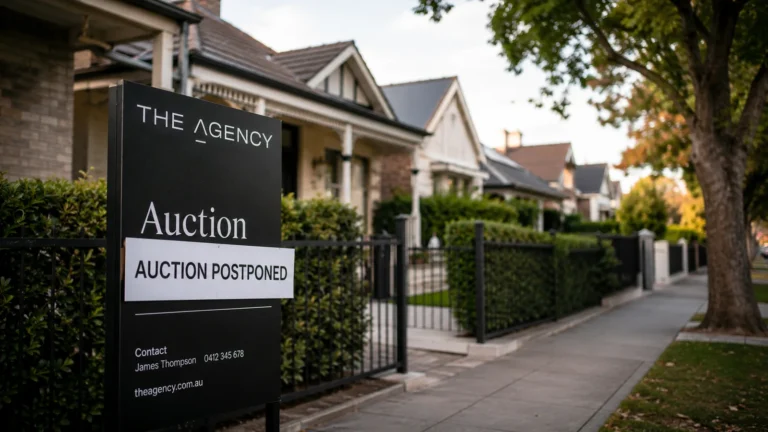
Melbourne’s auction rooms are telling two different stories. Units cleared at 62% last week while houses managed just 51%, a gap that’s held for three of the past four weeks. The preliminary citywide clearance rate sits at 52.1% after 326 results, but the unit-vs-house split is the number that matters.
The surface read is straightforward: units cost less, so more buyers can compete. Median house prices have dropped harder than units over the past twelve months, pushing houses further out of reach while units hold closer to their previous range. First-home buyers and rate-squeezed upgraders are concentrating in the bracket where units sit.
But two forces are at work here, not one. The first is demand compression, buyers who would have stretched for a house eighteen months ago are now maxing out serviceability on a unit. The second is supply constraint. New apartment construction has slowed sharply compared to 2021-22, so the unit stock available at auction isn’t being flooded by off-the-plan completions the way it was during the last cycle.
The affordability lens
First-home buyers are one of the few active cohorts in Melbourne right now. Investor activity has pulled back significantly as yields tighten and rate expectations shift. That leaves owner-occupiers, and within that group, entry-level buyers have the most urgency, they’re not timing the market, they’re trying to get in before serviceability tightens further or before rental increases force another move.
Units fit that profile. A two-bedroom unit in the inner or middle ring still clears at a price point where a household on $140,000-$160,000 combined income can service a loan without a guarantor. A comparable house in the same suburb is often $200,000-$300,000 higher, which pushes the buyer into a choice: stretch the deposit further, move to the outer suburbs, or wait.
The clearance rate gap suggests more buyers are choosing units over waiting. That’s a behavioural tell, it shows urgency is still present at the lower end of the market, even as higher price brackets soften.
The yield question
The other angle is investor interest, though the data here is thinner. Yields on units have held steadier than yields on houses over the past year, particularly in the inner and middle rings where rental demand from students, singles and downsizers remains consistent. A unit returning 4.2%-4.5% gross yield looks more defensible than a house at 3.2%-3.6% if an investor is running the numbers on cashflow rather than capital growth.
But investor activity is down overall, so this is more likely a story of relative investor interest, units are attracting a higher share of the smaller investor pool, rather than a surge in absolute numbers. The clearance rate gap is probably 70% affordability-driven demand and 30% yield-focused investors front-running further supply constraints.
Key numbers
- Unit clearance rate: 62% (final result, one week ago)
- House clearance rate: 51.3% (same period)
- Listings volume: 40% below same time last year
- Yield advantage: units returning ~4.2%-4.5% vs houses at ~3.2%-3.6% in comparable suburbs
What could narrow this gap
Three things would shift the dynamic. First, if house prices fall faster than units over the next 3-6 months, serviceability improves for house buyers and the affordability advantage narrows. Second, if listings volume increases, particularly if vendors who’ve been holding off decide to sell before spring, the limited-choice factor that’s supporting unit clearance rates weakens. Third, if investor activity picks up (either because rate expectations shift or because yields compress further in other asset classes), houses could see renewed competition from buyers with larger deposits and longer time horizons.
The base case is that this gap persists through winter. Listings are tracking well below last year, construction starts remain subdued, and the cohort of buyers active right now skews toward the affordability-constrained end. Units are the release valve.
Bottom line
Melbourne’s unit-vs-house clearance gap is a demand compression story, not a supply surge. Buyers are concentrating where they can still service a loan, and that’s pushing auction success rates higher for units than houses. The risk is that this dynamic reverses if house prices fall hard enough to bring affordability back into reach, or if listings volume jumps and removes the scarcity premium units are enjoying.
If you’re weighing a unit purchase in the next 3-6 months, the clearance rate advantage tells you competition is real, but it doesn’t tell you whether prices have bottomed. Run your own serviceability buffer, assume rates stay higher for longer, and factor in the strata levy as a non-negotiable cost that rises every year. For context on how the broader Melbourne market is tracking, see our breakdown of recent home price movements and where rate pressure is hitting hardest.
Subscribe to Australian Property Review’s weekly newsletter for clearance rate updates and market signals that matter.
General info, not financial advice.