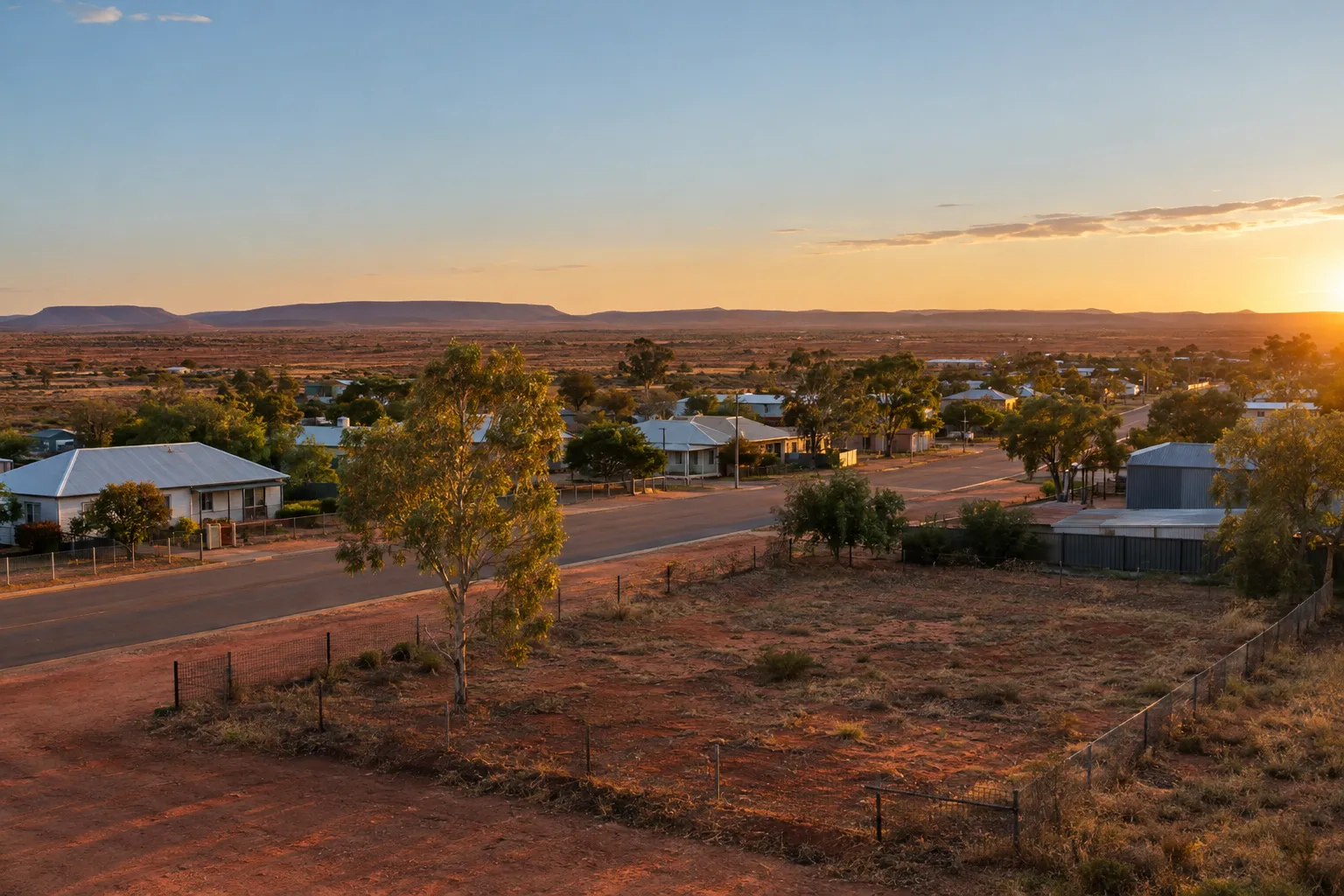
A free block of land sounds like the hardest part of buying a home is already solved. In Quilpie, an opal-mining town of just over 500 people about 1,000km west of Brisbane, it clearly is not.
The council has now put 62 more residential lots on offer, plus a $20,000 grant for anyone who builds. It did something similar in 2021. That round drew hundreds of inquiries and coverage around the world. Only six blocks of roughly 1,000 square metres were actually claimed, and takers had to build a house and live in it for six months.
The council’s chief executive said at the time that five homes within two years would be a big win. Five years on, two homes exist. This is a useful case study in regional housing incentives, because it shows where the real constraint sits.
Land was never the expensive part
A regional council can give away dirt because dirt is cheap out there. What it cannot give away is the cost of putting a house on it.
One family who left a Brisbane rental in 2023 with their four-year-old twins found that building far from the coast was prohibitively expensive. Two things drove that: competition from mining wages, and freight costs for materials. A commercial quote for their home would have reached about $1.2m.
So they built it themselves. They have since pivoted to commercial and government work plus flat-pack modular homes, which tells you where they think the viable model lies.
The point for policymakers is simple. A free lot lowers the entry cost by a small fraction of the total. The bulk of the bill is labour, materials and the logistics of reaching a remote site.
Why a $20,000 grant barely moves the number
Set a $20,000 grant against a quote near $1.2m and the gap is obvious. The incentive covers a small slice of the build, and it only pays out after construction.
That sequencing matters. A would-be builder still has to find a tradesperson, secure materials and fund the work first. Where local trade availability is thin and mining wages set the labour price, that is the hard bit.
Finance is the other part we cannot see from the outside. The source material does not say how lenders treat construction loans in towns this small, so treat that as an open question rather than a finding. It is reasonable to ask how easily a buyer could borrow against a home in a market with very few comparable sales.
A contrast: when the same idea worked
The model has worked elsewhere. In Jandowae, in southern Queensland, $1 blocks offered from 2001 produced a thriving neighbourhood.
The obvious difference is geography. Jandowae sits in southern Queensland, which is a different proposition from a town close to 1,000km from Brisbane. Distance feeds directly into freight costs and into how hard it is to get builders to turn up at all.
A state MP has also pointed to what she calls “postcode discrimination” alongside distance and costs as obstacles. That is a fair prompt to ask whether lenders and insurers price remote postcodes more cautiously, though the material here does not confirm that either way.
What the pattern says about supply policy
Quilpie’s mayor calls two homes progress after fifteen years without any. That is a fair reading of a tough starting point, but it is also a measure of how little a land giveaway achieves alone.
If a town wants more houses, three things need to line up:
- Build cost: the price of labour and freight, not the price of land.
- Trade capacity: builders and tradespeople who will work in a remote location.
- Finance access: lenders willing to fund construction where valuations are hard to anchor.
Fix one and the others still bite. That is why a land-only approach tends to generate headlines and inquiries rather than finished homes.
The pattern also echoes a wider problem in housing supply. Our look at construction business closures hitting a decade high shows how thin builder capacity already is nationally. In a remote town, that shortage is magnified. Our piece on the building approvals shortfall covers the same supply-side squeeze from a different angle.
A small town’s lesson for bigger schemes
Governments at every level are searching for ways to lift housing supply. Quilpie is a small, clean test of one approach: cut the land cost and see what happens.
The result is not that incentives are pointless. Two homes are two more than the town had before. It is that a incentive aimed at the wrong cost does not unlock much.
Key numbers
- 500+: Quilpie’s population, in outback Queensland
- 62: new free residential lots on offer
- $20,000: grant for anyone who builds
- 6 of the 2021 blocks claimed; 2 homes built in five years
- About $1.2m: a commercial build quote one family received
For anyone weighing a regional move, the practical step is to price the build before the block. Get a real quote for construction and freight, check trade availability, and ask a lender about construction finance in that postcode before committing.
Subscribe to the newsletter for weekly analysis of what is really driving Australian housing.
General info, not financial advice.