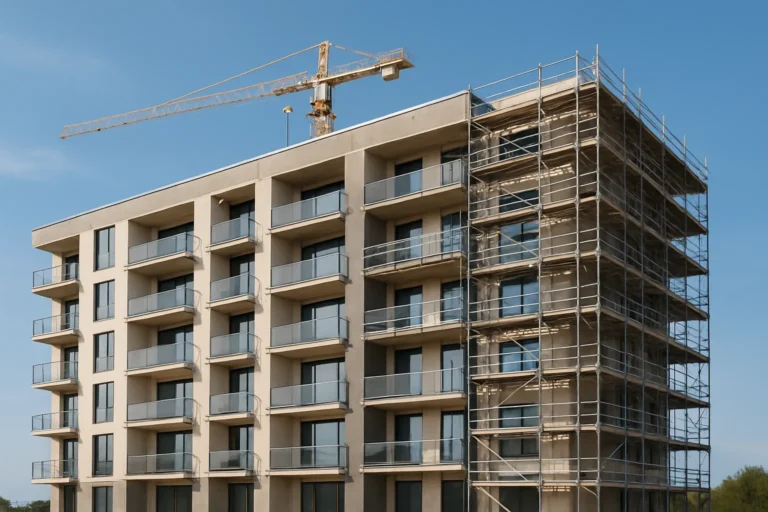
Building approvals dropped 3.6 per cent in July. Detached houses fell 4.5 per cent, units down 2.4 per cent. The political conversation remains locked on negative gearing and capital gains tax settings. Meanwhile, the actual binding constraint gets almost no airtime: developers cannot make medium-density projects financially viable at current build costs, regardless of tax settings.
The mismatch is stark. Australia needs roughly 250,000 new dwellings annually to meet the National Housing Accord target. Current annualised approvals sit at 206,298, a 9 per cent lift from last year, but still 43,700 homes short of the sustainable pace required.
The cost floor no one is lowering
Construction costs rose 1 per cent in the June quarter after a brief March slowdown, taking the annual increase to 2.8 per cent. That is nowhere near the pandemic spike, but it keeps the cost floor elevated when project margins are already razor-thin.
Suppliers report higher fuel, freight and machinery expenses. Most are holding back full cost pass-throughs until global conditions clarify, but the underlying pressure remains. For developers assessing whether a project clears the return hurdle, even modest cost creep can tip feasibility into the red.
The June quarter result suggests the softer March quarter was a pause, not a trend reversal. Cost escalation has returned to pre-2026 levels, reinforcing the difficulty of making projects stack up when revenue assumptions are under pressure from higher interest rates and tighter lending conditions.
Why the tax debate misses the binding constraint
Negative gearing and capital gains tax concessions affect investor demand for existing stock. They influence who competes for established homes. What they do not do is change the arithmetic on whether a new townhouse development or medium-density project can achieve a sufficient return to proceed.
The real constraint is simpler: build costs plus land plus holding costs plus regulatory compliance often exceed what the finished units can sell or rent for, after accounting for required developer margin and lender covenants. When that gap exists, projects do not proceed. No amount of investor tax adjustment closes it.
Investor lending fell 10.2 per cent month-on-month in June, hitting $37.1 billion. New South Wales and Victoria recorded the sharpest declines. First home buyers, supported by the 5 per cent Deposit Scheme, were the only demand segment to avoid a value-terms drop.
That shift has opened short-term opportunities. On the Gold Coast, investors dropped from 50 per cent of offers to 10 per cent in the entry-level bracket since the budget. Local owner-occupiers are buying at levels not seen in years. That is a genuine near-term benefit for buyers who previously faced investor competition.
The trade-off arrives later. If investor participation stays suppressed and new supply remains constrained by cost-revenue misalignment, rental vacancy tightens further and upward rent pressure builds. Reduced investor activity in established stock does not create new dwellings.
The tax settings almost no one mentions
GST adds 10 per cent to the cost of every new build. Stamp duty layers additional cost on new purchases in most states. Combined, these taxes create a material wedge between construction cost and final buyer price, making new housing less competitive against established stock that carries no GST component.
Removing GST from new residential construction would immediately reduce the price floor for new supply. The complication is fiscal: GST and stamp duty generate significant state and federal revenue. Removing them requires finding replacement revenue or accepting a structural budget impact.
The question is whether the housing system can sustain taxing new supply at current rates while simultaneously demanding a 20 per cent increase in output. The policy settings work at cross purposes.
The catch
- Annualised approvals: 206,298 (43,700 short of the 250,000 annual target)
- Construction cost increase: 1% in June quarter, 2.8% over the year
- Investor lending drop: 10.2% month-on-month in June
- New home sales: declined for three consecutive months to July
- GST on new builds: adds 10% to construction cost, no equivalent burden on established stock
What could shift the constraint
Three things would materially change the supply equation. First, a sustained decline in construction input costs, unlikely while fuel, freight and labour remain tight. Second, faster approval processes and lower compliance costs, reducing holding costs and project risk. Third, direct subsidy or tax relief targeted specifically at new construction, closing the cost-revenue gap where it exists.
Government-led social housing construction at scale could also absorb some demand, but current programs remain well below the volume required to move the dial on overall supply. The waiting game continues: developers hold off on marginal projects, buyers face limited stock, and the tax debate consumes political oxygen without addressing the core feasibility constraint.
Bottom line for the next 12 months
Watch new home sales data and investor lending trends. If investor participation continues falling and new supply approvals do not lift materially, rental markets tighten further and rent growth accelerates. If construction costs resume climbing above 1 per cent per quarter, the cost-revenue gap widens and more projects drop out of feasibility.
The political debate over investor incentives is a second-order question. The first-order constraint is making new projects financially viable. Until policy addresses that gap, through cost reduction, revenue support or direct construction, the supply shortfall persists regardless of tax settings on established stock.
If you are assessing whether to proceed with a development or waiting for clearer signals on supply, the next six months of approvals data and cost index movements will clarify whether the current pause is temporary or the start of a deeper pullback. Subscribe to Australian Property Review’s weekly newsletter for the latest data and policy shifts as they hit.
General info, not financial advice.