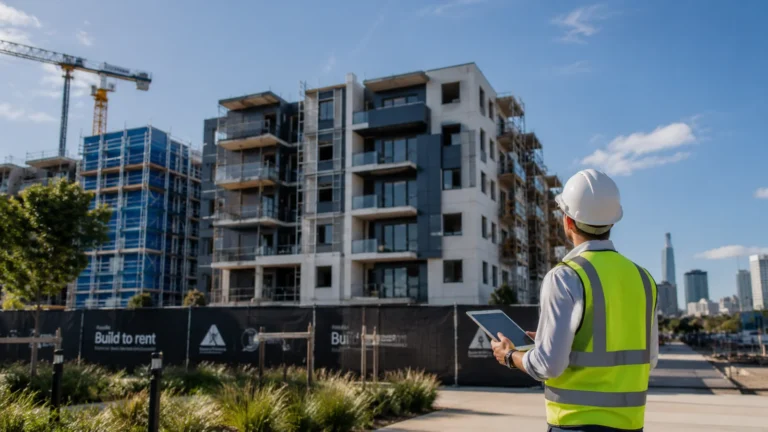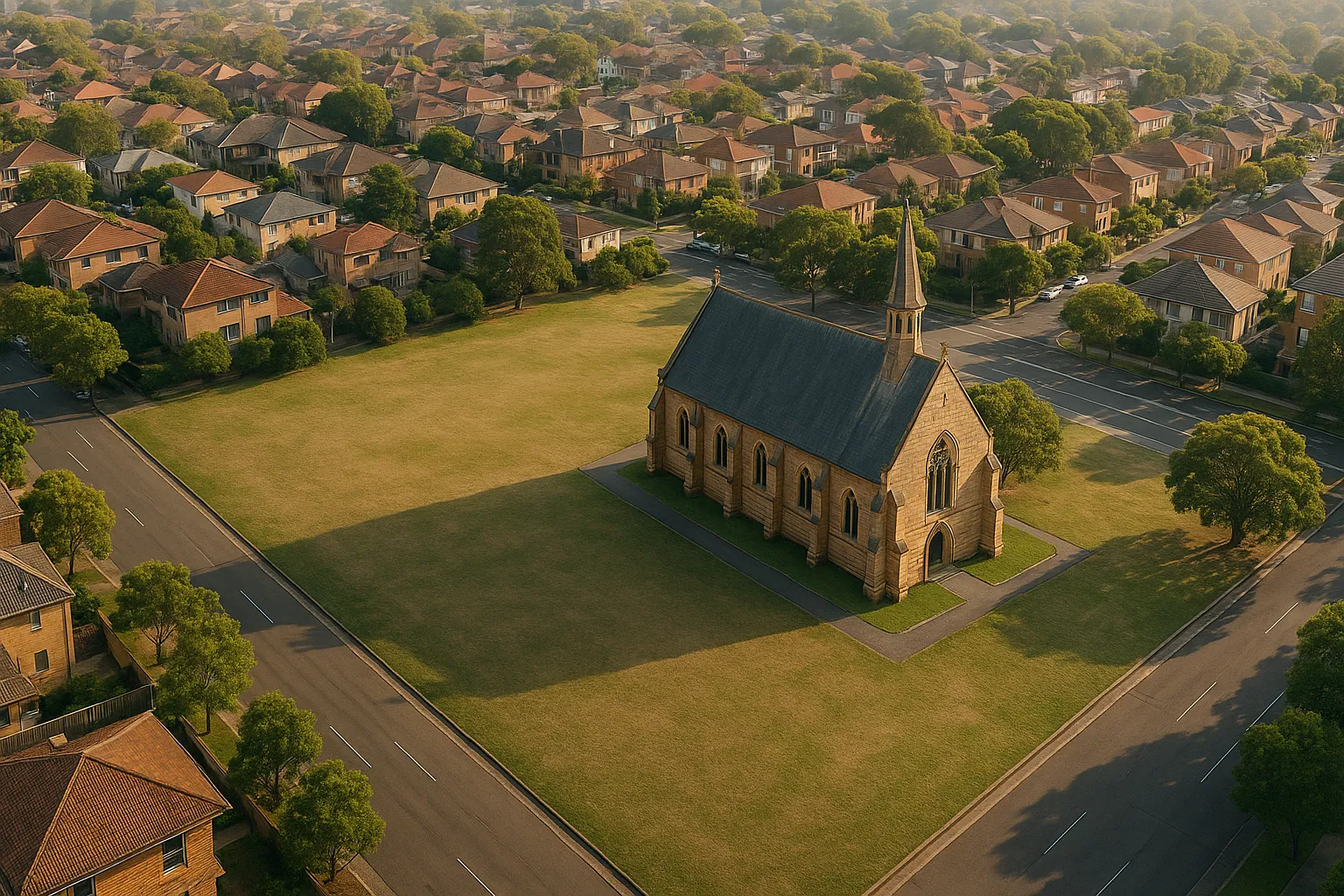
An Anglican parish in Sydney has structured a deal with a developer: eight storeys of housing in exchange for upgraded community facilities. The church keeps its mission footprint, the developer gets entitled land without acquisition cost, and the local housing stock grows without rezoning fights.
The model isn’t theoretical anymore. But it’s also not scaling, and the gap between one successful partnership and systemic deployment is where the real supply constraint sits.
The land and the numbers
Religious organisations control an estimated 3-5% of developable urban land across Australian capital cities, concentrated in inner and middle-ring suburbs with established infrastructure. Most of that land carries low-rise buildings (halls, churches, offices) on large blocks zoned for medium or high-density residential.
The Anglican Church alone holds property assets worth several billion dollars nationally, much of it in Sydney, Melbourne and Brisbane. Catholic, Uniting and other denominations add further holdings. Exact figures are opaque, religious bodies aren’t required to publish consolidated land registers, but diocesan annual reports and spot analysis suggest thousands of sites that could accommodate multi-storey residential without materially compromising worship or community use.
The catch: most of those sites aren’t moving. Land-swap partnerships like the Sydney example remain rare, limited by financing structures, tax treatment, governance complexity and risk appetite within church hierarchies.
Why this pathway exists and what blocks it
Churches face the same pressure as any landholder with ageing infrastructure and falling revenue per square metre: maintain the asset, or monetise it. Outright sale is common but removes the community anchor. Redevelopment for income (commercial or residential) requires capital, development expertise and tolerance for construction risk, capabilities most parish councils don’t hold.
Land-for-equity or land-for-improved-facilities partnerships solve that: the developer funds construction, the church trades development rights for new space (often strata-titled) and sometimes an ongoing income stream from ground-floor retail or retained apartments.
Barriers that keep the model niche:
- Governance layers. Parish councils, diocesan property boards, and sometimes state or national church bodies all hold decision rights. Deals can take years to structure and approve.
- Tax and charitable status risk. Churches worry that commercial development activity, even via a passive land contribution, could trigger GST, land tax or income tax exposure that erodes their tax-exempt status.
- Financing gaps. Developers prefer clean title and minimal conditionality. Church land often comes with heritage overlays, community-use covenants, or requirements that the church retain long-term space, all of which narrow the pool of interested partners and reduce residual land value.
- No policy scaffold. Unlike social housing or affordable housing pathways (which have NHFIC financing, planning bonuses, sometimes land tax exemptions), there’s no dedicated framework to de-risk or accelerate church land partnerships. Each deal is bespoke.
Rental affordability Australia: single workers now spend 50-69% of pay shows why unlocking even a fraction of this land matters, housing stress is structural, and supply constraints in the middle market (where most church sites sit) are a primary driver.
The catch
Church partnerships sound like a policy win, underutilised land, willing landowners, community benefit, no compulsory acquisition. But without standardised templates for tax treatment, strata structuring and planning pathways, each deal remains a one-off negotiation that only the most capable developers and most motivated parishes will pursue.
The volume sits with smaller parishes that lack internal expertise and can’t afford standalone feasibility studies. Those sites stay off the market or get sold outright to landbankers.
What would need to change for this to scale
Three levers could shift church land from edge case to meaningful supply contributor:
-
Tax clarity. Federal guidance (ideally legislation) confirming that land contributions to housing partnerships, where the church retains community space and doesn’t take a cash profit, won’t void charitable tax exemptions. This removes the single biggest deterrent at diocesan level.
-
Planning pathway. State governments could create a fast-track DA process for church land partnerships that deliver a minimum percentage of affordable or social housing, similar to the existing SEPP (Housing) provisions but tailored to non-profit landholders. Reduced council assessment times and clearer density bonuses would make deals more bankable.
-
Financing intermediary. A fund (government-backed or philanthropic) that covers feasibility, legal structuring and project management for smaller parishes, effectively a development advisor that doesn’t require the church to carry upfront cost or risk. Developers would bid into a more standardised, lower-friction process.
None of these exist at scale today. Individual state planning departments have run pilots or consultations, but no jurisdiction has operationalised a repeatable model.
Scenarios and what determines the outcome
Base case: Church land partnerships remain occasional, driven by developer initiative and parish-level motivation rather than systemic policy. Over five years, 20-30 projects nationally, delivering 2,000-4,000 dwellings, material at suburb level, rounding error at city level.
Upside: One state (likely NSW or Victoria) implements tax clarity and a planning fast-track within 18 months. Major denominations publish consolidated land registers and signal openness to partnerships. Deal flow grows to 10-15 projects per year per state, adding 8,000-12,000 dwellings annually by 2030.
Downside: Tax concerns stall momentum, a high-profile partnership fails (construction defects, cost blowouts, community backlash), and diocesan boards revert to outright sales or land-banking. Church land stays off the development pipeline for another decade.
What tilts the outcome: political willingness to create the enabling framework, and whether the development industry sees enough volume and margin to engage beyond trophy one-offs.
The bottom line for developers, buyers and policymakers
For developers: church partnerships offer entitled land without acquisition cost, but require tolerance for longer approvals, community consultation and sometimes affordable housing mandates. Best suited to mid-tier builders with patient capital and council relationships.
For buyers: church land projects are more likely to include affordable or discounted market dwellings (especially if government incentives apply), but supply will be sporadic until policy changes. Don’t wait for this to ease citywide price pressure in the next 12-24 months.
For policymakers: this is low-hanging fruit if you solve the tax and planning friction. The land is there, the willingness exists, and the community optics are better than rezoning single-family suburbs. The question is whether housing ministers and treasuries see it as worth the administrative effort to standardise.
First home buyer loans rising as investors retreat: what’s driving it shows first-home buyers are already stretching, adding mid-market supply via church partnerships could ease that pressure if it scales, but only if the policy scaffold arrives before the current credit window closes.
If you’re tracking supply pipelines or municipal planning, ask your council how many religious landholdings sit in their medium-density zones and whether any are in pre-DA discussion. That’s your leading indicator for whether this story becomes structural or stays anecdotal.
Subscribe to Australian Property Review for weekly analysis on supply constraints, planning shifts and what’s moving off the sidelines.
General info, not financial advice.