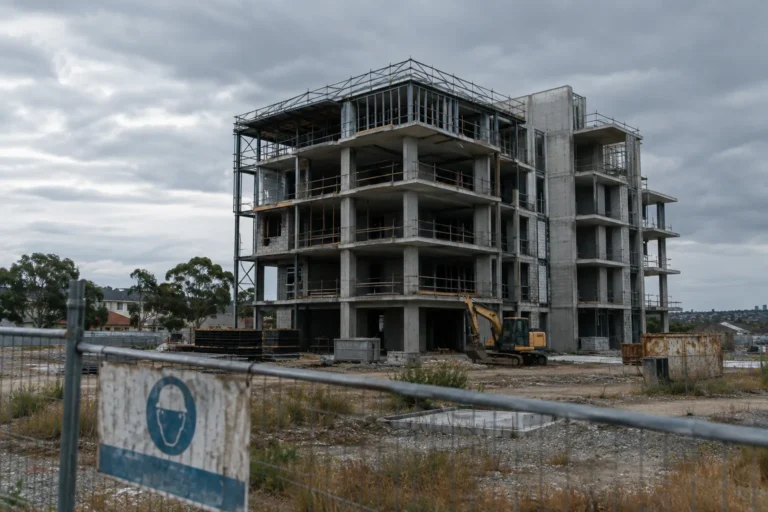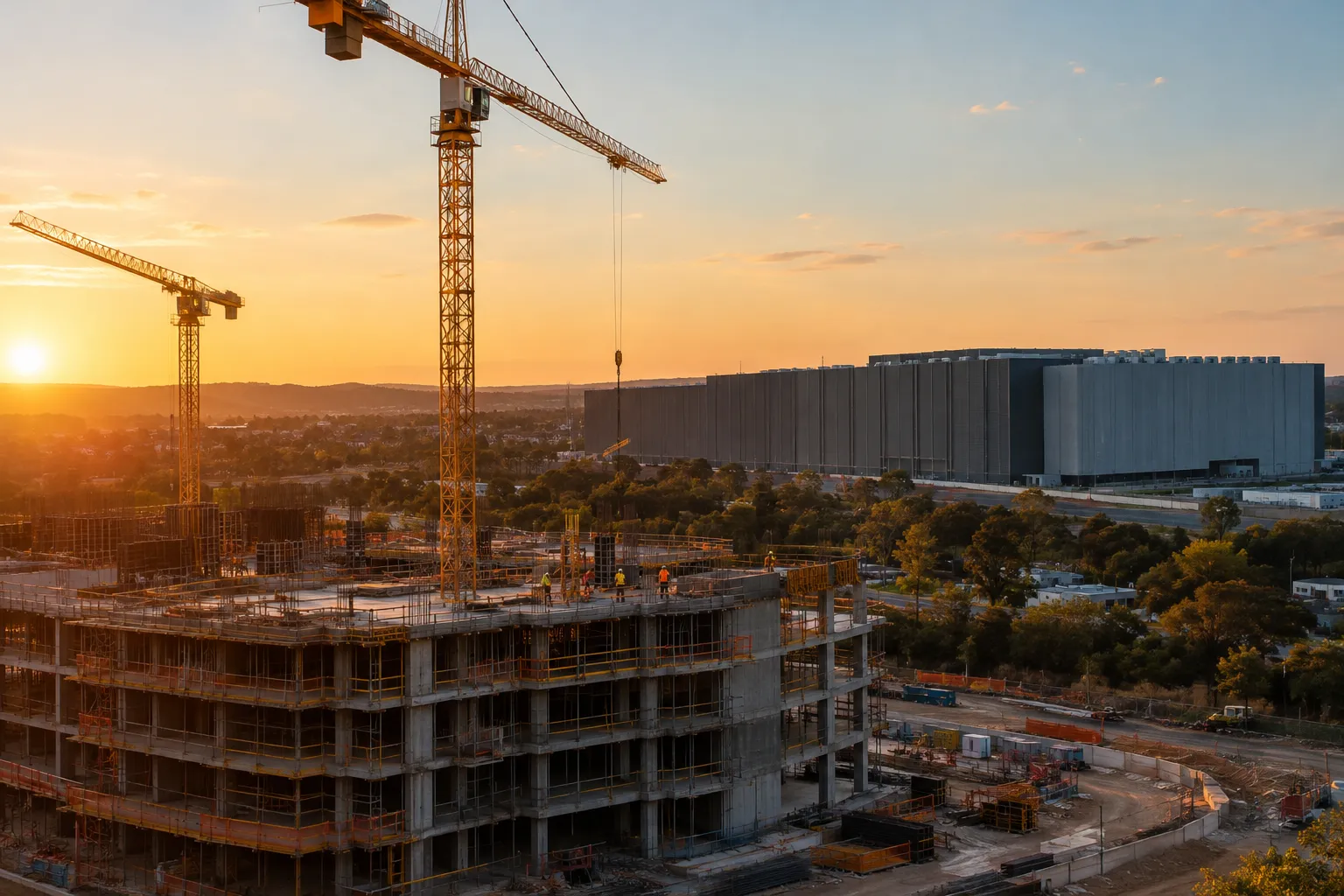
Australia is building more homes than it has in years, and it is also building a lot of datacentres. Both want the same scarce builders. That is the tension sitting inside the latest building statistics for the year to June.
The headline numbers look strong. Residential building volume rose 8.7%, the best result since 2016. Total building rose 10%, the strongest since the stimulus years after the global financial crisis. New private-sector house commencements climbed 11.6% to 31,707 dwellings. Outside the Covid homebuilder surge and a spike in March 2000 ahead of the GST, that is the highest level since 1994.
The datacentre boom holds a quieter story. This piece looks at what the data shows, what it does not show, and what it could mean for build costs and the completions shortfall.
The datacentre share is the outlier
Datacentres normally make up about 1% of non-residential commencements. Over the latest year they reached 20%. They supplied nearly three quarters of all the growth in non-residential starts. They also absorbed more than 17 times the spending that went into factories.
That is not a small shift in mix. It is one building type swallowing most of the new demand for commercial construction capacity.
Key numbers
- Residential building volume: up 8.7% in the year to June, the best since 2016
- Total building: up 10%, the strongest since the post-GFC stimulus years
- Private house commencements: up 11.6% to 31,707
- Datacentres: about 20% of non-residential commencements, against a normal 1%
- Public and social housing: 2.3% of new residential building
Why a datacentre can crowd out a house
Builders, subcontractors, electricians and civil crews are not unlimited. A large datacentre project locks up a lot of skilled labour and materials for a long stretch. Contractors choose the jobs that pay and de-risk their pipelines best.
The data given here does not break down how many tradies moved from housing to datacentres, and it would be a guess to put a figure on it. What the commencement figures do show is that demand for building capacity is rising across both residential and non-residential work at once. When two large sources of demand compete for the same finite pool of workers, the usual result is higher prices and longer timelines.
The catch is that the effect is hard to isolate. Housing starts are rising anyway, so the squeeze may show up as cost pressure rather than as fewer homes. That matters for the completions shortfall. Strong commencements only help if projects get finished, and finishing depends on labour being available at a workable cost. For more on the pipeline side, see our look at building approvals and what thin pipelines mean for prices.
One quarter does not make a trend
The quarter straddles the federal budget. That makes it difficult to read the jump in new-build investment as a lasting shift. It could be a durable turn toward building. It could also be a bring-forward ahead of or in response to budget measures, with a pullback to follow.
The sensible approach is to treat the figures as a strong signal, not a settled trend, and to wait for another quarter or two of commencements before drawing firm conclusions. Readers weighing what supply means for their own decisions can also look at why supply is the real limit on buyer assistance schemes.
Public housing is still a rounding error
While private building surges, public and social housing made up just 2.3% of new residential building in the latest year. Between 1955 and 1985 the average was 13%. Over the last three decades, outside the stimulus period, it has never gone above 4%.
A recent Senate select committee report on generational housing inequality described the housing crisis as undeniable. It recorded strong support for large-scale affordable housing investment. Its chair floated a decade-long target of at least 10% public and community housing, plus a cap on annual rent rises at 2% or inflation, whichever is lower.
Those are proposals, not policy. But they sharpen the datacentre question. If governments want to ramp up social housing, they will be bidding for the same builders that datacentres are now absorbing.
Who this affects
- Buyers of new homes: capacity competition can push up contract prices and stretch delivery times. Build in a buffer on both.
- Investors in off-the-plan or new stock: watch for cost variations and delays, and read contract terms on price adjustment carefully.
- Developers: margins depend on labour and materials costs, which are exposed to demand from other sectors.
- Policy watchers: any big public housing push has to account for competition from datacentres and other large projects.
Next step
Track the next quarter of commencements and completions together, not just starts. If starts stay strong but completions lag, capacity is the likely bottleneck. Subscribe to the newsletter for the weekly signal on housing supply and costs.
General info, not financial advice.