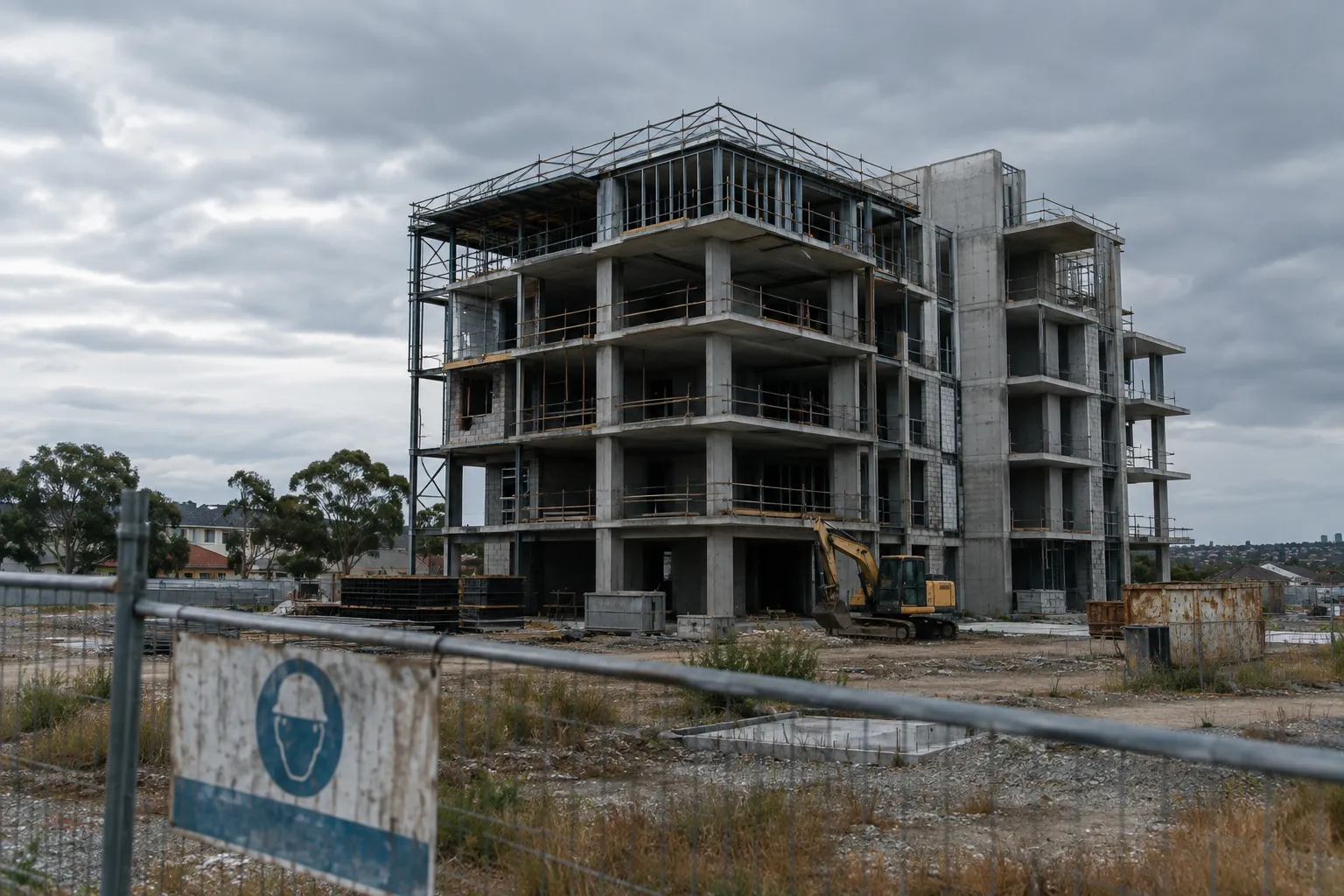
The gap between what gets approved and what actually gets built is about to become Australia’s defining housing problem. Approved developments are stalling at the construction stage, not the planning desk, as builders pull out of projects they can no longer deliver profitably.
A major developer has flagged that home building activity is approaching a sharp contraction, despite years of planning reform designed to speed up approvals. The issue isn’t permissions, it’s that the economics of turning those approvals into standing houses have broken.
Why approvals don’t equal delivery
Approval numbers have been treated as a proxy for pipeline health, but they measure intent, not capacity. A development approval is a permit to build, not a commitment that construction will start or finish.
The breaking point sits in the gap between when a project is approved and when it reaches site. Construction costs have climbed faster than sale prices in most markets outside prestige Sydney postcodes, labour shortages have extended timelines, and financing costs have roughly doubled since early 2022. Builders are running the numbers on approved projects and walking away.
This isn’t a supply problem that gets solved by approving more. It’s a delivery problem driven by the gap between what buyers will pay and what it costs to build.
The construction economics that broke
Three cost pressures have converged to make previously viable projects unviable:
- Materials and labour: Construction input costs rose approximately 30-40% between 2020 and 2024 (ABS construction price indexes), then plateaued at that elevated level rather than falling back.
- Financing: Interest on construction loans has roughly doubled. A project approved in 2021 with 2% construction finance now rolls over at 6-7%, adding hundreds of thousands to the cost of a mid-sized apartment block.
- Holding costs: Longer build times (due to labour shortages and supply-chain delays) mean builders carry interest and overheads for 18-24 months instead of 12, even when the project goes smoothly.
Sale prices in most metro markets have risen 10-20% over the same window (CoreLogic five-capital-city index, 2020-2024), which doesn’t cover the cost increases. Builders either renegotiate down (if they can), absorb the loss, or cancel.
Key numbers
- Construction input costs up ~30-40% since 2020 (ABS)
- Interest on construction finance roughly doubled since early 2022
- Typical apartment project build time stretched from 12 months to 18-24 months
- Sale price growth in most markets: 10-20% over the same period
What this does to the pipeline
Approved projects that don’t proceed create a statistical mirage. Policymakers count approvals as future supply, buyers assume those units will hit the market, and affordability models bake in delivery assumptions that won’t materialise.
The risk is a supply shortfall that looks like a planning failure but is actually a construction economics failure. Australia has spent years focused on speeding up approvals, state governments have reformed planning systems, released land, and set ambitious housing targets. None of that changes the fact that builders won’t start a project they expect to lose money on.
The delivery gap hits renters hardest. Fewer completions mean tighter rental markets, which pushes yields up and attracts more investors into existing stock, which pushes house prices up, which makes the construction gap worse because buyers won’t pay enough above replacement cost to make new builds viable in middle-market locations.
Who absorbs the loss
Three groups take the hit when a project stalls:
- Developers who’ve carried approvals, holding costs, and design fees with no sale to offset them.
- Off-the-plan buyers waiting for settlements that may not happen, or who face price renegotiations if the builder threatens to walk.
- Renters and first-home buyers competing for a smaller stock than the approval numbers implied.
Some projects will proceed at a loss if the builder or financier decides the reputational cost of walking is worse than the financial cost of finishing. But that’s a one-time decision, the next project doesn’t get approved in the first place.
Scenarios: base, upside, downside
Base case (60% probability): Construction activity contracts over the next 12-18 months as marginal projects are cancelled or delayed. Completions undershoot targets by 15-25%, rental vacancy stays tight, and price growth continues in markets where demand exceeds the reduced supply. Builders consolidate; smaller operators exit.
Upside case (20% probability): Policy shifts to address the cost side, either direct construction subsidies, changes to GST treatment of new builds, or a rapid fall in interest rates that makes financing viable again. Projects restart, and the delivery gap closes faster than expected.
Downside case (20% probability): A broader economic slowdown reduces demand at the same time supply contracts, creating a two-sided crunch where builders can’t deliver and buyers can’t afford what does get built. Prices stagnate, but supply remains tight because construction doesn’t restart even at lower price points.
What happens from here
The policy response will determine whether this is a two-year adjustment or a five-year structural problem. Approvals-focused reforms have run their course, the next phase needs to address construction economics directly, either through cost relief (subsidies, tax changes, planning fee waivers) or demand support (wage growth, lower rates, first-home buyer grants that cover the build-cost gap).
Without that, expect housing targets to be revised down, completions to undershoot even the revised numbers, and rental markets to stay tight through 2026-27.
For buyers, this means fewer off-the-plan options and longer waits for new stock. For investors, it means rental yields stay elevated in supply-constrained markets, but delivery risk is now a real factor in off-the-plan purchases. For renters, it means the supply relief that was supposed to arrive in 2025-26 is being pushed out or cancelled.
The practical take
If you’re holding an off-the-plan contract, check the builder’s financial position and have a lawyer review the sunset clause, the risk of project cancellation or delayed settlement is higher than it was 12 months ago. If you’re renting and waiting for supply to ease prices, expect that timeline to extend.
If you’re investing, focus on established stock in areas where the construction gap is widest, rental demand won’t ease if new builds aren’t being delivered. Avoid off-the-plan purchases unless you’re confident the project economics still stack up at today’s costs, not the costs assumed when the project was approved.
Subscribe to the weekly briefing for updates on construction starts, completions data, and policy shifts that could close the delivery gap.
General info, not financial advice.