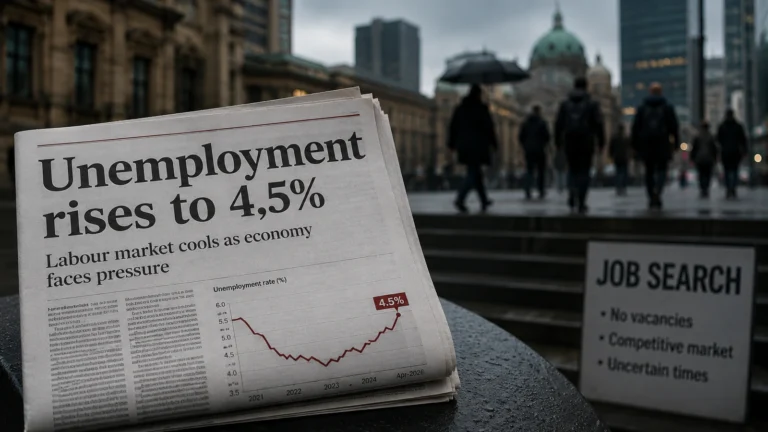
The ABS labour force numbers for August landed with a contradiction baked in: unemployment climbed to 4.6%, up from 4.5% the month before, but not because people were losing jobs at scale. Participation jumped to 67.1%, meaning more Australians are actively hunting for work. The gap between those two lines, more job seekers, not enough openings to absorb them, is what matters for the RBA’s next call.
That call is due September 28-29, and the unemployment print sits slightly above what the central bank had pencilled in. The question isn’t whether the labour market is loosening, it clearly is, but whether it’s loosening fast enough to cool wages and services inflation without forcing the RBA’s hand on another hike.
Why participation matters more than the headline rate
An unemployment rate ticking up from 4.5% to 4.6% sounds marginal. But the participation rate climbing from 66.9% to 67.1% in a single month is not. That’s tens of thousands of people re-entering the workforce or trying to pick up extra hours, most likely driven by cost-of-living pressure, mortgage repayments, insurance premiums, childcare, groceries.
When participation rises this fast, unemployment can edge higher even if job creation holds steady. The economy is adding roles, just not at the pace needed to absorb everyone now looking. For the RBA, that dynamic is a double signal: household budgets are under genuine stress (hence the surge in job-hunting), but wage pressure hasn’t collapsed yet because the market hasn’t fully loosened.
Victoria’s unemployment sits at 5.2%, the highest of any state. NSW is lowest at 4.3%. The gap reflects diverging construction pipelines, migration flows and public-sector hiring across states, Sydney’s labour market is tighter, Melbourne’s softer, and both are watching different parts of the same national slowdown.
The inflation override
Unemployment rising ordinarily buys the RBA breathing room to pause. Not this time. The July CPI reading, headline 3.5%, trimmed mean 3.6%, is still above the 2-3% target band, and the next print won’t drop until after the September meeting. That leaves policymakers staring at sticky inflation and a labour market that’s loosening, but not quickly enough to guarantee wages cool in time.
Futures markets are pricing a September hike at better than 90%. The major banks are split between one hike this month or two by November. The unemployment data doesn’t kill that probability, it just doesn’t override the inflation problem.
Here’s the bind: if the RBA hikes in September, it tightens into a labour market already softening, risking overcorrection. If it holds, and inflation stays elevated through Q3, it loses credibility on the 2-3% band and may need a bigger move later. Neither path is clean.
What tighter credit does to borrowing capacity
Another 25 basis points would lift the cash rate to 4.6%, matching the unemployment rate in a piece of symmetry no one finds reassuring. For a household with a $600,000 mortgage, that’s roughly another $90-100 a month in repayments, on top of the $400-plus already added since early in the year.
Serviceability buffers, the 3% loading banks apply when assessing loans, would shift higher again. Borrowing capacity for a couple earning $180,000 combined already dropped around 15% over the last six months. Another hike shaves another few percentage points off what they can access, which flows through to upgrade budgets, settlement risk for pre-approvals written months ago, and first-home buyer thresholds in cheaper suburbs.
Interest rate hike distribution: why the pain lands unevenly covers how repayment sensitivity varies by loan size, income and geography, worth reading if you’re trying to model your own exposure.
The catch
The RBA doesn’t target unemployment directly, it targets inflation, and uses the labour market as a lever. Right now, that lever is moving, but inflation isn’t responding fast enough. The risk is the bank tightens into a slowdown that’s already underway, then has to reverse course in 2025 when unemployment overshoots and services inflation finally cracks.
State-by-state divergence and what it hides
Victoria at 5.2%, NSW at 4.3%, WA and Queensland both at 4.5%, these aren’t rounding errors. Victoria’s higher rate reflects weaker construction activity post-pandemic and slower population growth than NSW or Queensland. WA’s holding steady on resources and infrastructure spend. Tasmania’s 5% sits in the middle, driven by a small labour market where seasonal work and tourism dominate.
For property investors, the state splits matter: a 5.2% unemployment rate in Melbourne signals softer rental demand in outer suburbs where renters are more likely to double up or move back home under financial pressure. A 4.3% rate in Sydney suggests tighter competition for stock, which keeps yields compressed but vacancy low.
If you’re buying into a market where unemployment is rising faster than the national average, factor that into your cashflow buffer and your assumptions about tenant stability over the next 12 months. Consumer spending holds up as sentiment crashes to historic lows shows how households are cutting discretionary spend while keeping essentials afloat, renters under that kind of pressure are more likely to negotiate, delay or miss payments.
Scenarios over the next four months
Base case: RBA hikes 25bp in September, holds in November, inflation prints softer in Q4, unemployment drifts to 4.8-5.0% by year-end. That keeps credit tight through summer but avoids a second hike.
Upside (for borrowers): participation surge proves temporary, unemployment plateaus, September CPI undershoots, RBA holds and signals easing bias for early 2025. Borrowing capacity stabilises, refinancing picks up.
Downside: RBA hikes September and November, trimmed mean CPI stays above 3.5% through Q4, unemployment hits 5.2% by February, credit crunch deepens, mortgage arrears tick higher in outer suburbs and regional centres.
The downside isn’t a crash scenario, it’s a grinding adjustment where serviceability, not prices, becomes the binding constraint for most households.
What to do if you’re refinancing or buying in Q4
If you’re refinancing: lock a rate now if your current deal expires in the next 90 days. September hike risk is real, and another 25bp moves your comparison rate enough to matter. Fixed rates are pricing in at least one more hike, so locking at 6.2-6.4% (depending on LVR and lender) may be the floor for the next six months.
If you’re buying: stress-test your budget at 5.0% cash rate, not 4.35%. That’s conservative, but if the RBA hikes twice more by February, you’re only slightly over. Run the numbers on a $50k income hit (redundancy, reduced hours, partner leaving workforce) and see if you can still service the loan. If the answer is no, you’re over-leveraged at current settings.
If you’re holding investment property: review your interest cover ratio. If rent barely covers interest now, another hike flips you to negative monthly cashflow unless you raise rent or cut costs elsewhere. Vacancy risk is higher in markets where unemployment is climbing fastest, check your suburb’s jobless rate trend, not just the state average.
The next four weeks
The RBA meets September 28-29. Between now and then, watch for any August retail sales data (due mid-September) and business conditions prints. If retail spending holds up despite higher rates, that reinforces the inflation-persistence argument and makes a hike more likely. If spending cracks, the bank has cover to pause.
Wage price index for Q2 is already published (3.8% annualised), so no new wage data before the meeting. That leaves employment and spending as the live inputs.
For borrowers, the practical move is: assume a hike, prepare for it, and treat a hold as upside. If you’re counting on the RBA to pause because unemployment ticked up 0.1%, you’re betting against the inflation mandate that’s driven every decision this year.
Final step
If this is shaping your refinance or purchase timeline, subscribe to the newsletter for the next CPI breakdown and RBA decision analysis as soon as they drop. If you’re a broker or adviser tracking how serviceability buffers are moving across lenders, the weekly signal covers that too.
General info, not financial advice.