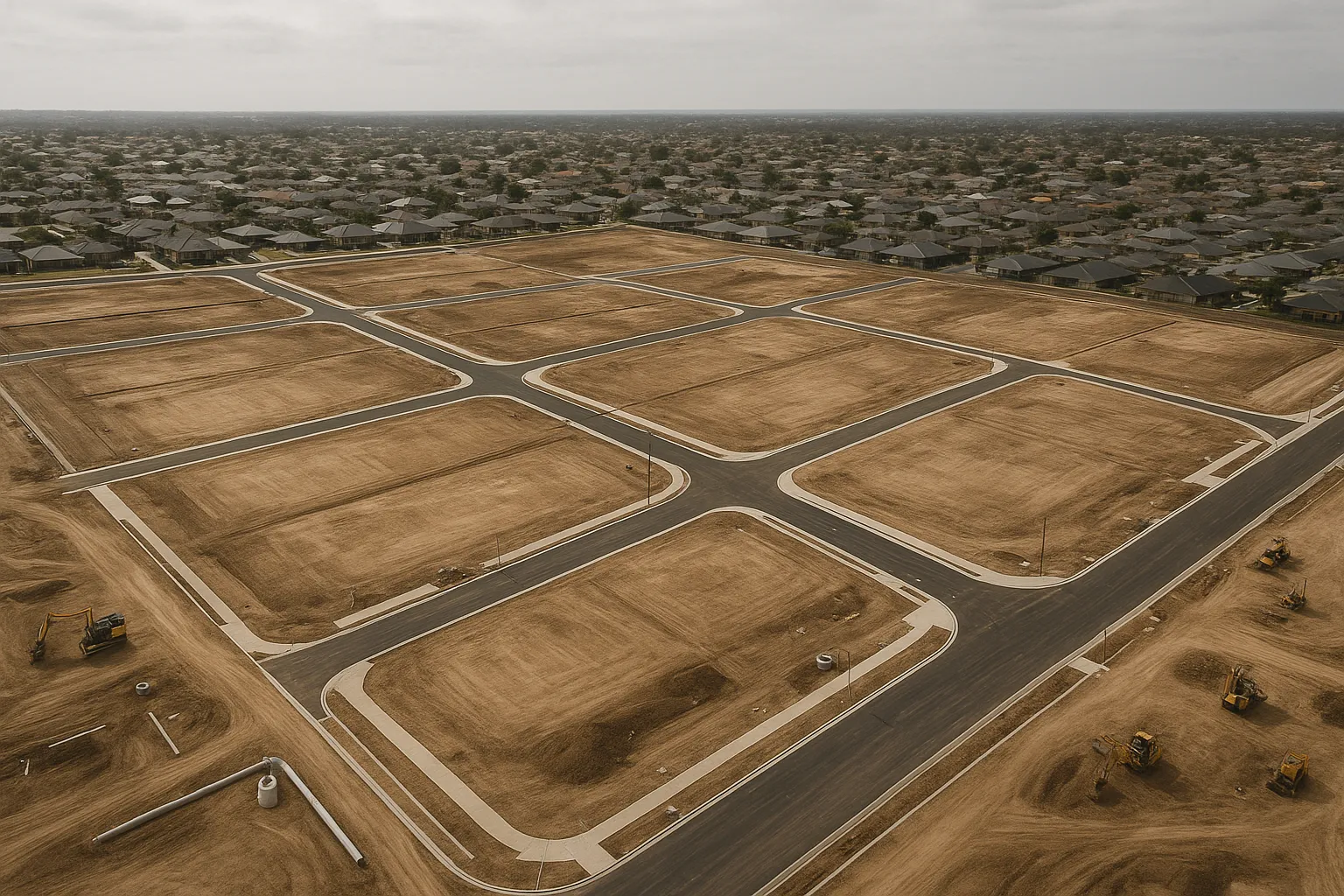
A Japanese corporate is backing a 650-home estate in Melbourne’s north, funding parks, sewers and streets months earlier than Australian capital would have delivered them. It’s the latest signal that foreign institutional money, Japanese and Korean firms, not the Chinese retail buyers who flooded apartments a decade ago, is stepping into residential land development while local players pull back.
The structural shift is simple: Australia has strong population growth, a housing supply shortfall, and not enough domestic capital to fund the infrastructure that unlocks new estates. Foreign institutional investors see that gap as an opportunity. The question is what this means for supply timelines, affordability, and the conditions attached to the money.
The numbers that matter
Victoria’s housing supply target is 80,000 new homes a year. The state has built 89,511 new residences over the past two years, it should have built 122,400. The National Housing Accord targets 240,000 homes a year nationally, and the country is falling short.
Melbourne built 19,000 apartments in 2016 at the peak of Chinese retail buyer demand. That’s roughly the annual supply the city needs now to keep pace with population growth, and current approvals are nowhere near that figure.
One estate in Wollert sold 60 per cent of its first stage in a weekend, mostly to first-home buyers. Blocks start at $320,000, house-and-land packages under $600,000. Block sizes are sub-300 square metres.
What’s different this time
The Chinese money that hit Melbourne apartments a decade ago was mostly retail buyers chasing capital growth. The current wave is institutional capital, Japanese and Korean corporates, backing land development and construction companies through joint ventures and equity stakes.
Institutional investors are funding the upfront infrastructure: roads, parks, drainage, utilities. That shifts the timeline, civil works can start months earlier because the developer doesn’t need to wait for pre-sales to fund earthworks. The trade-off is that the foreign partner takes a share of the profit, and in some cases brings sustainability requirements (eight-star energy ratings, EV charging) that lift build costs.
The money is also flowing into builders. Two of Victoria’s largest volume builders are now majority-owned by Japanese firms, which means the same institutional capital funding the land could also be backing the construction on top of it.
The catch
Foreign capital doesn’t fix the supply bottleneck on its own. Planning approvals, zoning constraints, and labour shortages still dictate how fast homes get built. The money unlocks sites faster, but it doesn’t speed up council processes or train more electricians.
The affordability impact is unclear. Institutional investors expect a return, and that return comes from either higher sale prices or faster turnover. If the capital accelerates supply, it could ease price pressure. If it just enables more expensive builds (sustainability upgrades, smaller lots), the benefit to first-home buyers is limited.
There’s also a concentration risk. If Japanese and Korean firms back a significant share of new estates and builders, any shift in their appetite, policy changes in their home markets, currency moves, a downturn in Australian population growth, could pull capital out quickly.
Key numbers
- Victoria built 89,511 new homes in two years against a target of 122,400
- Melbourne needs roughly 19,000 new dwellings a year to match 2016 apartment supply levels
- One estate’s first stage sold 60% in a weekend, house-and-land packages under $600,000
- Blocks starting at $320,000, mostly sub-300 square metres
What could stall this
A sharp drop in net migration would cut buyer demand and spook institutional investors. If arrivals fall below trend, foreign capital could shift to higher-return markets offshore.
Currency risk matters. A stronger Australian dollar makes local assets more expensive for foreign buyers. A weaker yen or won reduces the purchasing power of Japanese and Korean firms.
Policy changes in either direction, stricter foreign investment rules or, conversely, reduced incentives for institutional investors, would shift the flow. State and federal governments are currently relying on this capital to meet supply targets, but political pressure around foreign ownership could tighten approval processes.
Finally, if Australian superannuation funds or domestic institutional investors see residential land development as attractive again, they could crowd out foreign players. That hasn’t happened yet, but a shift in risk appetite or regulatory settings could change the mix.
Scenarios over the next 12 months
Base case: Japanese and Korean institutional capital continues backing Melbourne and Sydney estates, supply picks up modestly but stays below Housing Accord targets, first-home buyer activity stays elevated in outer suburbs where blocks are affordable.
Upside: Migration stays strong, more foreign capital flows in, infrastructure timelines compress, Victoria closes the gap on its 80,000-a-year target. Block prices stay flat or rise slowly because supply is catching up.
Downside: Migration slows, foreign investors pull back, domestic capital doesn’t fill the gap, supply falls further behind, block prices rise faster than wages, first-home buyers get priced out of outer estates.
The practical take
If you’re buying in a newly released estate, check who’s funding the infrastructure. Institutional backing usually means faster delivery of roads, parks and services, but it can also mean tighter build covenants and sustainability requirements that add to your build cost.
If you’re investing in outer-suburban land, the supply pipeline matters more than the capital source. Estates backed by foreign money might deliver faster, but the buyer pool is still local, and affordability is still the binding constraint.
If you’re waiting for supply to ease prices, the gap between current approvals and population growth suggests that’s a long wait. Foreign capital might narrow the gap, but it won’t close it in the next 12 months.
Subscribe to the newsletter for weekly data on housing supply, migration trends, and land market signals.
General info, not financial advice.