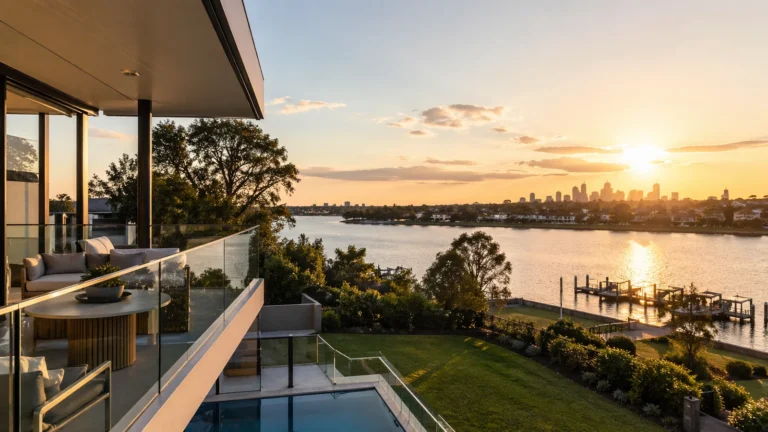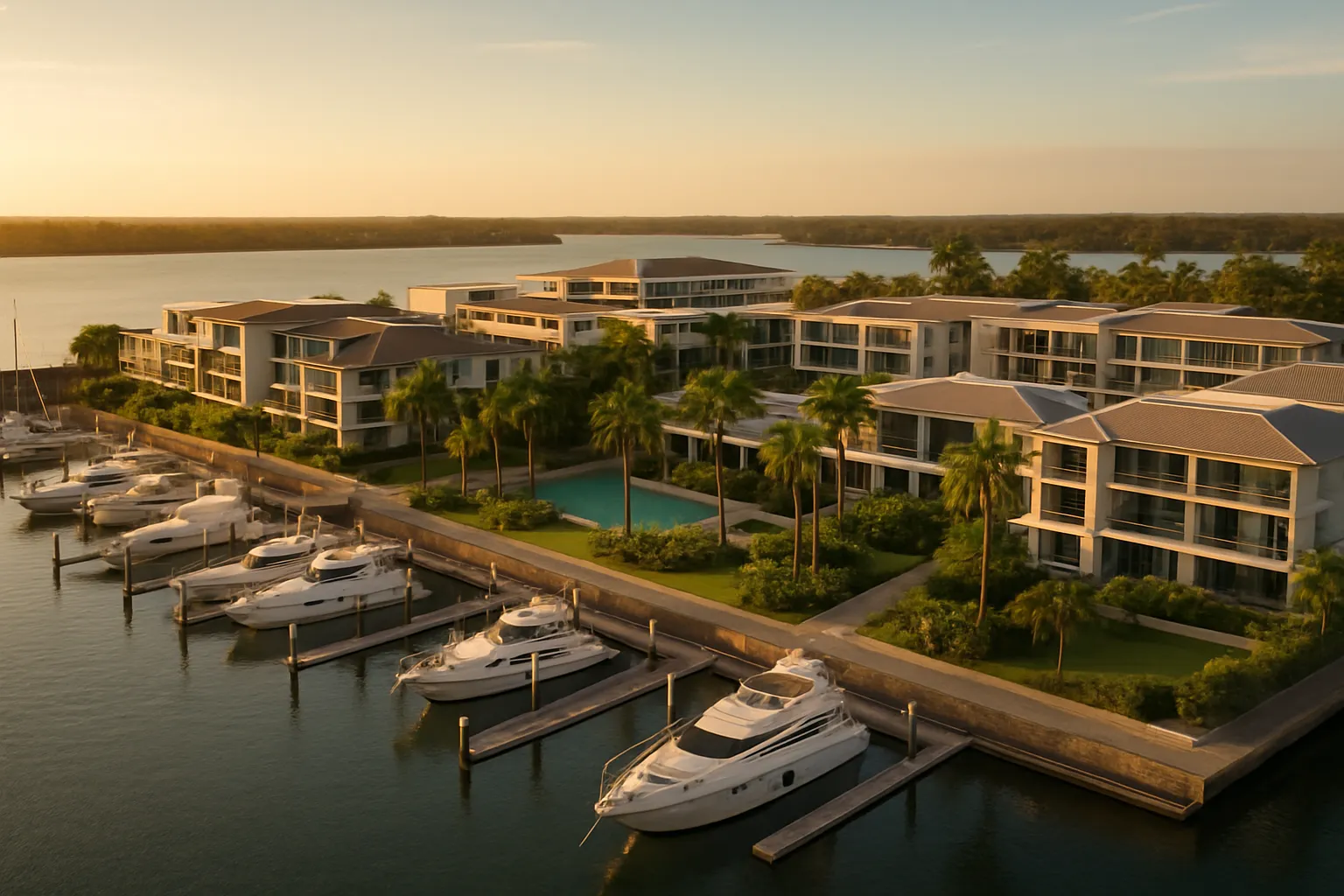
Construction is about to begin on a half-billion-dollar rebuild of Marina Mirage on the Gold Coast’s Southport Spit. The project packages 38 luxury residences, a 126-room Marriott hotel, retail and dining around a 50-metre pool and marina berths. Entry price sits at $6.45m. The timeline runs three years from September-October 2026 to mid-2029 delivery.
The site has changed hands multiple times since the 1980s and was acquired by its current owner in 2013 for $52m. Now it re-enters the market as a prestige coastal village at a moment when Gold Coast house prices are falling and apartment settlements are under strain across the country.
What separates luxury projects from the rest
Prestige developments targeting international and interstate wealth operate in a different cycle to the domestic owner-occupier and investor segments. Buyers at this price point typically carry less mortgage stress, purchase in cash or with substantial deposits, and treat the asset as lifestyle or portfolio diversification rather than yield-chasing.
That insulation shows up in presale velocity. The developer reports strong early demand despite broader market softness. Compare that to the $122m Broadbeach luxury sellout where 90 percent of stock moved in months during a similar window. Ultra-premium projects can move independently of headline sentiment when the buyer pool is global and discretionary budgets remain intact.
The risk appears when construction delays push settlements into a weaker economic window or when the offshore buyer cohort pivots to other markets. A three-year build finishing mid-2029 assumes stable international capital flows and no major currency or policy shocks between now and handover.
Callout: In plain English
Luxury resort developments rely on a narrow buyer segment that treats property as discretionary spend, not leveraged investment. When that segment stays confident, projects like Marina Mirage can thrive while the broader market contracts. The question is whether confidence holds through a three-year construction cycle and into settlements in 2029.
Pressure points in the Gold Coast pipeline
The Gold Coast supply pipeline carries elevated risk across the apartment segment. Construction costs remain high, labour shortages persist despite skilled migration targeting 115,000 additional tradies, and settlement failures are climbing as buyers reassess their ability to complete purchases locked in during 2021-2023 peak pricing.
Marina Mirage sits at the luxury end, which offers some protection. Buyers at $6.45m and above are less likely to face serviceability problems or forced sales. But the project still depends on offshore capital inflows staying open, the Australian dollar not collapsing relative to buyer home currencies, and no major financial dislocation between now and 2029.
Broader Gold Coast residential is softening. House prices are down, rental vacancy is edging higher, and investor appetite for standard apartments has cooled. That creates downward pressure on trades, materials and contractor availability, which can benefit large-scale projects with locked-in contracts but also introduces execution risk if subcontractors fold mid-build.
Who this targets and where the money comes from
The developer flags interstate and international demand as the core buyer base. That typically means Hong Kong, Singapore, Malaysia and mainland China buyers seeking Australian coastal lifestyle assets, plus Sydney and Melbourne wealth looking for holiday homes or diversification away from their primary markets.
Those buyers care less about rental yield and more about capital preservation, lifestyle access and currency diversification. A $6.45m residence in a marina precinct with hotel amenities competes against Mediterranean villas, Caribbean resorts and Asia-Pacific island property. The value proposition is scarcity, design and the perception of stable rule-of-law jurisdiction.
The catch: international capital flows respond to exchange rates, domestic policy in source countries, and relative opportunity cost. If China tightens capital controls, if the Australian dollar strengthens sharply, or if offshore buyers pivot to US or European assets, presales can stall quickly. The developer’s confidence suggests that hasn’t happened yet, but it’s a narrow dependency.
What could disrupt the timeline
Three variables matter most between now and mid-2029 delivery:
-
Construction execution. Labour shortages, material delays and contractor insolvency are systemic risks across Australian residential construction. A three-year build starting late 2026 assumes those issues stabilise or improve. If they worsen, completion dates slide and buyers face extended holding costs or contract renegotiation.
-
Offshore buyer confidence. A significant portion of demand comes from markets with volatile policy settings around capital outflows and foreign property ownership. If source-country governments restrict offshore investment or if currency moves make Australian property more expensive in home-currency terms, presales slow and settlement risk rises.
-
Domestic economic conditions at handover. Settlements occur in 2029. If Australia is in recession, unemployment is elevated, or credit is tighter than today, even wealthy buyers reassess discretionary purchases. The risk is not that $6.45m buyers can’t settle, but that they choose not to, preferring to forfeit deposits rather than complete in a deteriorating market.
None of these are certain, but all three introduce binary risk to a project with a narrow buyer base and long delivery horizon.
Where this fits in the prestige apartment cycle
Luxury coastal developments on the Gold Coast have delivered mixed outcomes over the past decade. Projects that completed during strong offshore demand windows (2015-2017, 2021-2022) performed well. Those that finished during capital-flow slowdowns or domestic economic weakness saw price cuts, extended marketing periods and settlement disputes.
Marina Mirage is betting on a 2029 delivery into a stable or improving environment. That assumption looks reasonable if interest rates stabilise, migration stays elevated, and China’s economy avoids hard landing. It looks riskier if any of those reverse.
For comparison, the broader Gold Coast market is now in decline, with house prices falling and rental conditions softening. Prestige projects can decouple from that trend, but not indefinitely. If the downturn deepens or extends through 2027-2028, even ultra-premium segments feel pressure.
What to watch through construction
Track presale velocity over the next 12 months. If the developer moves 60-70 percent of stock by mid-2027, the project is de-risked. If sales stall below 50 percent, it signals weakening offshore demand or pricing resistance, and the risk of delayed or downsized construction increases.
Monitor Australian dollar strength against Hong Kong dollar, Singapore dollar and yuan. A rising AUD makes Australian property more expensive for offshore buyers in home-currency terms, which slows presales and pressures pricing.
Watch for construction delays or contractor issues across the Gold Coast pipeline. If other large projects announce timeline blowouts or cost overruns, Marina Mirage faces the same risk.
What this means for investors and buyers
If you’re considering a purchase in this project, the decision hinges on three questions: Do you have the financial capacity to hold through any delivery delays or market weakness in 2028-2029? Is your purchase driven by lifestyle value rather than capital growth expectations? Can you absorb the risk of a 10-20 percent value correction if offshore demand weakens or the broader Gold Coast market deteriorates further?
If the answer to all three is yes, the project offers scarcity, design and marina access that few Gold Coast developments deliver. If any answer is no, the narrow buyer base and long settlement timeline introduce too much uncertainty.
For those tracking Gold Coast investment signals more broadly, Marina Mirage is an outlier. It tells you luxury resort projects can still attract capital, but it doesn’t predict anything about the mainstream market. Subscribe to the weekly newsletter for ongoing Gold Coast market coverage and prestige development tracking.
General info, not financial advice.