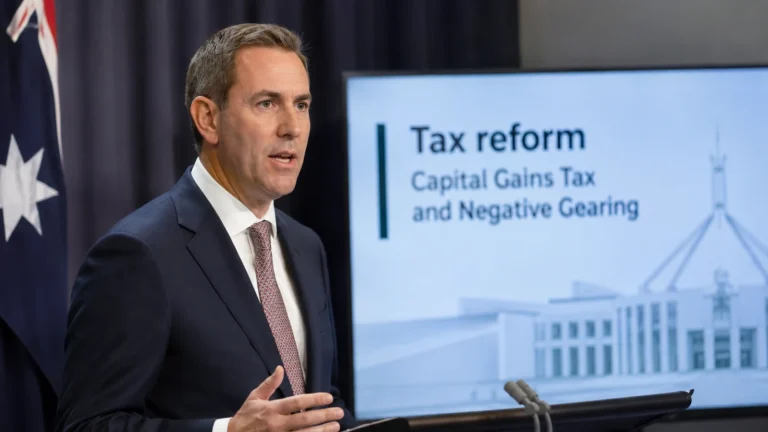
Australia’s housing market forecast for 2026 has taken a sharp turn.
Westpac expects the combined impact of higher interest rates and the Federal Government’s proposed property tax changes to cut new investor activity by 34 per cent and total housing turnover by 20 per cent.
Its central forecast is not a national housing crash. It is a market that loses momentum, becomes harder to price and finishes 2026 broadly flat across the major capital cities.
That distinction matters.
A flat national result can still conceal falling prices in Sydney and Melbourne, strong gains in Perth, and rental pressure in markets where new housing cannot arrive quickly enough.
The tax reforms are meant to reduce investor competition for established homes and redirect capital towards new construction. Whether they achieve that without tightening rental supply is now one of the biggest questions facing the property market.
The forecast has changed, but the shortage has not
Westpac expects average dwelling price growth across the major capitals to stall in 2026.
Its city forecasts remain sharply divided:
- Sydney: down 3 per cent
- Melbourne: down 4 per cent
- Brisbane: up 9 per cent
- Adelaide: up 7 per cent
- Perth: up 13 per cent
These figures do not point to one Australian property market. They point to several markets moving at different speeds.
Sydney and Melbourne are more exposed to reduced borrowing capacity because prices are higher and buyers often need larger loans. Brisbane, Adelaide and Perth still have stronger population growth, tighter listings and lower rental vacancy rates supporting demand.
Even so, Westpac expects the national market to lose ground during the second half of 2026 after recording gains earlier in the year.
This is the part buyers can easily miss. A city can finish the year with positive annual growth while prices are already falling from their mid-year peak.
Key numbers
Westpac’s base case includes a 34 per cent fall in new investor activity, a 20 per cent decline in dwelling turnover and flat average capital-city price growth for 2026.
These are forecasts, not guaranteed outcomes. Interest rates, legislation, listings and investor behaviour could move the result in either direction.
Why investors are expected to step back
The Federal Budget proposed two major changes affecting residential property investment.
First, negative gearing would be restricted for newly purchased established homes. Investors would no longer be able to deduct rental losses from salary or other non-property income. Losses could still be offset against property income or carried forward.
Second, the existing 50 per cent capital gains tax discount would be replaced from July 2027 by an inflation-adjusted cost base, together with a minimum 30 per cent tax rate on taxable capital gains.
Existing investments receive some protection, while qualifying newly built homes retain more generous treatment.
In plain English, the policy creates three different groups:
Existing investors may retain valuable tax treatment.
New investors buying established homes face less generous deductions.
Investors buying qualifying new homes may continue to access negative gearing and a more favourable capital gains tax option.
That changes the relative maths of each purchase.
An established property with strong capital growth prospects may still attract an investor. But a highly leveraged property producing a large annual loss becomes harder to justify when that loss cannot reduce tax on wages.
Australian Property Review has previously examined how negative gearing grandfathering may encourage existing landlords to hold for longer. That could reduce listings even as new investor demand falls.
The market may therefore experience fewer buyers and fewer sellers at the same time.
A fall in turnover is not the same as a fall in prices
Property prices are set at the margin. They reflect the small group of homes actually sold, not the value of every dwelling in the suburb.
When turnover falls, price signals can become less reliable.
Buyers may reduce their offers because finance is tighter or expected returns have weakened. Vendors may refuse to meet those offers because they are not under pressure to sell. The result is fewer transactions rather than an immediate price collapse.
This can create the “air pocket” identified in Westpac’s forecast.
An air pocket occurs when confidence and transaction volumes drop quickly enough that a small number of weak sales produce sharper price movements. Markets with high debt, stretched affordability or rising listings would be more vulnerable.
The early signs usually appear in:
- longer selling times
- lower auction clearance rates
- more withdrawn campaigns
- wider vendor discounts
- fewer investor loan approvals
Australian Property Review’s analysis of weakening auction clearance rates explains why buyer hesitation can appear before official price indexes record the change.
Here’s the catch. Lower investor demand does not guarantee cheaper homes for first-home buyers.
If existing landlords hold their properties to preserve grandfathered tax benefits, the number of homes reaching the market may also fall. Owner-occupiers may face less competition at individual auctions but still struggle to find enough suitable stock.
New housing becomes the policy’s pressure valve
The Government’s carve-out for newly built dwellings is designed to push investor capital towards additional supply.
Westpac estimates the share of investor lending directed towards new homes could rise from around one-fifth to roughly two-fifths. It also believes the shift could eventually support an additional 15,000 to 30,000 new homes a year.
That would be a material improvement.
But it depends on investors being willing to buy new housing and the construction industry being able to deliver it.
New apartments and house-and-land packages carry risks that established homes do not. Buyers must consider construction delays, builder solvency, defects, valuation risk, settlement timing and the premium sometimes attached to new stock.
Higher construction costs also reduce potential yields. A tax concession cannot rescue a project bought at the wrong price.
There is another unresolved issue. Treasury modelling reportedly points to weaker construction rather than stronger construction, suggesting lower expected dwelling prices may reduce project feasibility.
The difference between the two forecasts comes down to investor behaviour.
If investors switch heavily into new homes, the reforms may improve supply.
If investors simply leave residential property, fewer rental homes may be funded and the expected construction lift may fail to arrive.
Renters could feel the adjustment first
New housing takes years to plan, approve and complete. Investor decisions can change within weeks.
That timing gap is the main rental-market risk.
When an investor sells a rental property to an owner-occupier, one rental home disappears, but one household may also leave the rental market. At the national level, those changes can partly offset each other.
At the suburb level, the match is rarely clean.
A family renting a detached home near a school cannot necessarily move into a newly completed inner-city apartment. A worker priced out of one area does not instantly benefit because supply was added somewhere else.
If investor demand falls faster than construction increases, vacancy rates could tighten and rents could rise.
Westpac expects gross rental yields to increase gradually as the market adjusts to lower after-tax returns. That increase could come through higher rents, lower property prices or a combination of both.
Australian Property Review has examined the transition risk in its analysis of how negative gearing changes could squeeze the rental market.
The policy’s success should therefore be measured against more than house prices. Vacancy rates, rental listings, completions and tenant mobility will matter just as much.
The next landlord may look different
Over time, the reforms could change who owns Australia’s rental housing.
An investor with one negatively geared property may only be able to carry losses forward under the proposed rules. A larger landlord with several properties could potentially offset a loss on one property against income from another.
That gives portfolio investors an advantage.
The rental sector may gradually become more concentrated among professional landlords, larger private portfolios and institutional owners whose primary business is providing rental housing.
This is what Westpac describes as increased “landlordism”.
It is not automatically good or bad. Larger operators may have stronger systems, longer investment horizons and better access to finance. They may also gain more bargaining power and focus heavily on markets offering scale.
Housing stock could change as well.
If tax settings favour new construction, the rental pool may gradually include more apartments and newly built houses in outer growth corridors. Established detached homes in middle-ring suburbs could become relatively harder for renters to find.
That would affect families differently from singles, couples and students.
Now, the part most people miss: a policy can increase the total number of rental homes while still producing shortages in the types and locations tenants need most.
Interest rates may still matter more than tax
The tax reforms have attracted most of the political attention, but mortgage rates remain the faster and broader transmission channel.
Higher rates reduce borrowing capacity for investors and owner-occupiers. They also increase holding costs for existing landlords and weaken project feasibility for developers.
Australian Property Review has explained why higher rates hit property through serviceability and cash flow before broader inflation effects appear.
A further rate rise would strengthen Westpac’s downside case. It could reduce demand, weaken turnover and place additional pressure on highly leveraged owners.
A softer inflation result, weaker employment growth or a clear economic slowdown could produce a different outcome. If the Reserve Bank stops tightening or begins signalling future relief, owner-occupier demand may recover faster than investor demand falls.
That is why tax policy should not be treated as the sole driver of the 2026 market.
It is interacting with interest rates, population growth, lending standards and an already constrained supply pipeline.
Three ways the forecast could play out
The base case is a slower, thinner market.
Investor purchases fall, established-home turnover weakens and prices broadly stall. Sydney and Melbourne soften while tighter markets continue to grow at a slower pace. Rents rise gradually and investor lending shifts towards new housing.
The upside case requires a successful supply response.
Investors move into genuinely additional dwellings, construction capacity improves and interest rates stabilise. First-home buyers face less competition for established homes without a major contraction in rental availability.
The downside case is a disorderly pause.
Investors retreat, new construction remains too expensive, the Reserve Bank raises rates again and listings rise in vulnerable areas. Prices fall more sharply in leveraged markets while renters face tighter supply because new homes are not delivered quickly enough.
None of these outcomes should be treated as certain. The proposed legislation may change, lenders may adjust their assessment policies and investors may respond differently from economic models.
The practical move for buyers and investors
Property decisions made in 2026 need to work without relying on one forecast.
For buyers, watch local listings, vendor discounts and days on market. National price forecasts matter less than whether stock is accumulating in the suburbs and property types you are targeting.
For investors, model the property under the proposed tax treatment, not the rules you wish would remain. Include higher interest costs, vacancy, insurance, maintenance, land tax and realistic rent growth.
A simple rule of thumb applies: if a property only works because of a tax deduction, it does not work well enough.
Existing investors should also avoid holding a weak property solely to preserve grandfathered treatment. A tax benefit can improve an asset. It cannot turn poor fundamentals into a strong investment.
The next step is to pressure-test the numbers under flat prices, higher repayments and a delayed sale before making a decision.
Stay ahead of the policies, rates and market signals shaping Australian property. Subscribe to the free Australian Property Review newsletter.
General info, not financial advice.