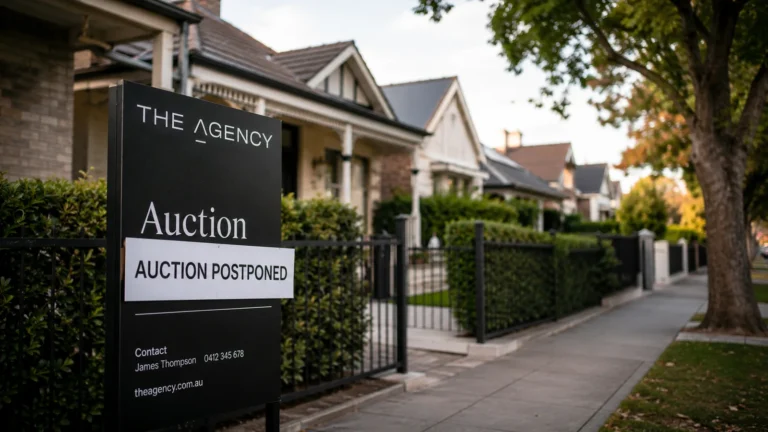
Melbourne’s latest price data shows a market splitting at the suburb level. Some postcodes posted double-digit annual gains while others slid backwards over the same twelve months. The city-wide median obscures what’s actually happening on the ground.
For buyers and investors making decisions this year, the aggregate number is almost useless. What matters is understanding which factors are pushing certain suburbs up while others stall or reverse. Three forces stand out: infrastructure timing, planning changes, and demographic pressure points.
Infrastructure moves money before shovels hit the ground
Suburbs with confirmed transport projects tend to see price lifts well ahead of completion. The effect shows up once funding is locked and timelines are public. Buyers price in future accessibility, especially if the project cuts commute time to the CBD or connects previously isolated pockets to established employment nodes.
The catch: speculation can run ahead of delivery. If a project gets delayed or scope gets cut, early movers can be left holding properties that priced in benefits that take years longer to arrive. Check construction timelines and state budget commitments, not just the press release.
Rezoning creates a supply overhang risk
Planning overlays that allow higher density can trigger sharp short-term price rises as developers compete for sites. But the second-order effect is more supply hitting the market within 18 to 36 months. If that new stock lands during a downturn or credit squeeze, the suburb can see prices fall as absorption slows.
Suburbs currently being rezoned for medium-density aren’t automatically a buy. The question is whether underlying demand (jobs, schools, amenity) can absorb the extra dwellings without a glut. Look at vacancy rates, rental growth, and whether the area has structural pull beyond the planning change.
Demographic shifts rewire demand faster than most expect
Areas seeing an influx of younger households or downsizers tend to hold or gain ground because those cohorts are active buyers with different price sensitivity than investors chasing yield. Conversely, suburbs losing population to interstate migration or aging in place without turnover can see prices drift even if the broader market is rising.
This is harder to track than infrastructure or zoning because census data lags. Proxy signals include school enrolment trends, new childcare centres, and whether local retail is refreshing or closing. If a suburb’s demographic base is shifting, prices will follow with a lag.
The interplay that separates risers from fallers
Suburbs gaining on multiple fronts (new transport link, planning that matches actual demand, demographic tailwind) tend to outperform. Those with only one driver or facing conflicting pressures (rezoning during population outflow, infrastructure promises but no delivery timeline) are where the price falls cluster.
The million-dollar suburbs analysis shows how affordability migration pushes buyers toward fringe areas, but not all fringe locations benefit equally. The ones capturing that flow have at least two of the three factors working in their favor.
Risks to watch
Interest rate moves: Another hike would hit higher-leverage outer suburbs harder than established inner areas with lower loan-to-value ratios.
State budget cuts: Infrastructure projects can be deferred or descoped if revenue falls short, erasing the price premium that speculation built in.
Oversupply in medium-density zones: Rezoning without demand discipline creates a glut that takes years to clear, especially if credit tightens and investors pull back.
What this means for decision-making
If you’re comparing Melbourne suburbs right now, price movement over the past year is a lagging indicator. Focus instead on:
- Infrastructure with locked funding and a construction start date (not just a feasibility study).
- Planning changes that match the suburb’s actual demographic trajectory (rezoning a retiree enclave for townhouses is a mismatch; rezoning near a university precinct for medium-density isn’t).
- Evidence of population inflow or household formation (school data, new retail, rental vacancy below 2 percent).
Suburbs with one of those might hold steady. Suburbs with two or three are where the risers tend to cluster. Suburbs with none, or where the factors conflict, are where falls happen even when the city-wide number looks fine.
The mortgage funding surge shows borrowing capacity is still flowing, but it’s concentrating in areas where buyers see a structural reason for future demand, not just recent price momentum.
Start here: pick three suburbs you’re considering and map each against infrastructure timing, planning trajectory, and demographic evidence. If all three are speculative or unclear, that’s the risk.
Subscribe to Australian Property Review for weekly analysis on what’s actually moving Melbourne’s micro-markets.
General info, not financial advice.