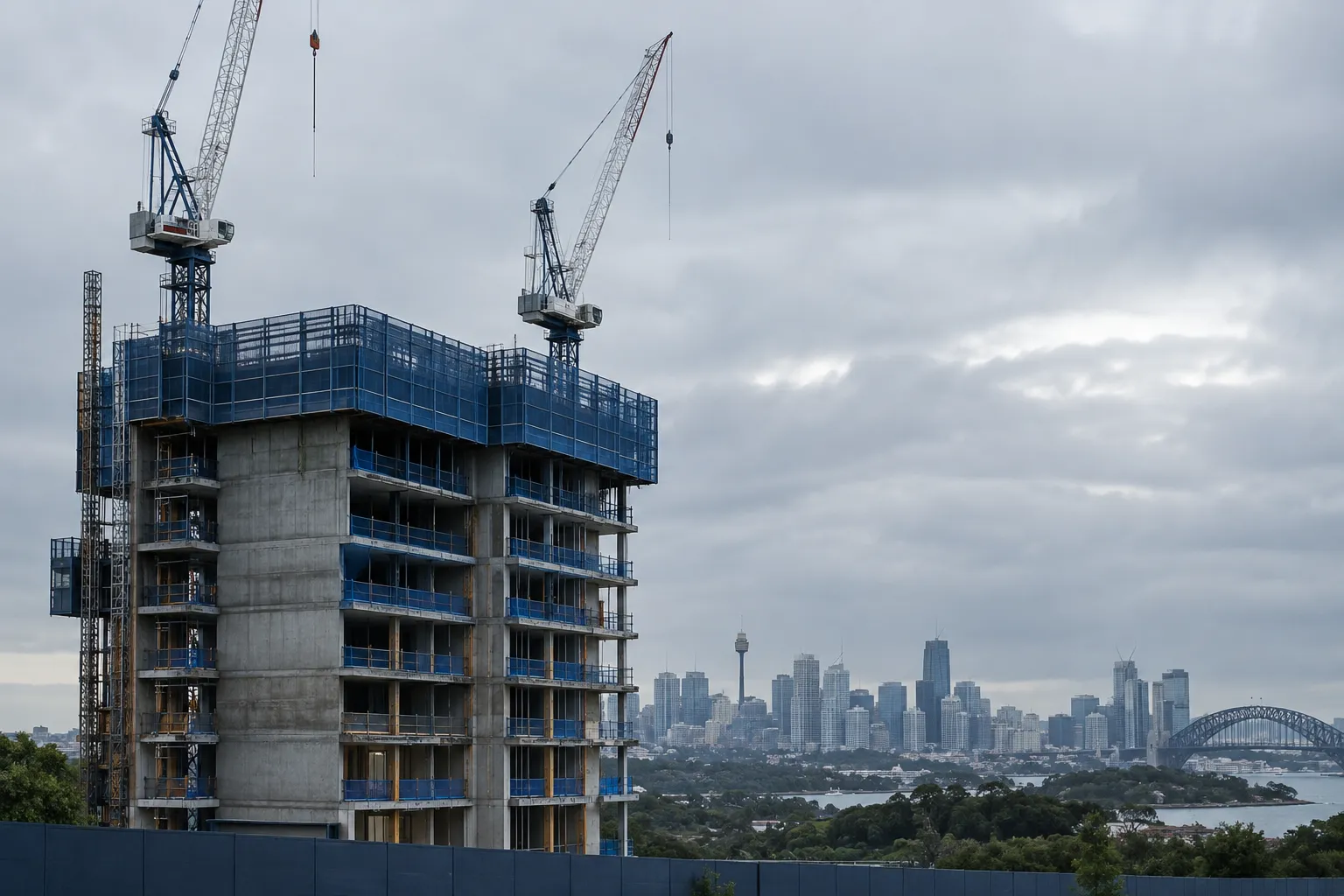
Mirvac’s shares have fallen 26% over the past year, and its latest trading update explains part of why. Sales and enquiries have slowed in its biggest markets. The more interesting story sits behind the sales figures: what a weak selling market does to the projects that haven’t started yet.
The Mirvac housing downturn is a useful window into the broader market. It shows a lagging pipeline of finished apartments sitting alongside a sales market that has already turned. That gap matters for supply, and it is easy to miss.
What the first-quarter update actually shows
Mirvac’s first quarter of FY27 delivered 291 lot completions, up from 265 a year earlier. That sounds like strength. It isn’t a read on today’s demand. Those apartments were sold in earlier, firmer conditions and are only now reaching settlement.
The forward-looking part is more sobering. Management says sales and enquiries have slowed, particularly in Sydney and Melbourne and, more recently, Queensland. It points to four rate rises in 2026 and recent tax changes as the drivers. Commercial assets, by contrast, remain close to full: offices 96%, industrial 97%, retail 99%. The weakness is in housing, not across the whole business.
The wider market is moving the same way
The company’s commentary fits the national data. The cash rate reached 4.6% on 29 September, a 15-year high. National home values fell 1.1% in September, a sixth straight monthly drop, and now sit 5.2% below the March peak. Sydney is 8.6% below its February high. Mortgage demand is down 19.2% on a year ago.
The 12 May Budget also narrowed negative gearing and changed capital gains treatment. For anyone weighing how those changes work, our negative gearing, CGT and investor tax guide covers the mechanics. One economist now expects peak-to-trough falls of 10 to 15%. That is a forecast, not a certainty, and it depends heavily on where rates go next.
Why weak sales matter for supply
Most people read a sales slump as a story about prices. For developers it is also a story about finance. Apartment projects typically need a set level of pre-sales before a lender will release construction funding. When buyers stop signing contracts, projects can’t reach that threshold, and approved sites sit idle.
That is the second-order effect. A project that stalls in 2026 does not complete in 2028 or 2029. If enough of them stall at once, the market ends up with a thinner pipeline just as the cycle turns and demand returns. Cheaper prices today can coexist with tighter supply later.
It also changes who is left holding sites. When developers fail, land changes hands at lower values, a dynamic we looked at in distressed development sites and who buys when a builder fails.
The settlement risk hiding in the forecast
Mirvac still forecasts 2,800 to 3,100 settlements in FY27, compared with 2,130 in FY26, weighted to the second half. That is a large step up, and it rests on buyers who committed when prices were rising.
Those buyers now face a different market: higher rates, tighter lending and values drifting lower. Defaults were only 0.3% in FY26, which is low. But a low default rate in a rising market says little about behaviour when valuations come in under contract price. The risk is not a collapse. It is that some settlements slip, renegotiate or fall over, and that earnings carry more uncertainty than the headline guidance suggests.
Reading the competing narratives
Commentary on results like this tends to split in predictable ways. One camp reads weak pre-sales as a demand and price story and stops there. Another reads them as a finance and supply story that plays out over years. Both can be true at once, but they lead to different conclusions about what happens next. The supply reading is the less comfortable one, because it implies today’s softer prices may be setting up tomorrow’s shortage.
What this means for different decisions
- Buyers: Softer conditions give more time and negotiating room. They do not guarantee a floor. Prices have fallen six months running, so waiting has a cost and a benefit.
- Investors: Tax changes and higher rates are squeezing returns at the same time. Hold-period assumptions matter more than they did a year ago.
- Off-the-plan buyers: Check how close your settlement date is and how a lower valuation would affect your loan. Speak to your lender early, not at the last minute.
Key numbers
- Mirvac share price: down 26% over a year
- Cash rate: 4.6%, a 15-year high
- National values: down 1.1% in September, 5.2% below the March peak
- FY27 settlement forecast: 2,800 to 3,100, against 2,130 in FY26
- Mortgage demand: down 19.2% year on year
The downturn is visible in today’s sales. Its more lasting effect may arrive later, in the projects that never reached finance. If you are making a property decision this quarter, stress-test your repayments against a further rate move before you commit. If you want the weekly signal on these shifts, subscribe to the newsletter.
General info, not financial advice.