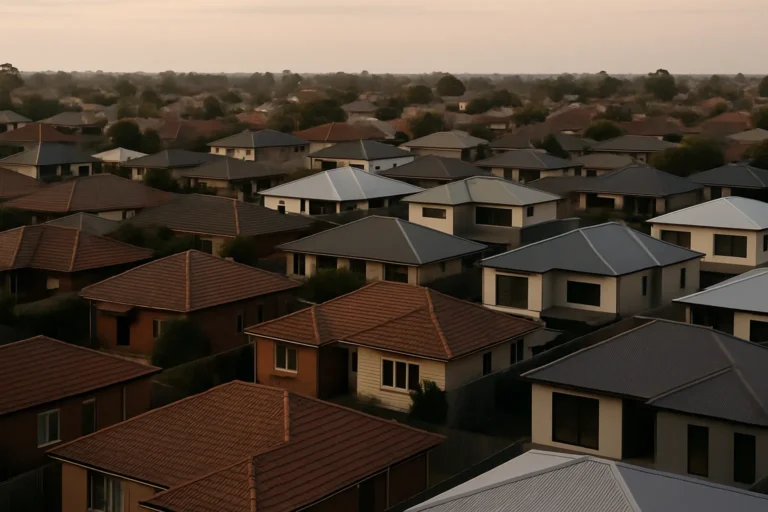
A forecast fall in home values is one number. A borrower who bought recently, with a thin deposit, is exposed to a different one: the gap between what they owe and what the home would fetch. That gap is where this month’s outlook gets uncomfortable.
Westpac’s October 2026 outlook expects the RBA to lift the cash rate again in November, to 4.85%, the highest of this cycle. It sees that rate holding until mid-2027, with cuts starting only in August. The same outlook has dwellings down about 8% nationally in 2026, and a full peak-to-trough decline of a little over 10%. If that plays out, it would be the biggest national fall since records began in 1980, although inflation-adjusted declines in earlier recessions were deeper.
The headline is a national average. Negative equity does not happen on average. It happens to specific loans.
Negative equity Australia borrowers face is a deposit problem first
Negative equity means the loan balance exceeds the property’s value. A 10% fall wipes out the entire deposit of anyone who put down 10%, before costs of sale. Buyers who borrowed at 90% or more of the purchase price in the last couple of years, often at the top of the market, sit closest to that line. Those with 20% or more behind them have a cushion.
That is why the average is misleading. The same 10% fall is an inconvenience for a long-held home and a balance-sheet problem for a recent, highly geared purchase.
The city split matters more than the national figure
The outlook’s regional forecasts are uneven. For 2026 it has Sydney down 12%, Melbourne 8%, Brisbane 4%, and both Perth and Adelaide 2%. A buyer in Sydney who geared heavily faces a far larger hole than one in Adelaide. National commentary tends to flatten that.
It is also worth separating a paper loss from a realised one. Negative equity only becomes damaging if the owner must sell or refinance. That is the link to the rest of the picture.
Where the squeeze actually comes from
Two pressures hit at once. Higher repayments eat into household budgets, and the serviceability buffers banks apply when assessing a new loan or a refinance mean a borrower with falling equity may struggle to switch lenders for a better rate. A borrower who is stuck is a borrower who cannot shop around.
Confidence is already weak. Consumer sentiment dropped 4.7% to 80.4, one of the weakest readings since the early 1970s. The outlook flags indebted households in the 35 to 54 age range as the most exposed group. These are often people with the largest mortgages and dependants, not discretionary buyers who can simply wait.
Sales volumes have already fallen about a fifth. That matters for forced sales. In a thin market, a seller who needs to exit quickly takes a bigger discount, which can pull down the next valuation nearby.
Why relief is slow to arrive
The outlook expects underlying inflation near 0.9% per quarter through the September and December quarters, leaving the annual rate around 3.5%. Westpac’s chief economist argues policymakers will want firm evidence that price pressure is cooling before easing. In other words, the first cut is tied to a data trail that takes months to build.
The budget’s changes to housing tax rules and the higher cost of borrowing are cited as drags on demand. Neither is easily reversed. The Westpac leading index, flat at -0.03% in September, points to growth near or below trend into early 2027, with 1.5% forecast for 2026. That is a slow economy, not a collapsing one, which suggests the pain is concentrated rather than widespread.
[Callout]
Key numbers
- Cash rate forecast to peak at 4.85% in November, held until mid-2027
- National dwelling values forecast down about 8% in 2026, over 10% peak to trough
- Sydney forecast to fall most, at 12% in 2026
- Consumer sentiment at 80.4, down 4.7%
Commentary has split, and both sides have a point
Some coverage treats this as a manageable correction that most owners will ride out. Another reading focuses on where lending buffers thin and which recent buyers are most exposed. Both are partly right. Most owners will not face a forced sale. But the minority with high loan-to-value ratios and little spare cash flow carry a risk the headline fall does not capture.
What a borrower can do now
If you bought in the last two to three years with a small deposit, work out your actual loan-to-value ratio using a conservative current estimate, not the purchase price. Then check how many months of repayments you could cover from savings at a rate above today’s. Our guide to RBA rate moves and repayments shows how to run those numbers, and the fixed versus variable break-even analysis helps if you are weighing a rate lock before the peak.
If the buffer is thin, talk to your lender early. Hardship arrangements are far easier to negotiate before arrears appear.
For a weekly read on rates, credit and prices, subscribe to the newsletter.
General info, not financial advice.