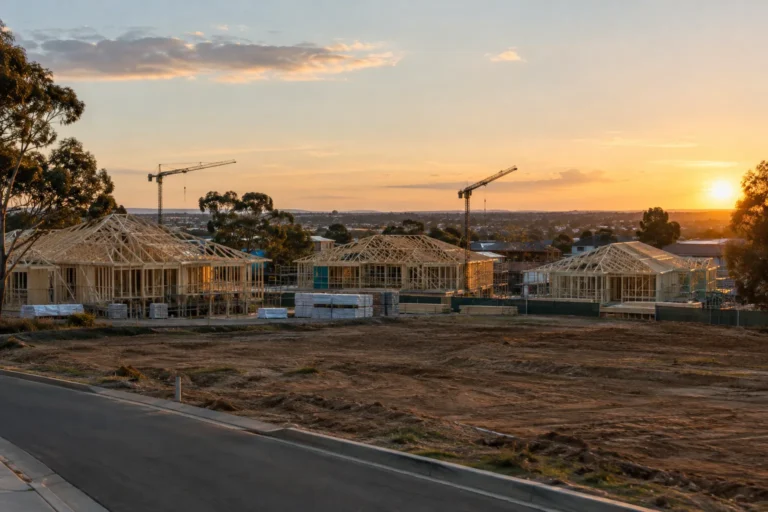
Perth property prices have slipped 1.2% in September 2026, leaving values 6% below the April high. A local buyer’s agent is telling clients that waiting for the exact bottom is a gamble. That is a fair warning, but it only tells half the story.
The other half is what a recovery would actually be built on. If rents stay tight and borrowing limits stay low, the next upswing may be slower and shallower than anyone selling urgency would like you to believe.
What the Perth numbers actually show
The cooling is real, but it is not uniform. Cotality data put September sales 24.2% below the same month a year earlier. Houses now take about 28 days to sell, which is 18 days longer than twelve months ago. Nationally, prices have fallen for six straight months.
The mix of sales has changed too. Listings are back near long-term norms. Roughly half of Perth houses now sell modestly under asking, compared with about one in ten earlier in 2026. An industry body’s recent column described conditions as more balanced than a buyer’s market.
That last point matters. Balanced is not the same as weak. Sellers are conceding a little, not slashing.
The case for not waiting
The buyer’s agent argument has some substance. Family homes in well-regarded school and transport areas still draw multiple offers. Population growth and limited new supply have not gone away. Those forces helped lift Perth dwelling values 74% over five years, the strongest among the capital cities.
Negotiating room also depends on the listing. A property that has sat for weeks gives a buyer leverage. A fresh, popular one demands speed. Both can exist in the same suburb on the same weekend.
There is also the practical problem of timing. Nobody knows the floor until it is behind us. By the time a turn is obvious in the data, the best-priced stock is usually gone.
Why a recovery may be shallow
Here is the catch. A buyer’s agent earns a fee when someone buys, so “don’t wait” is a natural message. It does not follow that prices are about to snap back.
The drivers behind the dip are still in place. The source material points to higher borrowing costs and the federal budget’s tax changes, which cut participation from investors and first-home buyers. Those two groups are a large share of marginal demand. Until they return, the upside has less fuel.
Tight rental supply cuts the other way. Scarce rentals support investor yields and keep would-be buyers motivated to leave renting. But scarcity helps only if investors can still afford to hold. If serviceability is the constraint, a rental shortage may push rents higher without pulling prices up much.
That is the tension. Strong fundamentals on supply and population limit how far prices can fall. Constrained borrowing capacity limits how fast they can rise.
For related reading on how rates squeeze buyers, see our look at Melbourne’s shrinking borrowing capacity.
Scenarios worth holding in mind
- Base case: prices drift sideways to slightly lower, with slow turnover and rising negotiation room on stale listings.
- Upside: rates ease, investors and first-home buyers return, and well-located family homes lead a modest rebound.
- Downside: borrowing costs stay high, listings build, and the 6% fall extends in weaker segments.
None of these is a forecast. They are ways to test your own decision against more than one outcome.
Quick take
- Values: 6% below the April peak
- Sales: 24.2% below a year earlier
- Time to sell: about 28 days, up 18 days
- Houses selling under asking: roughly half, versus about one in ten earlier in 2026
Where the real risk sits for buyers
The gamble is not only about timing the bottom. It is about the property you buy and what you can afford to hold through a flat patch.
If you are chasing a scarce, popular home, speed matters more than shaving the last 2%. If you are looking at a listing that has lingered, you can afford to negotiate. In both cases, the sturdier test is cashflow. Can you cover repayments if rates stay where they are and prices do not move for a year or two?
First-home buyers face a related trap. Waiting for lower prices can become self-reinforcing, as we covered in first-home buyers waiting for lower prices. Sitting out can mean saving longer while borrowing power erodes.
The bottom line
The buyer’s agent is right that nobody rings a bell at the bottom. But a falling market with balanced conditions, tight borrowing and a rental shortage is not a signal to rush. It is a signal to be selective.
Your next step: set a maximum price and a stress-tested repayment you could hold for two years, then act on the right property when it appears, not on a forecast of the floor.
If you want the weekly signal, subscribe to the Australian Property Review newsletter.
General info, not financial advice.