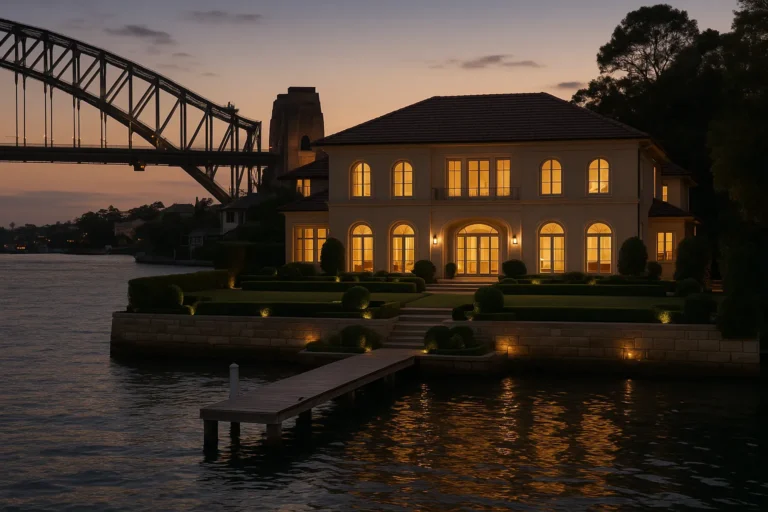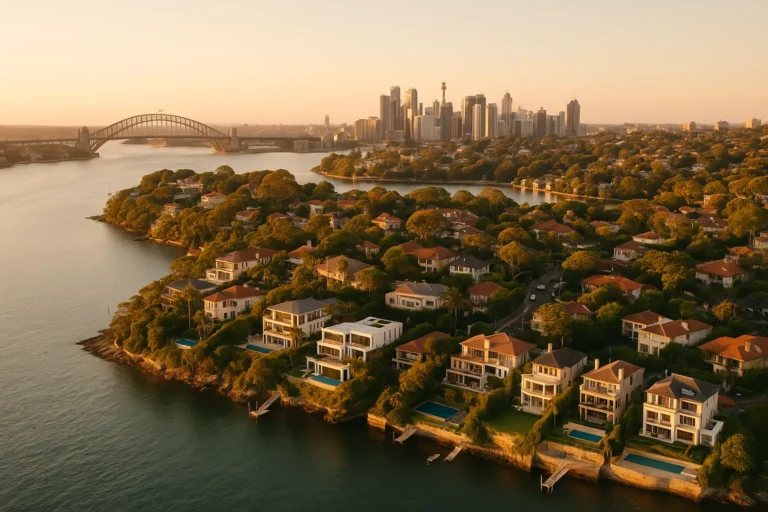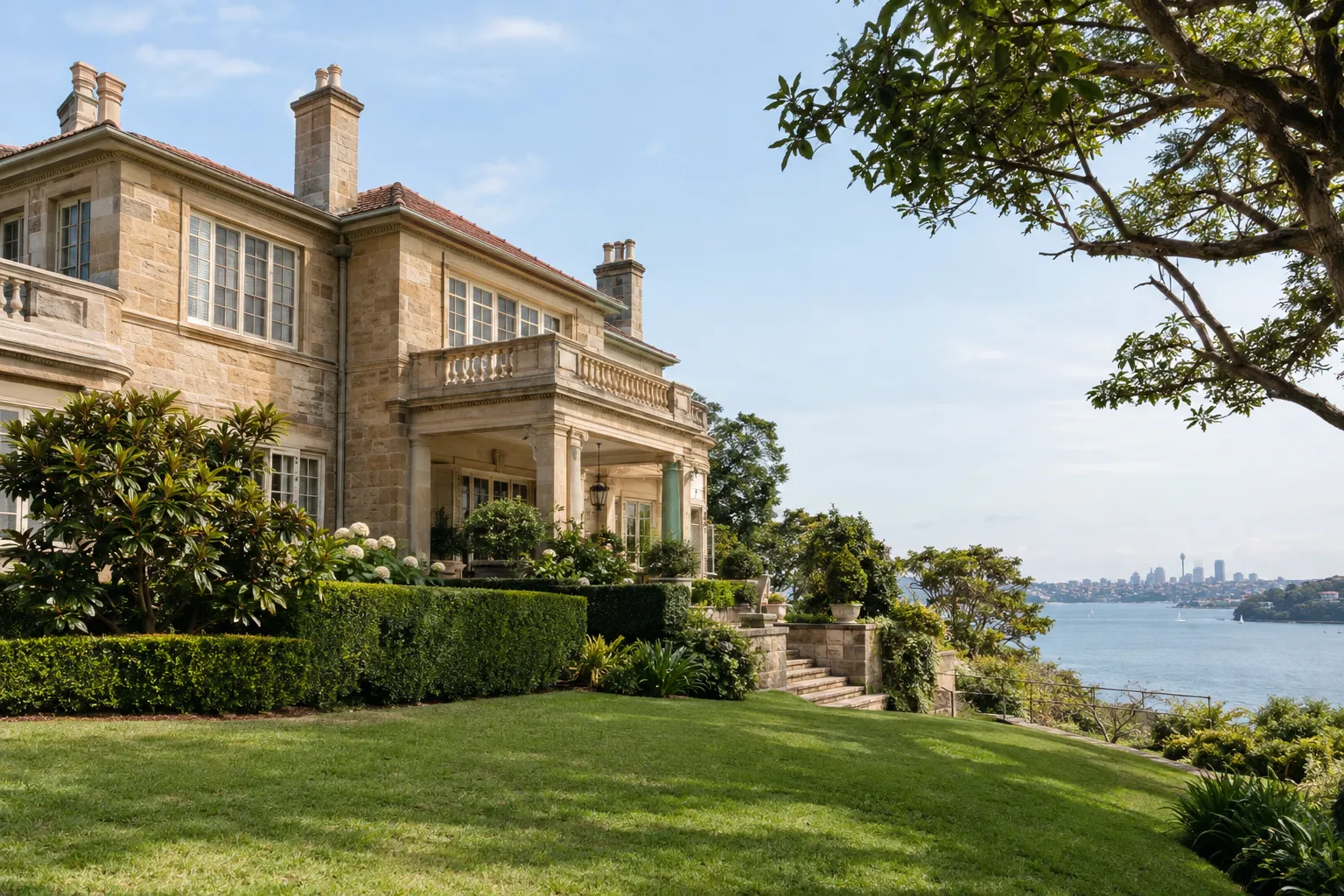
A mansion on Sydney’s Lower North Shore has changed hands for $33 million, punctuating a market segment that continues to perform while median prices across the harbour city track backwards. The sale sits well above the threshold where normal affordability constraints, serviceability tests and auction clearance rates stop mattering.
This is not just expensive property holding up better than cheap property. Above roughly $20 million to $30 million, the market operates under entirely different mechanics. The buyer pool shrinks to dozens rather than thousands, financing rarely involves a mortgage, and price discovery happens through quiet campaigns rather than public auctions. When the broader market softens, this tier can still see competitive tension.
The mechanics at the top end
Prestige transactions above $20 million typically involve buyers who are not borrowing, or borrowing trivially relative to their balance sheet. Serviceability calculators, loan-to-value ratio caps and the three per cent interest rate buffer that constrain most owner-occupiers do not apply. Cash buyers dominate, and when debt is used it is often structured as portfolio financing against other assets rather than a residential mortgage tied to income multiples.
The consequence: rate rises that freeze out leveraged buyers in the $2 million to $5 million bracket have almost no direct impact at $30 million. The buyer is typically deciding between holding more liquid assets or locking capital into a trophy home. The question is opportunity cost and lifestyle preference, not whether the repayments fit within a salary.
Supply is the other half. There are fewer than 100 properties in Sydney that could credibly trade above $25 million in any given year. Most never reach the market. Owners at this level are not forced sellers responding to cost-of-living pressure or rate stress. Properties come to market when family circumstances change, estate planning triggers a sale, or an offshore move prompts liquidation. Thin supply plus a globally sourced buyer pool equals price resilience even when the middle market sags.
Who is buying and why now
The buyer cohort includes Australian business owners taking chips off the table after exits or asset sales, offshore families establishing a foothold in Sydney (particularly from Asia and the Middle East), and existing local wealth rotating between assets. Demand has remained steady through the current rate cycle, supported by strong equity markets, continued business sale activity, and Sydney’s position as a stable, liveable city for mobile capital.
Some buyers are also making a deliberate call that prestige property in prime locations offers better downside protection than holding cash at term deposit rates or riding out equity market volatility. A harbourside estate or a landmark trophy home in Bellevue Hill, Point Piper or the Lower North Shore carries scarcity value that does not correlate tightly with RBA policy. When inflation erodes cash and equities swing, bricks in the right postcode can look like the safer bet.
Timing also matters. Buyers at this level often move when they find the right property, not when market conditions hit some optimal point. If the perfect home comes to market, they buy. If it does not, they wait. This episodic, opportunity-driven behaviour insulates the segment from the month-to-month sentiment shifts that drive clearance rates and auction volumes lower down the price ladder.
The wealth buffer
Wealth concentration in Australia has increased over the past decade, with the top 1 per cent of households now holding a disproportionate share of investable assets. Equity market gains, business valuations and offshore capital inflows have all expanded the pool of buyers who can write a $30 million cheque without debt. This structural trend supports prestige pricing even when household income growth stalls and mortgage serviceability tightens for the median buyer.
The same dynamic plays out in other global cities. London, New York, Hong Kong and Singapore all have prestige segments that decouple from their broader housing markets during downturns. Sydney is no exception. The difference is degree: because Australia’s prestige market is smaller and less liquid than those offshore hubs, individual sales can look like outliers when in fact they reflect consistent, if quiet, demand.
Key numbers
- Prestige threshold: transactions above $20 million to $30 million operate under different financing and demand dynamics
- Buyer pool: fewer than 100 properties in Sydney trade above $25 million annually
- Leverage: most buyers at this level use little to no debt, insulating them from rate rises and serviceability tests
- Wealth buffer: top 1 per cent of households hold a disproportionate and growing share of investable assets
What could change the picture
A sharp equity market correction that erodes paper wealth could reduce the buyer pool, particularly if it coincides with weaker business sale activity and tighter capital controls offshore. Luxury property is not immune to broader wealth shocks; it just takes a bigger shock to move the needle.
Increased foreign buyer restrictions or changes to tax settings around high-value property (land tax surcharges, higher stamp duty tiers, or wealth taxes if ever introduced) could also pressure pricing at the top end. So far, policy has targeted foreign buyers and vacant property rather than domestic wealth, but that could shift if affordability debates intensify.
Finally, if prestige supply increases materially, either through estate sales, offshore owners exiting, or new luxury developments hitting the market at the same time, competitive tension would ease and prices could soften. Supply shocks are rare at this level but not impossible, particularly if economic conditions or geopolitical factors prompt a wave of simultaneous listings.
What this means for the rest of the market
Prestige resilience does not forecast strength in the broader market. The two segments have decoupled before and will again. Median Sydney prices can fall while trophy homes hold or rise, because the buyer pools, financing structures and motivations are fundamentally different.
For investors and owner-occupiers in the $1 million to $5 million range, the lesson is simple: do not read prestige sales as a signal that the market has turned. Your financing costs, serviceability limits and competition from other leveraged buyers matter far more than whether a harbourside mansion just changed hands for eight figures. The constraints you face have not eased, and the prestige buyer’s balance sheet is not a useful comparison.
If you are holding property and waiting for a recovery, focus on median price trends, auction clearance rates, listing volumes and days on market in your actual price bracket and suburb. Those indicators will tell you when buying conditions improve or when holding becomes more expensive than selling. A $33 million trophy sale tells you something about wealth concentration and global capital flows. It tells you very little about whether now is a good time to buy in Parramatta or sell in Penrith.
For a deeper look at how far median prices may need to fall before value emerges, see Property overvaluation Australia: how far prices need to fall. And if you are weighing the trade-off between falling prices and rising rate risk, this breakdown of the math walks through the scenarios.
The takeaway for decision-making
Prestige property insulation is real, but it is narrow. It applies to a few dozen sales per year in a city of millions. If you are not operating in that wealth band, the mechanics that support prestige pricing have no bearing on your next decision.
Focus on the data that matches your own financing structure, buyer competition and risk tolerance. If you are borrowing, serviceability still bites. If you are buying in the middle market, clearance rates and days on market still matter. The ultra-high-end is a different game, played under different rules, with different players.
Subscribe to the newsletter for the weekly signal on what is moving the market, at the price points where most decisions actually happen.
General info, not financial advice.