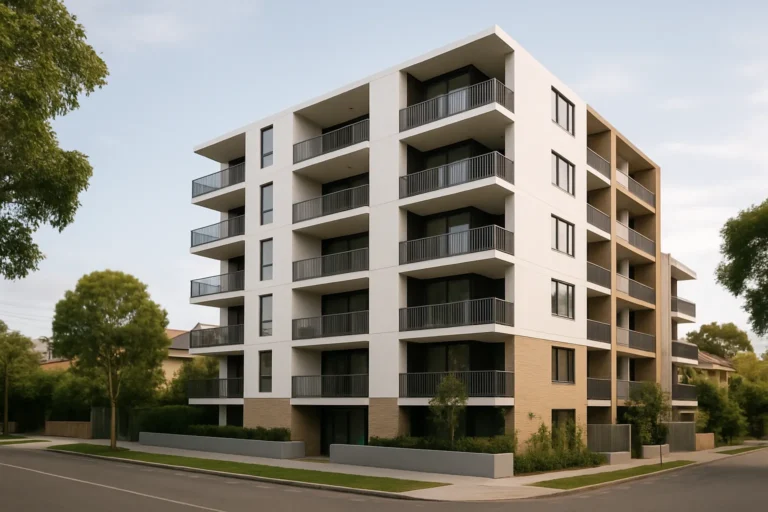
A property investor with a 400-home portfolio says fierce competition for sub-$500,000 stock is putting an iron floor under the national market. The argument: while prestige properties slide, entry-level buying is so intense it’s dragging median prices down without reflecting genuine weakness.
The claim matters because it reframes recent price falls as a compositional quirk rather than demand collapse. If true, it suggests the market has split cleanly into two tiers. If not, it’s wishful thinking that ignores credit tightening and serviceability walls hitting all buyers, not just those chasing penthouses.
Here’s what the numbers actually say, and where the floor thesis holds up versus where it breaks down.
What the compositional argument gets right
Median price is the middle sale in any given month. If high-end transactions dry up while entry-level volume stays steady, the median shifts down mechanically, even if individual properties aren’t losing value.
ABS investor lending data through March 2025 shows commitments below $500,000 rose 18% year-on-year, while loans above $1 million fell 22%. That split is real. CoreLogic’s stratified indices, which track repeat sales of the same property, show units in the bottom quartile held flat in Sydney and Melbourne over the past six months, while top-quartile houses dropped 4–7%.
So yes, the compositional effect exists. Entry-level stock, especially high-yield units in outer suburbs and regional centres, is seeing more bidders than it did 12 months ago. Investors priced out of negative-gearing plays in premium postcodes are hunting cashflow, and that demand is concentrated in a narrow price band.
Callout: The catch
The argument assumes entry-level demand can stay strong indefinitely. But serviceability buffers apply to all borrowers. A buyer stretching to $400,000 today faces the same 3% assessment rate buffer as someone buying at $2 million. If rates stay higher for longer, or if wages stall, that $400,000 cohort hits the wall too, it just happens six months later than the prestige segment.
The supply constraint isn’t symmetrical
Construction bottlenecks are real. Material costs have spiked, and new apartment completions in Sydney and Melbourne are running 30% below 2019 levels. That should, in theory, support prices by limiting new supply.
But the constraint isn’t evenly distributed. High-rise developments in CBD fringes, where most sub-$500,000 stock sits, are still completing, slowly, but they’re finishing. Detached housing in middle-ring suburbs, where land supply is genuinely frozen by planning rules and infrastructure lags, is where the bottleneck bites hardest.
That means the entry-level segment the floor thesis relies on is also the segment with the least supply protection. If investor appetite cools even slightly, there’s enough pipeline stock in Perth, Brisbane, and Melbourne’s outer west to absorb weakening demand without prices lifting.
Where first-home buyers fit
The floor argument frames investors and first-home buyers as competitors for the same stock. That’s partially true in the $400,000–$600,000 range, where both groups overlap.
But first-home buyer lending fell 11% in the March quarter, according to ABS data. Deposit gaps are widening faster than savings rates, and Home Guarantee Scheme places are capped. The competition the investor describes, multiple bidders on $350,000 units, is mostly investor-on-investor, not investors outbidding owner-occupiers.
That distinction matters. If the floor is held up by yield-chasing investors rather than end-user demand, it’s vulnerable to any shift in rental growth expectations or negative gearing sentiment. Owner-occupier floors are stickier because they’re driven by housing need, not return assumptions.
Three scenarios that test the floor
Base case: entry-level demand holds for another six months as investors chase yield in a falling market, then weakens as rental vacancy ticks up in oversupplied precincts. Median prices stabilise rather than fall further, but individual properties in high-supply corridors still drift lower.
Upside: rate cuts in late 2025 bring first-home buyers back into the sub-$500,000 market in volume, broadening the buyer base beyond investors. Floor holds, and some catchup growth appears in 2026.
Downside: serviceability squeeze hits the $400,000 borrower cohort harder than expected as fixed-rate rollovers peak in Q3 2025. Investor demand thins, pipeline apartments complete into softer demand, and the floor cracks in specific precincts, outer Melbourne, Perth’s northern corridor, Brisbane’s apartment belt.
What the floor thesis means for buyers deciding now
If you’re an investor chasing yield, the sub-$500,000 segment is crowded. You’re not getting bargains; you’re getting market pricing with more competition than 12 months ago. Check rental vacancy in your target suburb, if it’s above 2.5%, yield assumptions are at risk.
If you’re a first-home buyer being outbid on entry-level stock, the question is whether waiting six months gives you better odds or worse. If the floor is investor-driven and those buyers retreat, you face less competition. If it’s genuine housing shortage, waiting just means higher prices. The data leans toward the first scenario in high-supply precincts, the second in land-constrained middle rings.
If you’re holding prestige property and waiting for the bottom tier to catch down, the compositional split suggests that’s unlikely in the next 12 months. The two segments are moving independently, driven by different buyer types and different serviceability limits.
Bottom line for the next six months
The floor is real in the sense that sub-$500,000 transaction volume is holding up. But it’s narrow, it’s investor-heavy, and it’s vulnerable to any cooling in rental growth or tightening in serviceability.
The bigger risk isn’t a floor breaking, it’s that the floor becomes a ceiling. If entry-level buyers can’t move up because middle-tier stock isn’t clearing, and investors keep recycling into the same price band, you get market segmentation rather than market recovery.
Watch rental vacancy rates in the precincts where this investor demand is concentrated. If vacancy moves from 1.8% to 2.8%, the yield case weakens and the floor gets tested. If it stays tight, the thesis holds for another quarter.
Rate cuts might not save you in 2026. Here’s how to buy anyway walks through the serviceability math that applies whether you’re buying at $400,000 or $2 million.
If you want the weekly breakdown of where demand is actually shifting, subscribe to Australian Property Review’s newsletter.
General info, not financial advice.