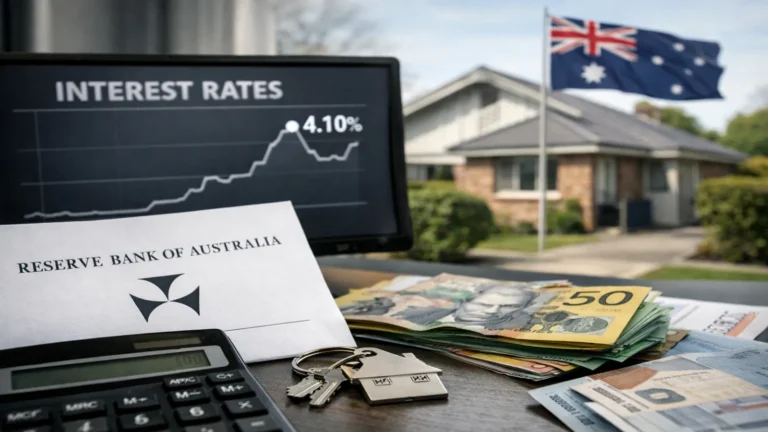
Futures markets crossed the line last week: a September RBA rate hike is now more likely than not, with probability sitting at 54% as of early September. That’s up from 40% in late August, and if the board holds in three weeks, November pricing climbs to 97%. The shift follows July’s inflation print, headline CPI eased to 3.5% year-on-year from 3.8%, but trimmed mean (the RBA’s preferred gauge) stuck at 3.6% for the second straight month, still well above the 2–3% target band.
What changed the calculus wasn’t the headline figure softening. It was the composition: services inflation remains elevated, rental costs are feeding through faster than wage indexation models predicted, and the central bank’s own deputy governor called out “upside risks” to inflation on primetime television. That’s not the language you use when you’re done tightening.
The rate path implied by current pricing
If markets are right, the official cash rate moves from 4.35% to 4.60% either late September or early November. For a borrower with a $600,000 variable-rate mortgage at 6.5%, that’s roughly an extra $90 per month in repayments, $1,080 per year. Serviceability buffers (the 3 percentage point add-on banks use to stress-test loans) mean borrowing capacity drops another $25,000–$30,000 for every 25 basis points the cash rate climbs.
The direct hit matters, but the secondary effect is what changes behaviour. Buyers who were pre-approved six months ago find their maximum loan has shrunk by $50,000–$60,000 if two hikes land before year-end. That’s the difference between a three-bedroom house and a two-bedroom unit in many middle-ring suburbs, or between proceeding and pulling out entirely.
The catch
- Trimmed mean inflation at 3.6% for two consecutive months signals persistence, not a blip
- Services inflation (haircuts, childcare, insurance, trades) less responsive to rate moves than goods prices
- Rental inflation feeding back into headline CPI faster than RBA’s February forecasts assumed
- Global risks flagged by deputy governor (Middle East conflict, AI-driven demand surge) could offset any domestic demand slowdown
- One more hike might not be enough if services inflation doesn’t roll over by Q4
Which inflation components aren’t moving
The RBA’s trimmed mean measure strips out volatile items and focuses on the middle 70% of price changes. When that figure flatlines at 3.6% despite three hikes already this year, it tells you the inflation that’s left is stickier. Services are the primary culprit: tradies, childcare, insurance premiums, haircuts, restaurant meals. These prices move with wages and capacity constraints, not interest rates.
Rents are the other pressure point. Vacancy rates below 1% in most capital cities mean landlords can push through increases even as mortgage holders feel the squeeze. That rental inflation feeds directly into the CPI basket, creating a feedback loop the RBA can’t easily break without a genuine demand collapse.
The borrowing-cost timeline for the next six months
Base case: one more 25bp hike lands between now and November, taking the cash rate to 4.60%. Variable mortgage rates for owner-occupiers with principal-and-interest loans push toward 6.7%–6.9% depending on lender, up from the current 6.45%–6.65% range. Investor rates, already 15–20 basis points higher, cross 7% at most of the major banks.
Upside scenario (for borrowers): inflation data for August and September shows a meaningful step-down in services prices, the RBA holds in September and November, and rate cuts come back into view for mid-2027. Probability: under 30% based on current forward curves.
Downside scenario: trimmed mean stays above 3.5% through year-end, the board hikes twice more (September and February 2027), and the cash rate peaks at 4.85%. That would take standard variable rates above 7% and knock another $50,000–$60,000 off borrowing capacity. Markets aren’t pricing this yet, but it’s the risk the deputy governor’s “upside risks to inflation” comment was flagging.
What one more hike does to investment cashflow
For property investors, the margin between rental income and mortgage cost is already tight or negative in most markets. Take a $700,000 investment property yielding 4% gross ($28,000 per year, or roughly $540 per week). At today’s investor rate of 6.65%, interest-only repayments run about $46,550 per year. After rates, body corporate, insurance, and maintenance, the property is cashflow-negative by $20,000–$25,000 annually before tax.
Another 25bp hike pushes the annual interest bill to $48,300, an extra $1,750 per year, or $146 per month. That’s not catastrophic on its own, but it compounds with vacancy risk (one extra week vacant wipes out $540), insurance renewals running 10%–15% ahead of last year, and body corporate fees climbing with construction-cost inflation. The cumulative effect: investors who bought in 2021–2022 at sub-3% rates are now carrying properties that cost $30,000–$35,000 per year out-of-pocket, and capital growth has stalled or reversed in several markets.
The decision point for that cohort: hold and hope for rate cuts in 2027, or sell into a market where buyer borrowing capacity just dropped again. Forced sales aren’t widespread yet, banks report distress remains low, but the longer rates stay high, the more investors facing genuine cashflow stress will choose to exit.
Red flags for September 28–29
Three data points land before the RBA’s September meeting: August monthly CPI (due mid-September), latest labour force figures, and any updated commentary from the board members who’ve been doing the media rounds. If August CPI shows trimmed mean ticking up to 3.7% or services inflation accelerating, the case for a September hike strengthens materially. If it softens to 3.4%–3.5%, the board likely holds and reassesses in November.
Labour market data matters because the RBA’s tolerance for higher unemployment has limits. If the jobless rate jumps from 4.2% to 4.5% or higher, that changes the trade-off: more rate hikes risk tipping the economy into genuine contraction, not just a demand slowdown. The deputy governor’s comment that Australia’s capacity to produce goods and services is stretched implies the RBA thinks there’s still room to cool demand without breaking employment. If that assumption proves wrong, the tightening cycle ends abruptly.
What to do before the meeting
If you’re pre-approved and waiting to exchange contracts, lock in your rate or get formal written confirmation your borrowing limit won’t be reassessed before settlement. Lender pricing strategies are diverging, and some are already pricing in the next hike while others are holding steady to protect market share.
If you’re an investor running negative cashflow, model what two more hikes do to your annual out-of-pocket cost and whether you can sustain that for 12–18 months. The exit isn’t urgent yet, but knowing your pain threshold before it’s tested keeps decisions rational.
If you’re holding cash waiting for lower prices, the next three months matter. If the RBA hikes and demand softens visibly (auction clearance rates drop below 60%, stock on market climbs), that’s when pockets of genuine value start appearing. Watch for suburbs where listings are rising faster than sales, not just the headline index figures.
Subscribe to the newsletter for the signal when the inflation data actually shifts.
General info, not financial advice.