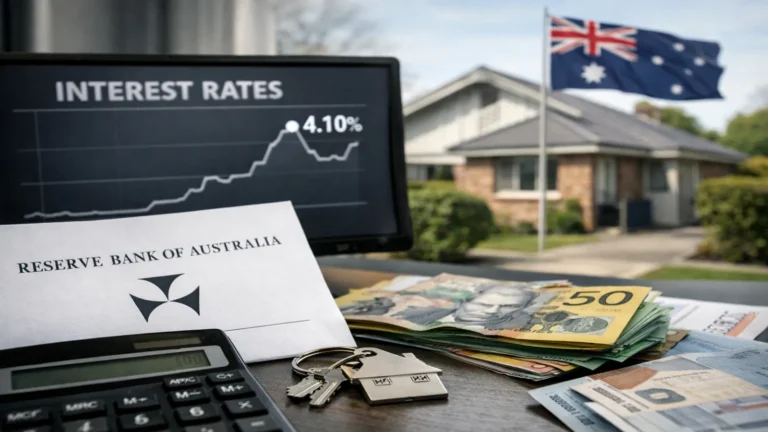
Pressure is mounting on the Reserve Bank to pause at its August meeting, with borrowers already absorbing the combined weight of three cash rate increases and external cost shocks that aren’t being driven by household spending.
The RBA lifted rates by 25 basis points in February, March and May before holding in June. The cash rate now sits at 4.35%. On a $735,000 loan, close to the national median for new borrowing, another quarter-point move would add roughly $120 a month to repayments.
But the argument for an RBA rate hold isn’t just about what’s already happened to mortgage bills. It’s about what’s hitting household budgets from directions the central bank can’t control: petrol prices driven by Middle East conflict, grocery inflation tied to global supply chains, and fiscal spending that keeps aggregate demand elevated while wage growth stays subdued.
The inflation mismatch
Inflation is rising, but the composition matters. Consumer spending hasn’t driven the latest uptick, global fuel shocks and imported cost pressures have. For borrowers, that creates a double squeeze: higher repayments from RBA action, plus higher non-discretionary costs from factors beyond monetary policy’s reach.
A rate rise targets demand by making debt more expensive. When the demand problem is actually supply-side (fuel, food, geopolitics), the transmission mechanism hits mortgage holders without addressing the underlying pressure. The risk: you slow the economy without slowing the specific inflation you’re trying to manage.
The repayment arithmetic
Three hikes since February have already shifted the baseline. A borrower with a $750,000 variable-rate loan at 6.15% is now paying approximately $370 more per month than they were in January, assuming the standard owner-occupied 30-year term with no offset activity.
Another 25 basis points would take that cumulative increase to roughly $490 a month, a $5,880 annual lift. For a household also dealing with higher fuel and grocery bills, the margin for error is thin. Serviceability buffers built into loan approvals assume stable non-mortgage costs; when those costs spike simultaneously, the buffer compresses faster than the original stress test anticipated.
What’s doing the work already
Consumer behaviour has already shifted. Discretionary spending is pulling back, savings rates are climbing where they can, and households are trimming wherever control exists. The RBA’s job is to cool demand, but that cooling is already underway, driven by the combined effect of past rate action and external cost shocks that function like shadow rate rises.
Fuel is the clearest example. A 15% jump in petrol prices over three months doesn’t show up in the cash rate, but it hits the household budget the same way a mortgage increase does: less disposable income, less consumption, less economic activity. From a demand-management perspective, it’s doing some of the RBA’s work without the central bank needing to act.
The case for another move
The counterargument: inflation is still above target, wage growth is picking up in pockets, and the RBA’s credibility depends on keeping expectations anchored. If households and businesses start pricing in persistent inflation, the cost of bringing it back down later is higher, more rate rises, deeper slowdown, worse labour market outcomes.
There’s also the fiscal variable. Government spending remains elevated, adding to aggregate demand at a time when monetary policy is trying to subtract from it. If the RBA judges that fiscal settings are working against it, the logic for moving rates again strengthens, even if it’s households rather than government budgets absorbing the impact.
Callout: The catch
Rate policy treats all borrowers the same, but the squeeze isn’t evenly distributed. A household with a $500,000 loan, offset account, stable dual income and low non-mortgage costs can absorb another $80-$100 a month. A household with a $900,000 loan, minimal offset, single or gig income and two kids in childcare is already at capacity before fuel and food costs spiked. The blunt instrument problem: one rate setting, very different transmission effects.
Red flags for the next four weeks
Watch monthly CPI prints and RBA commentary around the drivers of inflation. If headline inflation stays elevated but core measures (trimmed mean, weighted median) show moderation, that supports the hold case. If core inflation is also rising, the probability of another move increases.
Second variable: labour market data. If unemployment ticks up or underemployment rises, that signals the economy is already slowing and another hike risks overshooting. If the jobs market stays tight and wage growth accelerates, the RBA has more room to move without triggering a sharp downturn.
Third: global oil prices. If Middle East tensions ease and fuel costs stabilise or fall, that removes one external pressure and gives monetary policy more space to work. If geopolitical risk escalates and energy costs spike further, the case for holding strengthens.
Scenarios over the next six months
Base case (60% probability): RBA holds in August and September, watches data, moves once more in Q4 if core inflation doesn’t moderate. Borrowers get a reprieve but not certainty.
Upside case (25%): inflation cools faster than expected, fuel prices fall, labour market softens, RBA holds through year-end and signals cuts for early 2027.
Downside case (15%): core inflation stays sticky, wage growth accelerates, RBA moves twice more by December, pushing the cash rate to 4.85% and tipping marginal borrowers into stress.
One action to take this month
Run your current loan through a repayment calculator at two settings: current rate and current rate plus 50 basis points. If the higher scenario puts you within $500/month of your actual cashflow ceiling, start building a buffer now, cut one discretionary cost, redirect it to offset or redraw, and pressure-test your household budget against the downside case. If you’re already at capacity, speak to your lender about options before serviceability becomes a forced conversation.
Subscribe to Australian Property Review’s weekly newsletter for RBA analysis and rate-policy updates that cut through the noise.
For more on how external shocks interact with rate policy and borrower stress, read Oil Shock Hits Property Investors Where It Hurts Most: The RBA May Not Be Done Yet.
General info, not financial advice.