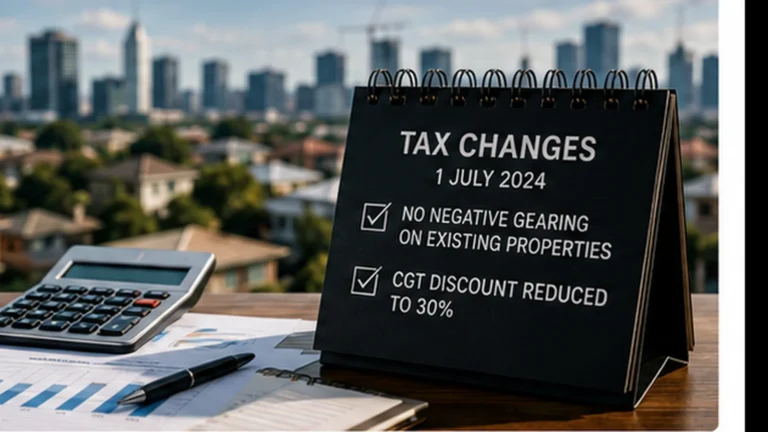
Australia’s property tax debate is moving beyond the usual fight over mum-and-dad landlords.
The next pressure point is build-to-rent.
A new Savills Australia analysis argues proposed Australian tax reforms may be less punitive than the UK’s current buy-to-let rules, partly because mortgage interest would still be deductible from rental income. But the bigger issue is not whether one investor group wins or loses.
It is whether the rules give enough confidence for long-term capital to keep funding new rental housing.
That is where build-to-rent tax changes become more than a tax story. They become a housing supply story.
The policy fight is shifting
Most of the investor tax debate has focused on negative gearing, capital gains tax and whether established-home investors receive too much support.
That argument is familiar.
Investors say tax settings help make rental housing viable. Critics say they inflate prices and tilt the market away from first-home buyers. Both sides have a point, depending on the suburb, the property type and the cycle.
Build-to-rent adds a different layer.
Build-to-rent means housing built specifically to be rented, usually held by a single institutional owner such as a fund, developer or major operator. It is not the same as a small landlord buying an established unit and renting it out.
The promise is scale. One project can add hundreds of rental homes at once.
The catch is that scale needs capital, and capital does not like unclear rules.
Why institutional investors care about tax certainty
A household investor often looks at tax after asking a simple question: can I hold this property without bleeding too much cash?
An institutional build-to-rent investor thinks differently.
They are comparing Australian rental housing against offices, logistics warehouses, overseas housing funds, infrastructure and listed property markets. The project has to compete for capital before it even gets built.
That means tax settings matter at the front end.
If the rules change too often, investors do not just demand a higher return. Some pause. Some redirect capital. Some wait until the policy dust settles.
That matters because Australia’s rental market is already short of slack. Vacancy risk is low for renters, but policy risk is rising for investors.
Australian Property Review has already covered the wider issue in Housing Investment Tax Changes Leave Supply Risk Unresolved. The core problem is similar here: a policy can be defensible on fairness grounds and still create supply friction if it weakens confidence in new housing delivery.
In plain English:
The government wants to reduce investor advantages in housing. But if the same policy settings make new rental projects harder to finance, renters may not get relief quickly. The risk is not an overnight collapse. It is a slower supply response.
Build-to-rent is not a free pass
None of this means build-to-rent should be treated as untouchable.
Institutional landlords still need scrutiny. Renters will want stable leases, fair rent increases, transparent fees and decent maintenance. Governments will want proof that concessions deliver extra homes, not just higher margins.
There is also a political problem.
Large landlords are not always popular. In a cost-of-living squeeze, giving tax support to big investors can look awkward, even if the policy is aimed at adding rental supply.
That is the trade-off.
Small investors are politically easier to understand, but fragmented. Institutional investors can deliver housing at scale, but they usually want predictable rules, tax clarity and planning certainty before committing.
If governments want more build-to-rent stock, they may need to accept that the policy design has to be boring, stable and bankable.
That will not make a great slogan. It may be what gets projects funded.
What changed and what did not
What changed is the direction of the debate.
Tax reform is no longer just about whether investors should get deductions or capital gains concessions. It is now about whether different types of housing investment should be treated differently.
New housing is not the same as bidding for established stock. A build-to-rent tower is not the same as one investor buying a 1980s unit at auction. A fund backing hundreds of rentals is not the same as a household investor buying one townhouse.
The policy question is whether the tax system can recognise those differences without becoming a loophole factory.
What did not change is the basic constraint.
Australia still needs more homes. Planning delays, construction costs, labour shortages, infrastructure bottlenecks and financing hurdles still shape the supply pipeline. Tax settings can help or hurt, but they cannot fix those problems alone.
That is why treating tax reform as a clean affordability lever is risky.
Australian Property Review made a similar point in Housing Tax Changes Raise New Supply Concerns. Weakening investor demand may help some buyers at the margin, but the supply response decides whether renters benefit or wear the cost later.
The second-order effect investors should watch
Now, the part most people miss.
The first-order effect of tax reform is obvious: some investors reassess returns.
The second-order effect is more important: developers, lenders and funders may reassess timelines.
A build-to-rent project can take years to plan, approve, finance and complete. If tax settings are uncertain, the decision may not be “build or do not build”. It may be “wait six months”, “resize the project”, “move capital to another sector” or “demand a higher return”.
That delay can matter.
Rental markets do not need a dramatic supply shock to stay tight. They only need new housing to arrive slower than household formation, migration and demand.
This is where tax uncertainty can become a rent problem.
Investors should not assume every industry warning is neutral. Developers and agents have commercial incentives. But they should not dismiss the warning either. Housing supply is slow. Confidence matters before cranes appear.
Who wins and who loses
The possible winners are first-home buyers who face less competition from tax-driven investors in established housing.
That is the cleanest case for reform.
The possible losers are renters if investor demand falls faster than new supply rises. A renter saving for a deposit does not benefit much from slightly less auction competition if their rent keeps climbing and their cashflow buffer shrinks.
Institutional investors may still proceed where projects stack up, especially in cities with deep renter demand and supportive planning settings. But marginal projects become more sensitive.
Small landlords face a different calculation. If tax settings reduce after-tax returns, they may shift towards newer dwellings, higher-yield suburbs or simply hold existing assets longer.
That behaviour matters because investor supply is not just about purchases. It is also about whether existing rentals stay in the market.
For related context, read Australian Property Review’s coverage of Negative gearing changes put housing supply on notice and CGT Changes Put Housing Supply Fight Back in Spotlight.
The practical take
For property investors, the next move is not to panic over a headline.
Pressure-test three things.
First, check whether your strategy depends mainly on tax treatment or whether the property still works on yield, vacancy risk and long-term demand.
Second, separate established-property investing from new supply exposure. The policy direction may increasingly favour investment that adds homes rather than competes for existing stock.
Third, keep a bigger cashflow buffer than the old cycle required. Tax rules, interest rates, insurance, strata costs and maintenance are all moving parts. A thin buffer turns policy uncertainty into forced selling risk.
The base case is not that build-to-rent tax changes kill institutional housing investment. The base case is that they raise the importance of clarity.
If governments want private capital to help solve the rental shortage, they need rules that investors can model before committing billions.
If investors want to stay in the game, they need to stop treating tax settings as permanent.
Start here: review your current property assumptions under a lower-tax-benefit, higher-cost scenario before making your next move.
Subscribe to the free Australian Property Review newsletter for weekly property market signal
General info, not financial advice.