Housing supply is now one of the most important signals for property investors in 2026.
Not because demand no longer matters. It does.
But the next phase of the Australian property market may be decided less by how many buyers want a home and more by how many homes actually make it from planning documents to keys in doors.
That distinction matters.
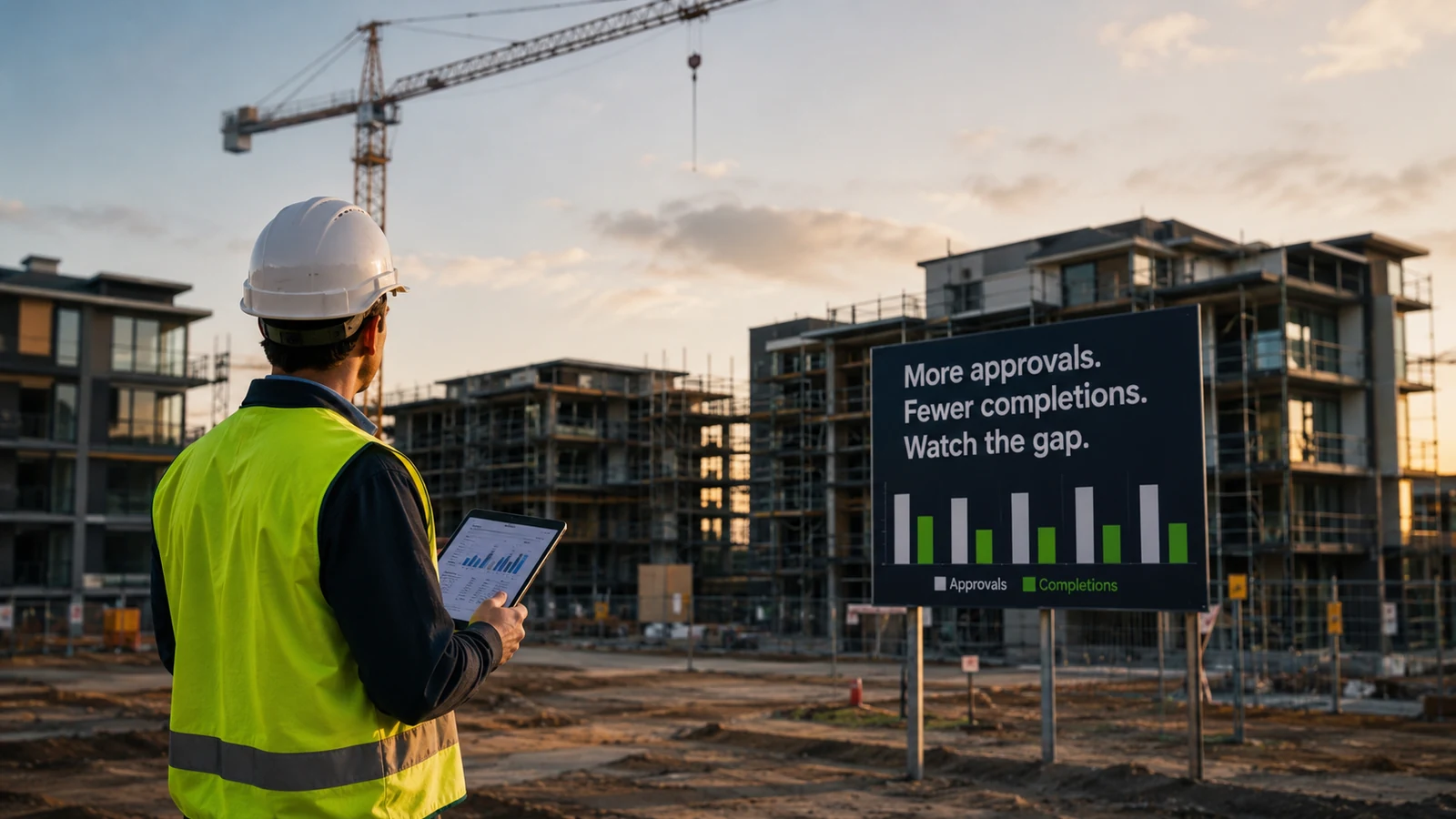
A dwelling approval is permission to build. A completion is a finished home. The gap between those two numbers is where a lot of market calls can go wrong.
The federal government’s Housing Accord target is 1.2 million new homes over five years from mid-2024, according to Treasury. That means Australia needs to average about 240,000 homes a year. The problem is that the pipeline still looks uneven, and the delivery side remains under pressure from labour shortages, financing costs, planning delays and higher building costs. (Treasury)
The market signal investors should stop ignoring
Most property commentary starts with demand.
Population growth. Migration. Interest rates. Borrowing power. First-home buyer incentives. Investor lending.
All of that matters. But demand is only one side of the market.
The other side is supply: how many properties are available, how many new homes are being built, and how quickly those homes can be delivered.
If demand softens but supply remains tight, prices do not automatically fall. They may flatten, split by city, or keep rising in undersupplied pockets.
That is the part investors need to pressure-test.
The Australian Bureau of Statistics said total dwelling approvals fell 1.1 per cent in May 2026 to 17,019 in seasonally adjusted terms. Private sector houses rose 2.8 per cent, while private sector dwellings excluding houses fell 10.4 per cent. (Australian Bureau of Statistics)
So the picture is mixed.
House approvals improved. Higher-density approvals weakened. Total approvals were still nowhere near the annual pace required to comfortably hit 240,000 homes a year.
Australian Property Review has already covered this problem in Dwelling approvals rise, but supply risks remain, where the key point was simple: approvals can bounce without solving the delivery problem.
Approvals are useful. Completions are decisive
Here’s the catch.
An approval does not house anyone.
It tells investors that a project may be coming. It does not tell them whether the builder can make the numbers work, whether finance is locked in, whether materials arrive on time, or whether the project gets delayed by labour shortages.
That is why completions matter more than approvals when assessing actual supply.
For investors, this is not an academic point. It changes how you read the market.
If approvals are rising but completions are weak, the market may still feel tight on the ground. Listings can remain limited. Rents can stay under pressure. Buyers can still compete for scarce stock.
If completions start rising meaningfully, especially in the right suburbs and price brackets, the balance can shift.
That is when investors need to watch vacancy rates, days on market, rental growth and discounting more closely.
In plain English:
Approvals show possible future supply. Completions show real supply. Investors should watch both, but prices respond most directly to what actually reaches the market.
Why this matters more in 2026
The old lazy line is that Australian property always rises over time.
That may be broadly true across long periods, depending on the market and the asset. But it is not useful enough for decision-making.
Investors do not buy “Australia”. They buy a specific property, in a specific street, with a specific loan, at a specific price.
A national average can hide large differences between Brisbane and Melbourne, houses and apartments, inner suburbs and fringe estates, or investor-grade stock and owner-occupier stock.
Australian Property Review recently wrote about this split in Property Investment Faces Its Hardest Test In Years. The practical question is no longer just whether property rises over 20 years. It is whether a specific asset can survive the next five years if growth is slower, rates stay higher, and costs keep biting.
Supply is central to that question.
A market with tight supply can support prices even when confidence weakens. A market with rising supply, weak rents and stretched buyers can behave very differently.
The construction bottleneck has not disappeared
The problem is not just planning.
Australia can approve more homes and still fail to deliver enough homes if the construction sector cannot build them profitably.
Developers need pre-sales, finance, trades, materials and enough margin to justify the risk. Builders need labour and cashflow. Buyers need bank approval. Local governments need to process infrastructure, zoning and design requirements.
Any one of those can slow the pipeline.
That is why the cost side matters.
Higher construction costs do two things at once. They make new homes more expensive to build, and they make some projects harder to justify. If the final sale price needed to make a project viable is too high for buyers, the project may sit on paper rather than move to construction.
That is one reason the approval-to-completion gap deserves more attention.
The political story may be “more homes are coming”. The investor question is sharper: where, when, at what price, and in what form?
What changed and what did not
What changed is the policy pressure.
Governments know supply is the affordability lever they can no longer ignore. Planning reform, new-build incentives, apartment delivery, build-to-rent and investor tax settings are all being pulled into the same debate.
Australian Property Review has covered how tax settings are pushing some investor attention toward new apartments in Negative gearing shake-up hits new apartments. That matters because investor capital can help projects get funded, but it can also crowd first-home buyers into the same lower-priced new stock.
What has not changed is the core constraint.
Australia still needs more completed homes in the places people want to live. That is harder than announcing a target.
The supply pipeline is not a single tap. It is a long chain. Land, zoning, feasibility, finance, construction and settlement all need to line up.
If one link fails, the finished home does not arrive.
The investor rule of thumb
A simple rule of thumb: do not treat low supply as a free pass.
Low supply can support a market. It does not rescue every deal.
If you overpay, buy poor-quality stock, ignore body corporate costs, assume constant capital growth, or stretch your cashflow too far, a shortage will not protect you from a bad investment.
This is where investors need to separate the macro story from the asset story.
The macro story may say Australia is undersupplied.
The asset story asks:
- Is this property scarce in its local market?
- Is similar stock being built nearby?
- Is the rent strong enough after costs?
- Is vacancy risk low?
- Is the buyer pool deep if you need to sell?
- Does the deal still work if growth is flat for two years?
If the answer depends entirely on prices rising quickly, the margin for error is thin.
What would change the outlook
There are several signs that would make the supply story less supportive for prices.
First, completions would need to lift, not just approvals. A broad and sustained rise in finished homes would matter more than one strong approval month.
Second, listings would need to rise in the same markets where buyer demand is weakening. More choice changes negotiation power.
Third, rental vacancy would need to loosen. If vacancy rises and rents stop growing, investor cashflow assumptions become more fragile.
Fourth, borrowing power would need to deteriorate further. Even a tight housing market can slow if buyers cannot pass serviceability tests.
Finally, construction costs would need to stabilise enough for more projects to become viable. Without that, the pipeline can stay clogged.
Australian Property Review has also examined the broader shortfall problem in Australia’s housing shortfall and house price outlook, where the key tension was that national shortages can support prices while individual borrowers still make poor decisions.
That remains the practical point.
The second-order effect: renters and first-home buyers
Supply shortages do not only affect investors.
They hit renters first through vacancy and rent pressure. They hit first-home buyers through competition for entry-level stock. They hit upgraders when limited listings make it harder to buy before selling. They hit developers when feasibility becomes too tight to start new projects.
For investors, this creates both opportunity and risk.
A tight rental market can support income. But higher prices, higher rates, insurance, land tax, maintenance and body corporate fees can still squeeze returns.
That is why yield matters.
Yield is annual rent divided by property value. It is a quick way to compare income against price, but it is not the whole story. Investors still need to account for debt costs, vacancy, repairs, tax, fees and future resale demand.
Bottom line
Housing supply is not just a policy issue. It is now a market signal.
Investors who only watch interest rates and population growth may miss the bigger shift. The key question for 2026 is not whether Australia needs more homes. It clearly does.
The sharper question is whether enough homes can be completed quickly enough to change the balance in specific markets.
Start here: before buying, compare local listings, recent sales, vacancy, rents and the new supply pipeline within the suburb, not just the city.
For more clear property market analysis, subscribe to the free Australian Property Review newsletter.
General info, not financial advice.