Capital gains tax changes are no longer a narrow argument about how much tax an investor pays when an asset is sold.
They have become a test of where Australian capital goes next.
The federal government argues its tax package will improve fairness, encourage investment in new housing and help more Australians become homeowners. Business and investment groups are warning that poorly designed exemptions could instead discourage risk-taking, make Australian start-ups less competitive and push capital offshore.
Both arguments deserve scrutiny.
The key question is not whether the tax system should change. It is whether the new settings move money into productive businesses and additional housing, or simply move investors from one constrained part of the economy to another.
A housing tax story with a much wider reach
From 1 July 2027, the government will replace the flat 50 per cent capital gains tax discount with inflation-adjusted cost-base indexation and a minimum 30 per cent tax rate on real capital gains.
Negative gearing will also be limited largely to new residential builds. Properties held before 7.30pm on 12 May 2026 are grandfathered, while qualifying new builds will retain more favourable treatment. The government estimates the wider housing package could support an additional 75,000 homeowners over a decade. That remains a forecast, not a guaranteed result. (Consult hub)
The stated logic is straightforward.
Reduce the tax advantage attached to buying established homes. Preserve an incentive to fund new construction. Give owner-occupiers a better chance when competing for existing properties.
Here’s the catch. Tax rules do not only affect who bids at an auction. They influence where investors place capital across housing, shares, private companies, venture funds and other assets.
That is why the debate has spread well beyond landlords.
The start-up carve-out has become the pressure point
Treasury has proposed an Innovative Business CGT Concession intended to protect investment in qualifying start-ups.
Its consultation tested a 10-year company age limit, a $50 million turnover ceiling and a five-year minimum holding period. Industry objections have also focused on a proposed $10 million lifetime limit for individual investors. Critics argue that the settings may exclude businesses just as they begin needing larger amounts of expansion capital. (Consult hub)
The Australian Investment Council represents venture capital, private equity and other private-capital investors. It says its members support about 700,000 jobs, back 2,200 businesses and contribute $120 billion to the Australian economy each year.
The council’s concern is that a narrow concession could protect very early-stage companies but become less useful when those businesses start scaling.
That matters in industries where commercialisation is slow and expensive. Artificial intelligence, advanced manufacturing, biotechnology and defence technology can require years of investment before producing reliable profits.
Investors can also move more easily than housing.
A property cannot be shifted to Singapore or the United States. A funding round, corporate headquarters or intellectual-property structure can.
Industry groups naturally have an interest in lower taxes and broader concessions. Their preferred model should not be accepted without examining its cost to revenue.
But dismissing the concern entirely would also be risky. Capital is mobile, and Australia competes internationally for founders, specialist workers and long-term investment.
In plain English
Tax policy does two jobs at once. It raises revenue and changes behaviour. A reform can collect more from successful investments while also making fewer investors willing to fund the next one.
Capital is already being redirected inside housing
The property side shows how quickly incentives can alter attention.
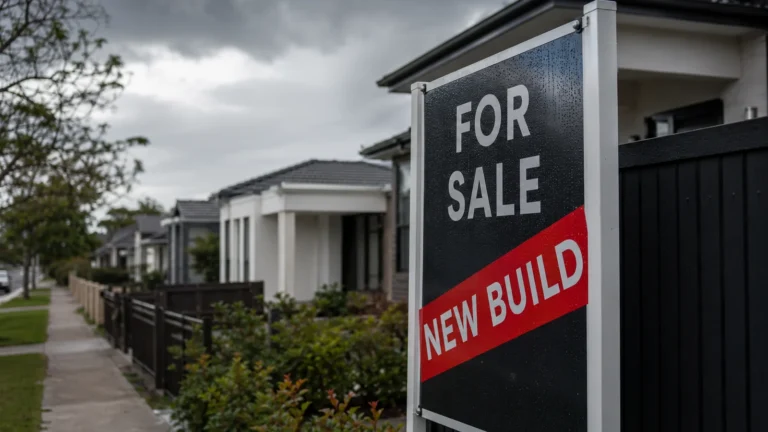
By reserving negative gearing for new builds, the government has given investors a reason to look at new apartments, townhouses and house-and-land packages rather than established homes.
Australian Property Review has already examined how the negative gearing shake-up is steering investors towards new apartments.
Developer Meriton reported a 20 per cent increase in investor traffic through display centres after the Budget. That is an early indicator, not proof of completed sales. It does, however, show that buyers are reconsidering their shopping lists. (Australian Property Review)
The government’s parliamentary agreement with the Greens also included restrictions preventing self-managed superannuation funds from being used to borrow for residential property investment. That closes another pathway that some investors might otherwise have used to keep buying established homes. (ABC News)
Some redirected investment could help developers reach their pre-sale targets and secure construction finance.
That is the best-case scenario. Investor demand supports viable projects, more homes are built and the eventual increase in supply reduces pressure across both ownership and rental markets.
The downside is a timing mismatch.
Investors can shift demand within weeks. Planning, financing and constructing a medium-density project can take years.
First-home buyers may face a crowded entry lane
New homes are not a separate market reserved for investors.
Compact townhouses, outer-suburban house-and-land packages and lower-priced apartments are also the products most commonly targeted by first-home buyers.
Push both groups towards the same limited stock and the early result may be more competition, particularly around government scheme limits and lower price brackets.
That does not mean first-home buyers receive no benefit.
Investor demand for established homes may weaken in some suburbs. Fewer investor bidders could improve negotiating conditions for owner-occupiers, particularly where rental yields are already low and investors are highly sensitive to tax treatment.
But a cheaper purchase price does not automatically create affordability.
A buyer still needs a deposit, loan approval and enough income to handle repayments. Someone saving while paying record rent may struggle to benefit from softer prices if their borrowing capacity is also under pressure.
This is why Australian Property Review previously warned that new-build tax incentives could crowd first-home buyers out of the same entry-level projects.
The policy may reduce competition in one market while increasing it in another.
Rents are rising, but the cause is not settled
Australian rents have continued to rise sharply.
Australian Property Review recently reported Cotality median weekly rents of about $841 in Sydney, $784 in Perth, $734 in Brisbane and $641 in Melbourne. The typical household was estimated to be spending roughly one-third of gross income on rent in March, up from about 27 per cent five years earlier. (Australian Property Review)
Those figures are serious.
They should not, however, be treated as proof that several weeks of federal tax reform caused the entire increase.
Rental prices reflect population growth, household formation, vacancy, wages, interest expenses, insurance, land tax and the volume of available housing. The tax changes may affect landlord decisions at the margin, but separating that effect from the existing shortage will take time.
The supply figures provide the more immediate warning.
ABS data shows total dwelling commencements fell 11.2 per cent in the March 2026 quarter. Private-sector commencements for apartments, townhouses and other non-house dwellings fell 20.7 per cent. In May, total dwelling approvals fell another 1.1 per cent, with non-house approvals dropping 10.4 per cent. (Australian Bureau of Statistics)
That weakness predates the full implementation of the tax reforms.
It means the government is redirecting investors towards a construction pipeline that is already struggling with feasibility, finance, labour and delivery.
Australian Property Review examined the same constraint in Housing Accord Falls Behind as New Builds Slide.
The policy could eventually support more building. The risk sits in the gap between investor demand shifting and completed homes arriving.
The budget is leaning harder on workers
The tax debate also sits inside a wider budget problem.
The Parliamentary Budget Office projects personal income taxes will rise from 47.9 per cent of total government revenue in 2026-27 to 53.8 per cent by 2036-37.
It expects personal income tax to be the only major revenue source that rises materially as a share of the economy over that period, largely because of bracket creep. Other major revenue sources are projected to remain broadly flat. (Parliamentary Budget Office)
Bracket creep occurs when wage increases push taxpayers into higher effective tax rates, even when their purchasing power has not improved by the same amount.
That creates an uncomfortable policy choice.
Governments can rely more heavily on personal income tax, restrain spending, find new tax bases or improve economic growth enough to generate additional revenue without continually lifting the burden on workers.
Investment and productivity matter because they affect the size of that economic base.
A better-designed start-up concession would not solve Australia’s budget problem by itself. Nor should every investment be tax-exempt simply because it is labelled innovative.
But rules that discourage productive risk-taking can make the broader problem harder.
Lower business investment can mean weaker productivity, slower wage growth and a smaller future tax base. Poorly targeted property concessions can also steer too much capital towards existing assets rather than new businesses or additional homes.
The issue is not tax versus growth.
It is whether the tax system raises revenue while causing the least damage to worthwhile investment.
Three tests that would improve the outcome
The first test is whether the start-up concession works beyond the smallest funding rounds.
Treasury should pressure-test its company-age, turnover, holding-period and lifetime limits against the real funding cycles of capital-intensive businesses. A concession that expires before a company reaches commercial scale may look generous on paper while doing little in practice.
The second test is whether housing supply responds.
Government should publish regular figures covering investor lending for new builds, project pre-sales, dwelling commencements, completions and rental listings. More investor inquiries are not enough. The objective is more completed homes.
The third test is distribution.
Policymakers need to track whether first-home buyers gain access to established homes or simply face stronger investor competition in new estates. Changes in prices, rents, borrowing volumes and buyer type should be measured separately across market segments.
That would allow the reforms to be judged on outcomes rather than political claims.
The practical take
Property investors should not make a decision based on tax treatment alone.
A new build still needs to work after allowing for purchase premiums, rental yield, vacancy, strata or estate costs, settlement risk and resale competition. A useful rule of thumb is simple: if the investment only works because of the concession, the numbers need another look.
First-home buyers should not assume the exit of some established-property investors will make purchasing easy.
Pressure-test repayments at a higher interest rate, allow for ownership costs and compare established homes with new projects where investor demand may be increasing.
Business owners and start-up investors should model the proposed rules before committing to a structure or exit timetable. The final concession design may materially change the after-tax outcome.
The broader lesson is that capital gains tax changes cannot be assessed one asset at a time.
The same policy package is affecting start-up finance, established housing, new development, rents and household taxation. The government may still achieve its stated objectives, but only if new investment and housing supply respond faster than the unintended pressure builds.
For weekly analysis of housing policy, rates, credit and property markets, subscribe to the free Australian Property Review newsletter.
General info, not financial advice.