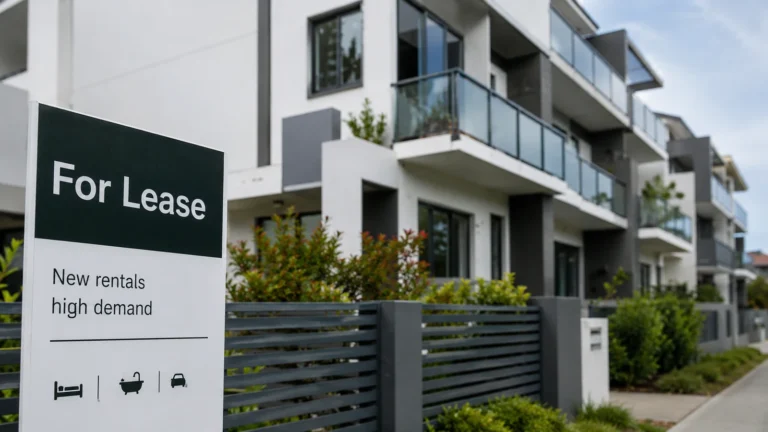
Clearance rates have dropped from 71.9 per cent to 47.9 per cent in twelve months, and a large segment of the vendor pool has responded by stepping away entirely. Survey data from Seniors First shows 33.7 per cent of homeowners over 55 are delaying sales, with 62.2 per cent now saying they would prefer accessing equity through a reverse mortgage rather than testing the downsizing property market under current conditions. With more than 5.5 million Australian homeowners aged over 55 according to the ABS, that hesitation translates into a meaningful supply constraint at a time when listings are already thin.
The pattern is straightforward. Vendors who were planning to downsize into a smaller property or relocate to a lifestyle precinct are watching weekend auctions and deciding the trade-off no longer makes sense. Capital gains tax liability on any profit, stamp duty on the replacement property, and the risk of a lower sale price combine to push the decision into the too-hard basket. Instead, interest in reverse mortgages has climbed as retirees look for ways to unlock cash without the transaction friction or market-timing risk.
Why confidence collapsed
Clearance rate declines of this magnitude shift vendor behaviour quickly. When seven out of ten auctions were clearing last year, downsizers could move with reasonable confidence that their property would sell close to expectation. At under 50 per cent, that certainty evaporates. The fear is not just a lower price but the possibility of sitting on market through multiple campaigns, burning holding costs and watching comparables reset lower each weekend.
Capital gains tax adds another layer. While the principal residence exemption covers the family home, any period of rental use or investment overlay can trigger a partial liability. For retirees who may have rented out part of the property or used it for income in prior years, the tax bill on a sale can be material. Stamp duty on the next purchase then compounds the friction, especially in New South Wales and Victoria where concessions for downsizers remain limited compared to other states.
The reverse mortgage trade-off
A reverse mortgage allows homeowners to borrow against the equity in their property without making repayments during their lifetime. Interest compounds monthly, and the loan is repaid when the borrower sells, moves into aged care, or passes away. For retirees who are asset-rich but cash-constrained, it can unlock liquidity without the hassle of moving or the risk of a weak sale.
The catch is the compounding. Because no repayments are made, interest accrues on an ever-growing balance. Rates on reverse mortgages typically sit higher than standard variable home loans, often in the 6 to 8 per cent range depending on the lender and loan-to-value ratio. A lump-sum drawdown of $200,000 at 7 per cent annual interest will grow to around $280,000 after five years, $390,000 after ten, and $545,000 after fifteen, assuming no additional drawdowns and no repayments. That compounds quickly, and the equity remaining for the estate or future sale shrinks accordingly.
Families are often surprised when the loan is settled. If the property was worth $1 million when the reverse mortgage was taken out and $200,000 was drawn, the borrower might expect $800,000 to remain. But if fifteen years pass and the loan has compounded to $545,000, only $455,000 is left assuming no price growth. If the property appreciated to $1.3 million over that period, the net position improves, but the compounding cost is still significant. The longer the loan runs, the more equity it consumes.
What this does to supply
When a third of the over-55 cohort delays downsizing, the supply pipeline loses a meaningful chunk of stock. Retirees moving out of three- and four-bedroom homes in established suburbs have historically been a key source of mid-tier family housing. Those properties tend to be well-located, already on infrastructure, and priced within reach of upgrading owner-occupiers. When that turnover stalls, it creates a bottleneck.
The effect is most visible in markets where downsizer activity has traditionally been high: inner and middle-ring suburbs in Sydney, Melbourne and Brisbane, coastal precincts in Queensland and northern New South Wales, and lifestyle zones around Perth and Adelaide. Investor activity has shown tentative signs of recovery in some of these markets, but the absence of downsizer listings means fewer opportunities for buyers at the upper end of the first-home and upgrader segments.
The supply gap also shows up in rental markets. Some retirees who defer downsizing choose to rent out part of their property or take in a boarder to generate income, which adds marginal rental supply but does not solve the ownership turnover problem. Others simply stay put, which tightens the stock available for sale without adding any rental capacity at all.
Policy levers that could shift behaviour
Two settings stand out as practical tools to ease the downsizing bottleneck. The first is stamp duty. Several states already offer concessions for over-55s or over-60s who downsize, but eligibility thresholds and discount levels vary widely. New South Wales provides a concessional rate on properties up to $800,000 for eligible pensioners, but the cap excludes much of the Sydney market. Victoria offers no broad downsizer concession at all. South Australia and Western Australia have more generous settings, with partial or full exemptions for qualifying retirees buying below certain price points.
Broadening those concessions and lifting the price caps would reduce the transaction cost and make downsizing more financially viable, especially in high-value markets where retirees hold significant equity but face steep stamp duty bills on replacement properties. Mortgage applications have fallen 26 per cent under current settings, and while rate pressure is the primary driver, transaction costs layer on top.
The second lever is the downsizer superannuation contribution. Homeowners aged 55 and over can contribute up to $300,000 from the proceeds of selling their home into superannuation without it counting toward contribution caps. The measure was introduced in 2018 and remains underutilised, partly because awareness is low and partly because many retirees are already drawing down super rather than adding to it. Increasing the cap or allowing partial contributions after downsizing into a rental or granny flat could widen its appeal and give retirees more flexibility in how they structure the transition.
Capital gains tax settings are harder to adjust without creating distortions elsewhere, but clarity around partial exemptions and simplified calculations for mixed-use properties would reduce some of the friction. The current rules are complex enough that many retirees defer the decision rather than engage with the tax implications, even when the liability is modest.
Base case and risks
If clearance rates stay below 50 per cent through the next six months, expect downsizer hesitation to deepen. Retirees who might have tested the market in spring will wait for a clearer recovery signal, and reverse mortgage uptake will continue to climb. That keeps supply constrained and maintains upward pressure on prices in the segments where downsizers typically sell, even as broader market sentiment remains weak.
Upside scenario: clearance rates recover to the low 60s by mid-year as interest rate expectations stabilise and buyer confidence returns. That would bring some downsizers back into the market, easing the supply bottleneck and giving upgraders more stock to choose from. Policy changes around stamp duty or super contributions would accelerate that shift.
Downside scenario: rates stay elevated longer than expected, clearance rates drift lower, and the retiree cohort locks in for another twelve months. That compounds the supply problem and widens the gap between family housing demand and available stock in established suburbs. Reverse mortgage balances grow, equity erodes, and when those properties do eventually come to market, the net proceeds are lower and the capacity to fund aged care or estate planning is reduced.
Practical next step
If you are over 55 and considering downsizing, model the full transaction cost: sale price minus agent fees and marketing, stamp duty on the next property, capital gains tax if applicable, and moving expenses. Compare that to the cost of a reverse mortgage over five, ten and fifteen years at realistic interest rates. If the reverse mortgage saves you a weak sale today but costs you $200,000 in compounding interest over a decade, the timing trade-off needs to be explicit.
If you are a buyer waiting for downsizer listings to ease competition, understand that policy changes would unlock supply faster than a market recovery. Watch for state budget announcements around stamp duty and track federal budget commentary on superannuation settings. Those shifts matter more than monthly clearance rate moves.
Subscribe to the newsletter for weekly analysis on supply dynamics, policy shifts, and what drives turnover in the markets that matter.
General info, not financial advice.