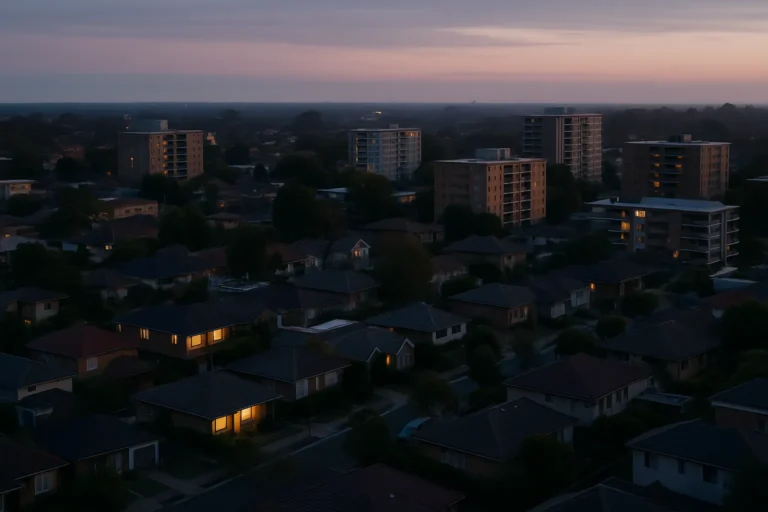
A revised bank forecast is shining a light on what happens when property prices fall faster than mortgage balances. ANZ now expects Sydney dwelling prices to drop 14.5% peak to trough, with the median house sliding from $1.63 million in January 2026 to $1.39 million by mid-2027. For buyers who entered the market with 10% or smaller deposits over the past year, that trajectory lands them firmly in negative equity territory before they’ve owned the property for two years.
The math is blunt: a buyer who paid the median Sydney price in January with a 5% deposit would owe roughly $128,000 more than the property is worth by the middle of next year, even after making standard principal-and-interest repayments for 17 months. A 20% deposit buyer in the same scenario keeps 8% equity.
The numbers that matter
Key numbers
- Sydney median house forecast to fall $236,312 from January 2026 peak to mid-2027 trough
- 5% deposit buyer at peak: -9% equity by mid-2027, owing $128,322 more than property value
- 20% deposit buyer: retains 8% equity under same scenario
- Low-deposit lending (5% or less): $10.2 billion approved Oct 2025–Mar 2026, up 51% on prior period
- Share of new owner-occupier loans with 5% or smaller deposits: 4.3%, a record high
Melbourne is tracking a similar pattern with a projected 12.8% decline, translating to a $127,577 drop in the median. Brisbane, Adelaide and Perth are forecast to shed between $50,000 and $100,000 each, with Adelaide’s 9.8% fall the sharpest outside the two largest capitals.
Why low-deposit exposure is climbing
The volume of mortgages written with 5% deposits or less has jumped sharply. In the six months to March 2026, lenders approved $10.2 billion in new owner-occupier loans at that deposit level, a 51% increase on the previous half year. That surge followed the government’s decision to remove caps on the Home Guarantee Scheme in October 2025, opening the scheme to unlimited participants and effectively normalising single-digit deposits as a common entry route.
Low-deposit loans now represent 4.3% of all new owner-occupier mortgages, the highest proportion on record according to prudential regulator data. The timing matters: many of those buyers entered the market near the price peak, meaning they bought into a falling market with minimal equity buffers.
What negative equity actually changes
Being underwater on a mortgage is not a default trigger if repayments continue. The property still functions as a home, and prices move in cycles. ANZ’s own forecast expects a recovery to begin in the second half of 2027 when the central bank is projected to start cutting rates.
The real constraints appear when circumstances force a sale or when a borrower wants to refinance. A buyer in negative equity who needs to sell to relocate, separate or manage financial stress must cover the shortfall in cash at settlement. Refinancing becomes difficult or impossible because lenders assess loan-to-value ratios at current market prices, not purchase prices. That means borrowers locked into higher rates can’t easily switch to cheaper deals at precisely the moment rate cuts would make refinancing most valuable.
The serviceability buffer is another pressure point. Lenders typically assess loans at rates 3 percentage points above the actual rate to ensure borrowers can handle future increases. When equity disappears, that buffer shrinks in real terms because the borrower has less financial flexibility to absorb income shocks, job loss or emergency expenses. Some lenders may respond by tightening credit conditions further or repricing risk, which would make it harder for marginal buyers to enter or existing borrowers to restructure.
Scenarios for the next 18 months
Base case: prices fall in line with ANZ’s forecast, negative equity materialises for a cohort of recent low-deposit buyers, but most continue repayments and ride out the cycle until the recovery begins in late 2027. Refinancing activity stalls, household consumption stays weak, but default rates remain low.
Upside: the Reserve Bank cuts rates sooner than expected, confidence rebounds, migration stays elevated, and prices stabilise or recover faster than forecast. Low-deposit buyers avoid negative equity or exit it quickly.
Downside: a recession, job losses or credit tightening accelerates price falls beyond ANZ’s forecast. Negative equity widens, forced sales increase, and lenders pull back on refinancing and new low-deposit lending. Default rates tick up, particularly among recent buyers with thin equity and high debt-to-income ratios.
Risks to watch
Unemployment is the trigger variable. If the jobless rate climbs above 4.5%, repayment stress will shift from uncomfortable to unsustainable for a segment of recent buyers. Migration flows are another unknown: if net overseas migration falls sharply due to visa policy changes or economic conditions offshore, rental demand softens and price falls could extend beyond current forecasts.
Lender behaviour is less predictable than the economic data. If banks begin treating low-deposit loans as higher risk and reprice or restrict them, the supply of credit contracts just as prices are falling, which can accelerate the decline. The inverse is also possible: lenders may tolerate negative equity positions to avoid crystallising losses through foreclosure, giving borrowers time to rebuild equity as rates fall.
The practical take
If you bought in the past 12 months with a deposit under 10%, the priority is building a cash buffer outside the mortgage. That means accelerating offset account balances, cutting discretionary spending, and avoiding new debt. The goal is not to pay down the mortgage faster but to create liquidity that can cover repayments if income drops or an emergency expense hits.
For prospective buyers, a $200,000-plus fall in Sydney prices would open entry points that were out of reach a year ago. The catch is timing: trying to pick the bottom risks missing properties that fit your needs, and if ANZ’s forecast is wrong on the upside, prices could stabilise sooner than mid-2027. The trade-off is between waiting for further falls and locking in borrowing capacity while serviceability is still accessible.
Sydney’s housing supply plan targeting 800,000 homes across three CBDs is a multi-year pipeline that won’t impact prices in the short term, but it does signal where zoning and density are heading, which matters for location decisions now. Supply hitting seven-year highs while clearance rates collapse is another data point confirming the current imbalance, and it reinforces that buyer power is shifting.
If you’re weighing a purchase decision in the next six months, model your serviceability at rates 1-2 percentage points higher than today’s, even if cuts are coming. The equity wipeout scenario shows what happens when prices move against you: you need enough buffer to absorb that risk without being forced into a sale or trapped in an unaffordable loan.
Subscribe to the newsletter for weekly analysis on what’s moving markets and what it means for your next decision.
General info, not financial advice.