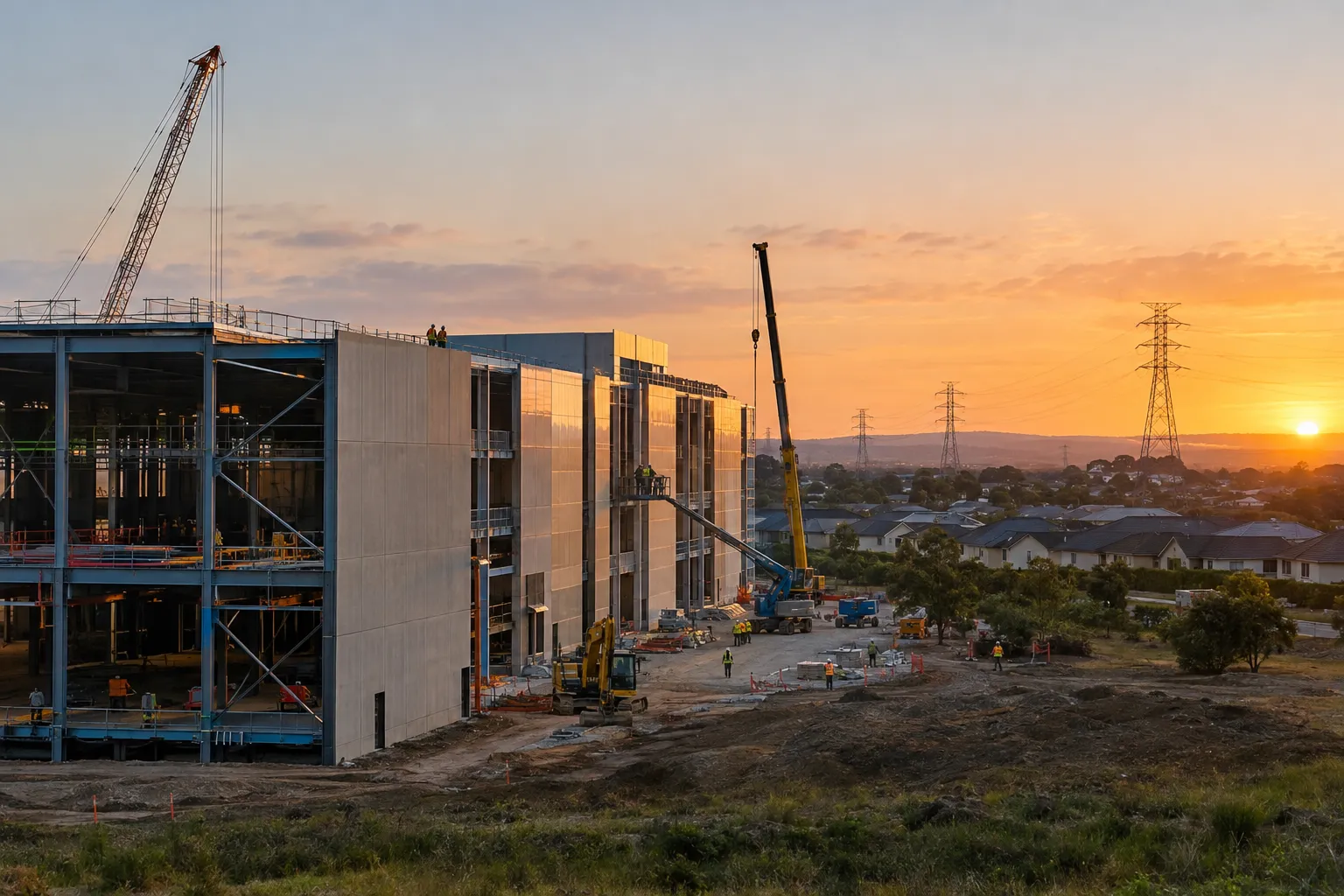
Data centre construction has overtaken offices and warehouses combined, and the gap is not small. In 2025 to 2026, about $18.2 billion of work started in the category that covers data centres, according to the latest Australian Bureau of Statistics building figures. Warehouses managed $10 billion. Offices managed $7.3 billion.
Five years ago this was a footnote. In 2019/20 the category ranked fourteenth out of fifteen non-residential building types. Last year it ranked first. That is a structural shift in where commercial construction money is going, and it lands in the same labour market that housing depends on.
A pipeline that is long and slow
The size of the starts is only half the picture. Over the latest financial year, about $6.4 billion of work was carried out, but only $2.4 billion of projects were completed. At the end of June, $18.3 billion was still to be built.
In plain English, these projects take a long time. They progress more slowly than a typical commercial fit-out or warehouse, so crews and materials stay tied up for longer. A big backlog also means the demand for trades does not fall away quickly.
Key numbers
- $18.2 billion of data centre work started in 2025-26
- $10 billion for warehouses and $7.3 billion for offices
- $6.4 billion built in the year, $2.4 billion completed
- $18.3 billion still to build at the end of June
Where housing feels it
Here is the catch. A data centre employs thousands of tradespeople while it is being built, then needs just 20 to 50 permanent staff once it is running. The construction phase draws heavily on electricians, concreters, steel fixers and project managers. Those are the same people needed to hit housing supply targets.
The source figures do not say how many tradespeople are being drawn away from residential work, so any precise crowding-out number would be a guess. The direction, though, is easy to reason about. When one sector bids hard for a limited pool of skilled labour, wages and costs rise across the board, and homebuilders usually have thinner margins to absorb it. Our earlier look at construction costs lifting 1% in a quarter showed new homes feel cost pressure first. A long data centre pipeline adds to that pressure rather than easing it.
There is also an inflation link. The central bank has cited the boom as one contributor to persistent inflation, which has fed into rate rises and softer property prices. That is a second-order effect worth holding onto: spending on server halls can indirectly affect borrowing costs for a household trying to buy in Western Sydney.
Power is the other bottleneck
Trades are one constraint. Electricity is the other. The market operator forecasts that data centre consumption in the south-east will triple by 2030 and reach 13 per cent of national demand by 2036.
Research by Primara for a renewable energy firm went further, putting data centres at 66 per cent of electricity demand in NSW and 33 per cent in Victoria. Treat that as one commissioned estimate, not a settled number. But it points the same way as the operator’s forecast, and the firm’s founder has urged government planning for grid impacts.
Why does this matter for property? New housing estates need grid connections too. Where large loads take priority for network capacity, residential and mixed-use projects can face longer waits or higher connection costs. The source does not quantify that, so the reasonable reading is risk, not certainty.
What it means for commercial property allocation
For investors, the signal is mixed. Data centres are a growing, purpose-built asset class, and demand is clearly strong. But the long build times, heavy power needs and tiny permanent workforce make them different from offices or logistics. They do not generate the foot traffic or tenant churn of a conventional commercial building.
The warehouse side is worth watching alongside this. Our piece on industrial property vacancy tightening covered how tight that market already is. If data centres draw capital and trades toward themselves, new industrial supply could stay thin for longer.
A simple rule of thumb: when a single asset class jumps from fourteenth to first in five years, ask what has to give elsewhere. Labour, power and capital are finite.
What would change the picture
A few things could shift this. Faster project delivery would clear the backlog sooner. Government grid planning could ease connection risk. And a slowdown in data centre investment would release trades back to housing, though that would bring its own questions about the pipeline.
The numbers say the boom is real. They do not say how much housing it displaces. The honest position is that the pressure is likely, the size is unknown, and the next few quarters of building and cost data will show more.
Subscribe to the Australian Property Review newsletter for the weekly signal on supply, costs and credit.
General info, not financial advice.