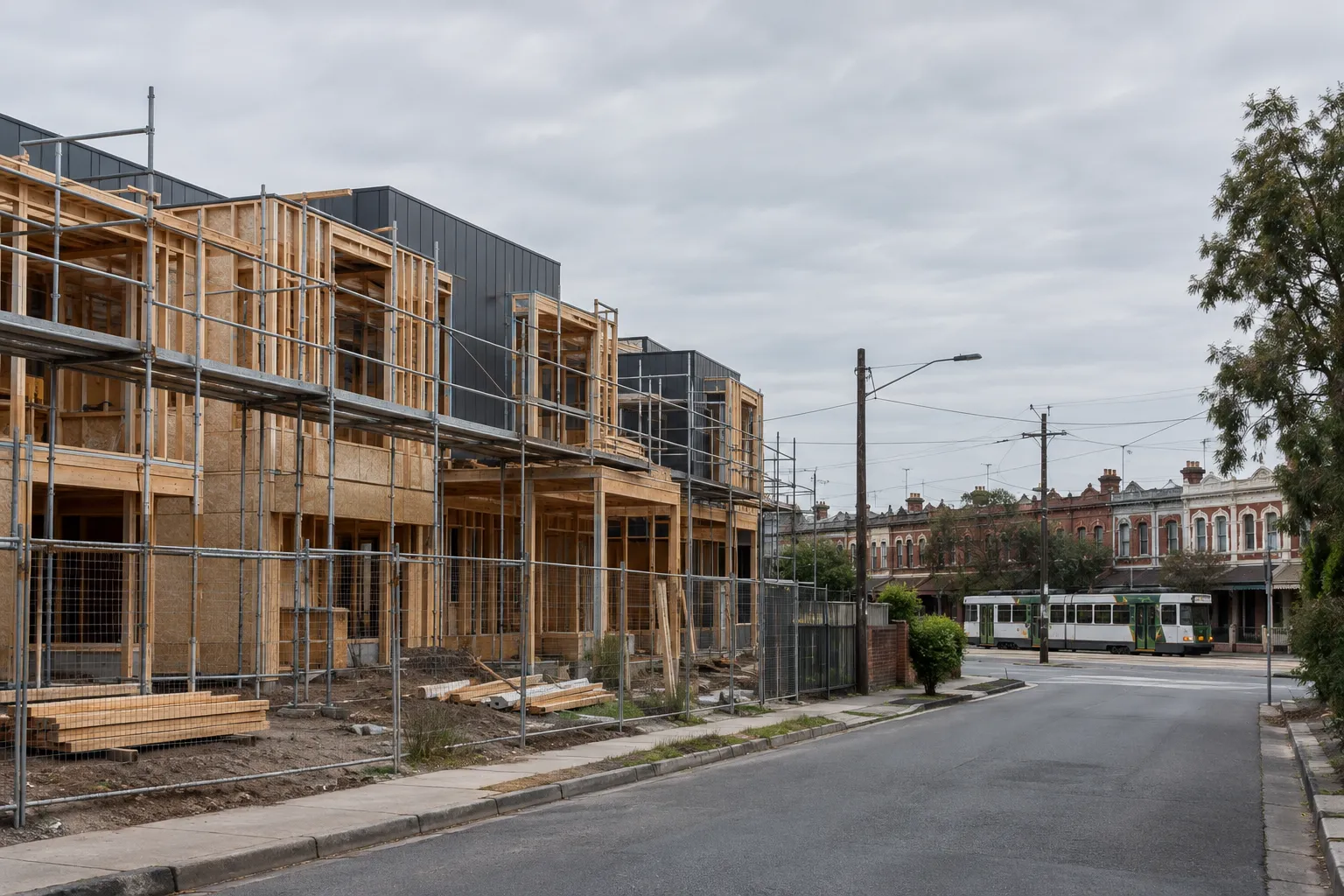
Melbourne dwelling values fell 6.2% over the year to September 2026, according to Cotality, and national sales over the latest three months ran 19.1% below the same period a year earlier. Against that backdrop, the Victorian division of a national property lobby has asked the state government for a rescue package. The headline item is abolishing stamp duty on every newly built home. It also wants the first home owner grant lifted from $10,000 to $20,000, plus a $25,000 payment for older owners who downsize.
The pitch is simple. The harder part is working out who ends up holding the benefit if the state says yes.
Stamp duty on new builds: the case for cutting it
The lobby backs its request with Roy Morgan polling of 3,863 Victorians, taken 8 to 12 October. Some 80.7% said the 32 state property taxes introduced or increased since 2014 make buying and renting dearer. Affordability worried 88% of respondents. Roughly two-thirds thought lower taxes would draw in private investment, and more than 40% saw taxes as a barrier to building.
Treat that as sentiment, not proof. A poll shows what people believe about costs. It does not measure how much a given tax actually adds to a finished home’s price. Still, the supply-side logic has weight. A developer selling off the plan needs buyers to commit before a lender releases construction funds. If purchasers disappear, pre-sales stall, lenders hesitate and sites sit idle. Any measure that restarts those contracts has a plausible route to more dwellings.
Who captures the saving
Here is the catch. Duty relief on new homes is a demand-side measure. It lowers the cost to the buyer. Whether it creates extra dwellings depends on how fast construction can respond.
If builders, trades and approvals are already stretched, extra buyer demand tends to bid up what is scarce. In many markets that means land. A $20,000 duty saving can be absorbed in a higher lot price or a firmer developer margin, leaving the buyer no better off and no new home built. If there is spare capacity and sites ready to go, the same saving is more likely to turn into real starts.
That is why the weak market matters. Falling values and thin sales suggest demand, not capacity, is the current bottleneck. A cooling market is the setting where relief is least likely to inflate prices. The risk rises later, once buyers return and the pipeline still cannot keep pace. Doubling the first home owner grant sits on the same fault line: grants have a long record of being priced into purchases.
The revenue problem
Stamp duty is one of Victoria’s biggest own-source revenue lines, and it is volatile. A weak market already cuts collections. Removing duty from new builds hands up more revenue in return for a hoped-for lift in activity. The lobby’s argument is that extra construction, GST-adjacent activity and land-tax or other receipts would partly offset the loss, but the figures supplied do not quantify that offset. Without it, the net cost to the budget is an open question.
The state also has other priorities competing for the same dollars. For context on how governments weigh tax settings against affordability, see our guide to negative gearing, CGT and investor tax, and our look at how Help to Buy faces political risk of its own.
Downsizer payment: a different lever
The $25,000 downsizing payment is aimed at a separate problem. It tries to free up larger homes by nudging older owners to move. That targets turnover of existing stock rather than new construction. The size of the response is uncertain, because downsizing decisions turn on more than a one-off payment, including age pension rules, moving costs and attachment to a neighbourhood.
What would change my mind
I would read this proposal more favourably if it came with a measurable condition: relief tied to projects that actually start construction, rather than a blanket concession on settlement. I would read it less favourably if applied broadly with no supply trigger, because that is the version most likely to leak into land values.
What it means for readers
For buyers weighing a new build, a duty waiver is not yet policy. Do not price a purchase on a concession that may never arrive, and watch for how any final design treats off-the-plan contracts signed before the change. For investors, ask what the relief does to land values in your target area before assuming it helps your yield. For brokers and borrowers, the most concrete near-term risk is the pre-sale and lender-confidence channel the lobby describes.
The practical step: if you are weighing a new build, ask the developer how much of the price reflects land versus construction, because that split shows where any future duty relief would likely land. For the weekly read on policy and credit, subscribe to the newsletter.
General info, not financial advice.