Victoria’s two taxes on overseas property buyers have been in place for more than a decade. Now the governing Labor party says it will look at them again if it wins the 28 November election. That is a notable shift for a state that pioneered the tough settings in the first place.
The foreign investor property tax Victoria applies comes in two parts. The Foreign Purchaser Additional Duty adds 8 per cent on top of standard stamp duty. The Absentee Owner Surcharge is a land tax loading on owners who live overseas. The proposed review would examine how much revenue the taxes raise, what they have done to foreign funding of construction, and how first-home buyers are affected.
The one change that is already on the table
The only concrete step so far is narrow. Before caretaker mode begins on 3 November, developers building affordable housing under the Development Facilitation Program would be spared the surcharge while they build.
That program fast-tracks planning approvals and lets the planning minister override councils. Eligibility typically requires a minimum spend of $50 million in Melbourne or $15 million in regional areas, and a medium or high-density multi-unit project. So this is a carve-out for large projects, not a general softening for individual buyers.
Does foreign money add homes or just bid for them?
This is the core of the debate. Foreign capital can do two very different things.
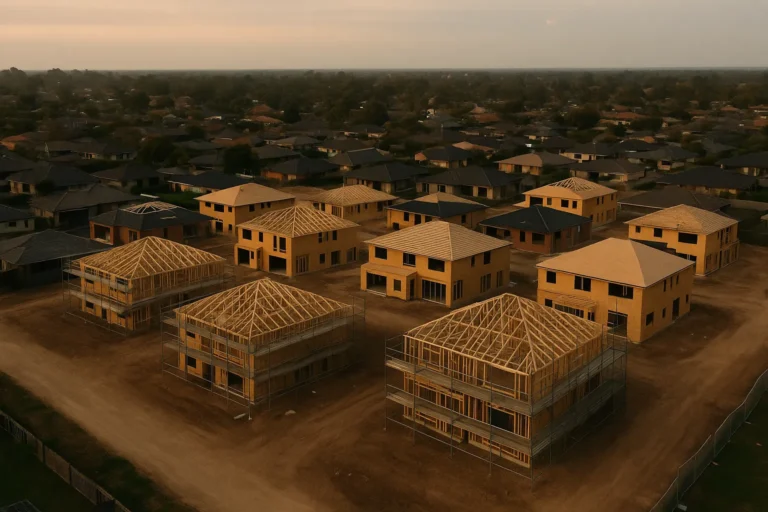
- It funds new construction. Offshore buyers who commit to off-the-plan apartments can help a developer hit the pre-sales needed to secure finance. More projects get built.
- It competes for existing stock. Overseas buyers who purchase established homes add to demand without adding any dwellings. That can nudge prices up for local buyers.
The taxes were designed to discourage the second behaviour. The risk is that they also dampened the first. A property-sector body points to roughly $5 billion in lost activity since the surcharge doubled in 2023. That figure is an industry claim, not an independent estimate, and it should be read that way.
Why the industry response was lukewarm
A building-industry leader called the move helpful but minor. The reasoning is about scale. Costs and charges make up more than 40 per cent of a Melbourne house-and-land package, so a change to one tax on one type of buyer only touches part of the problem.
The numbers behind the supply gap are stark. Victoria builds about 55,000 homes a year. The target is 800,000 over ten years, which is roughly 80,000 a year. On those figures, the state is running well short of the pace it has set itself.
The catch: a reversal may not bring investors back
An industry economist doubted overseas investors would return easily, and that is a fair point. Investors respond to expected returns, not only to tax settings. If a decade of rules has pushed capital to other states or other countries, announcing a review does not undo that overnight.
There are also trade-offs on the other side. Softening the taxes could raise competition for established homes, especially at the entry level where first-home buyers are already stretched. The review’s remit includes first-home buyer impacts, which suggests the government knows that risk exists. For context on how these policy levers fit together, see our guide to budget, policy and government housing schemes.
The market backdrop matters too. Melbourne house prices have fallen for five straight months, which changes how much appetite any buyer, local or foreign, may have right now.
What a review can and cannot do
A review is a promise to look, not a promise to cut. Three things are unknown:
- Whether either tax would be reduced, reshaped or scrapped.
- Whether any change would apply to new builds only, or to established homes too.
- How much revenue the state is willing to give up.
Until those details emerge, the sensible reading is that policy direction has softened, but outcomes remain open.
A step for readers
If you are a developer, investor or buyer with exposure to Victorian property, hold off on assumptions until the review’s scope is published after the election. Watch for any distinction between new-build and established-home settings, because that single detail will decide who benefits.
Subscribe to the newsletter for weekly policy and market updates.
The catch
- The 8 per cent surcharge sits on top of stamp duty, so it directly changes the cost of a purchase.
- Victoria builds about 55,000 homes a year against a pace of roughly 80,000 implied by its target.
- A review is not a repeal, and investors may not return quickly even if it leads to cuts.
General info, not financial advice.