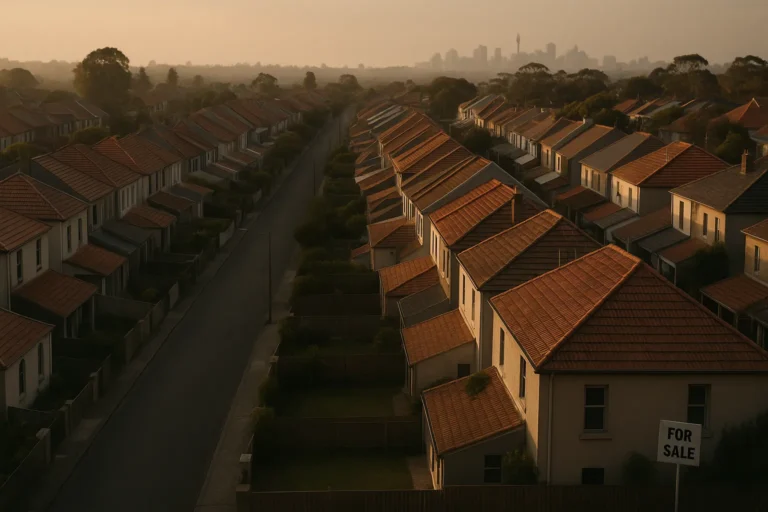
Fewer than half of the homes taken to auction are selling under the hammer, and that has now happened two weeks running. For a measure that spent much of the past few years sitting comfortably above 60 per cent, it is a sharp change in tone, and agents are describing it in strong terms.
The headline number matters less than what it points to. Australian auction clearance rates are one of the fastest reads on buyer confidence, because they update every weekend. Monthly price indexes take weeks to catch up. So when clearance rates drop and stay down, it is worth asking what comes next for values.
What a sub-50pc reading tells you
A clearance rate is the share of reported auctions that end in a sale on the day. Below 50 per cent, more properties are passing in than selling. That usually means buyers are unwilling to meet vendor expectations, and sellers have not yet adjusted.
Two caveats apply. First, the rate only counts homes that actually reach auction. Vendors who sense weak demand often switch to private treaty or withdraw, which can shrink the sample. Second, preliminary figures are usually revised once all results are in, so the early number can overstate the weakness. Treat one or two weekends as a signal, not a verdict.
Why the gap between sellers and buyers matters
The key tension is expectations. Vendors anchor to what a neighbour achieved six or twelve months ago. Buyers anchor to their borrowing capacity today, which has been squeezed by higher interest rates and tighter serviceability assessments.
When those two views are far apart, auctions fail. Prices only reset when vendors accept lower reserves, or when buyers regain capacity. Commentary on this has split along predictable lines. One camp reads falling reserves as proof the correction is still early. Another reads a thin auction market as a temporary freeze rather than a collapse in demand. The data so far cannot settle that argument.
Rates, tax and listings: the three forces to weigh
Interest rates. Every rate rise cuts borrowing power directly. A buyer who could stretch to a given price last year may now be a meaningful step below it. That pulls the ceiling down on what buyers can pay.
Tax settings. Changes affecting investors can thin out one of the most active buyer groups at auction. Fewer investors means less competitive bidding, particularly on mid-priced homes and units. For a sense of how policy can shift investor behaviour, see our look at how foreign buyer tax changes are opening a new front for investors.
Listings volumes. This is the swing factor. If sellers who are unhappy with bids pull their homes from the market, stock stays tight and prices can hold up even with weak clearance rates. If more owners list because they need to sell, supply rises into soft demand and the pressure builds.
Do prices have further to fall?
A clearance rate under 50 per cent has historically lined up with flat to falling prices, not rising ones. It is a lead indicator, and the lead is pointing down. But it does not tell you how far.
The base case is a gradual grind lower or sideways rather than a sudden drop, because most owners are not forced sellers. Many hold fixed or manageable loans and can wait. The downside case is a rise in forced sales, which would push clearance rates lower again and speed up price falls. The upside case is a rate pause that restores some borrowing capacity and brings buyers back by spring.
It also helps to separate the market by segment. Weakness is often uneven, with some suburbs and price brackets holding firm while others soften. Our guide to house prices, downturns and auctions explains how to read clearance data without over-reading a single weekend.
What to watch over the next four to eight weeks
- Whether clearance rates stay under 50 per cent or bounce back above it
- The share of auctions withdrawn or passed in before bidding
- New listings volumes against the same period last year
- Any shift in rate expectations from the RBA
- Price index updates that confirm or contradict the weekend signal
Quick take
- Two weeks below 50 per cent is a warning, not a forecast
- The rate reflects a buyer-seller expectations gap, not a collapse in demand
- Listings volumes will decide whether weak auctions turn into falling prices
If you are buying, a soft auction market gives you more room to negotiate and time to do your due diligence. If you are selling, price to where buyers actually are, not where the street was last year. Start by checking the clearance trend in your own suburb or price bracket rather than the capital city headline.
If you want the weekly signal, subscribe to the free newsletter.
General info, not financial advice.