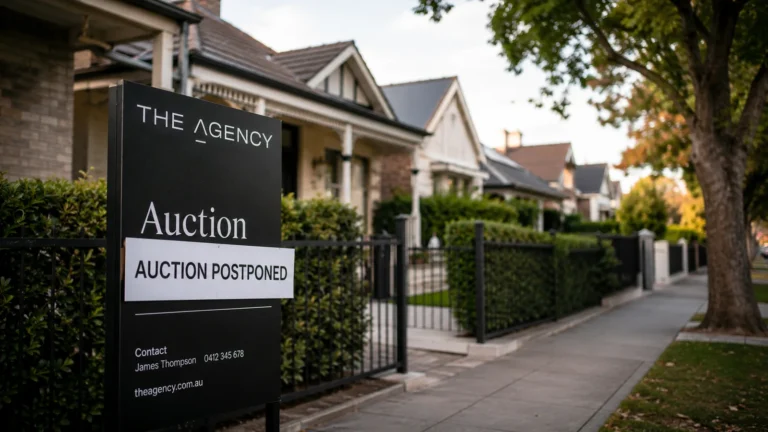
Registration numbers are telling a story clearance rates can’t. When an agent plans for eight bidders and only two register, the headline clearance figure becomes noise, the real signal is the gap between what vendors expected the market to deliver and what buyers were willing to show up for.
This isn’t about a single auction. It’s about the mechanics of how market corrections unfold when buyer demand retreats faster than vendor pricing can adjust. The standoff creates a vacuum: properties listed at prices that worked six months ago now sit waiting for someone to prove the market’s moved, and no one wants to be that buyer.
The registration gap no one’s measuring
Clearance rates track whether a property sold. Registration numbers track whether anyone serious turned up. The difference matters because clearance rates lag: they measure the outcome of decisions made weeks earlier when the reserve was set and the campaign launched. Registration numbers are real-time, they show you what buyers think today, not what the vendor hoped last month.
When that gap widens from expected-eight-got-two territory to expected-eight-got-one, you’re watching buyer sentiment collapse in a way headline clearance figures won’t capture until three months later when the volume of passed-in properties forces the aggregate number down.
The agent offering champagne to entice bids isn’t the story. The story is that no incentive bridged the pricing gap between what the vendor wanted and what the two registered buyers were prepared to pay.
Why this standoff persists
Vendors set reserves based on comparable sales from the previous quarter. Buyers form their ceiling based on what they think the next quarter will look like. When interest rate expectations shift, credit conditions tighten, or economic confidence wobbles, those two timeframes stop overlapping.
The vendor’s comparable might show $2.6 million. The buyer’s serviceability calculator and risk appetite might top out at $2.3 million. Neither side is wrong on their own terms, they’re just pricing different markets. The vendor’s looking backward at what sold. The buyer’s looking forward at what they’ll be able to refinance or sell into if conditions deteriorate further.
That $300,000 gap doesn’t close with champagne or a better campaign. It closes when one side capitulates: either the vendor drops the reserve to meet the market, or the buyer decides the risk of waiting (and missing out if rates fall or supply tightens) is worse than overpaying today.
What breaks the standoff
Three things force resolution. First, vendors who must sell, job relocation, divorce, financial pressure, start cutting reserves to clear. That resets the comparable sale data and gives the next round of buyers evidence the market’s moved. Second, listing volume rises as more vendors test the market, flooding supply relative to the smaller buyer pool and creating competition among sellers instead of buyers. Third, credit conditions or rate expectations shift enough that buyer serviceability improves and the ceiling lifts.
The first two favour buyers. The third favours vendors. Right now, we’re in phase one and two simultaneously: some forced sales are happening, and listing volumes in parts of Sydney are climbing as vendors who held off during spring test winter demand. That combination puts downward pressure on prices, but it’s uneven, suburbs with thin transaction volume can see one or two strong sales hold the median up even as the underlying buyer pool shrinks.
Pressure points
- Registration numbers consistently undershooting agent expectations by 50% or more signal buyer retreat is systemic, not property-specific
- Passed-in rates rising above 30-35% in a given suburb suggest vendor pricing hasn’t adjusted to the new buyer ceiling
- Time on market stretching beyond 45 days for comparable properties shows the standoff is hardening, not resolving
- Clearance rates holding steady while registration numbers fall means fewer properties are being tested, not that buyer demand is stable
Who this environment suits
Buyers with pre-approval and a 12-month horizon can wait for capitulation without risking being priced out if rates fall, the volume of listings and thin buyer competition gives them negotiating power they didn’t have six months ago. Vendors who bought recently and need to sell are the most exposed: they’re carrying a purchase price that reflected the previous market, a mortgage tied to today’s rates, and a sale price that reflects tomorrow’s lower buyer ceiling.
Investors holding negatively geared properties in low-yield areas face the same math: if rental income isn’t covering the higher mortgage cost and capital growth has stalled, the monthly shortfall becomes harder to justify. That’s when listings accelerate and the standoff breaks.
What happens when one side moves first
If vendors start dropping reserves before buyers re-enter, prices fall faster than clearance rates suggest because the market’s being reset by forced sales rather than genuine demand recovery. If buyers return before vendors adjust, because rates fall or credit loosens, prices stabilise and the standoff ends without a broad correction. The registration numbers tell you which is happening: if they start climbing before clearance rates do, buyers are coming back. If clearance rates start falling while registration numbers stay flat, vendors are cutting prices to meet the existing (smaller) buyer pool.
Right now, Sydney’s inner west and parts of the eastern suburbs are showing the first pattern: registration numbers aren’t recovering, but some vendors are starting to clear by meeting the market. That suggests the adjustment is supply-side driven, not demand-side recovered.
What to watch next
Track registration numbers as a leading indicator, not clearance rates. If eight-expected-two-registered becomes a pattern across multiple agents and suburbs, the correction is already underway, clearance data will confirm it two months later. Watch for listing volume: if it rises while registrations stay flat, the standoff is about to break in buyers’ favour. And monitor passed-in rates by suburb: anything above 35% sustained over four weeks means vendor expectations are still anchored to the old market.
For buyers, patience is the strategy until one of two things happens: registration numbers start climbing (demand is recovering) or time-on-market data shows vendors are capitulating (supply is adjusting). For vendors, the risk is waiting too long, if you’re the last to adjust your reserve after comparable sales have reset the market, you’re negotiating from the weakest position.
Subscribe to the weekly signal for the registration and clearance data that tracks where the standoff is breaking.
General info, not financial advice.