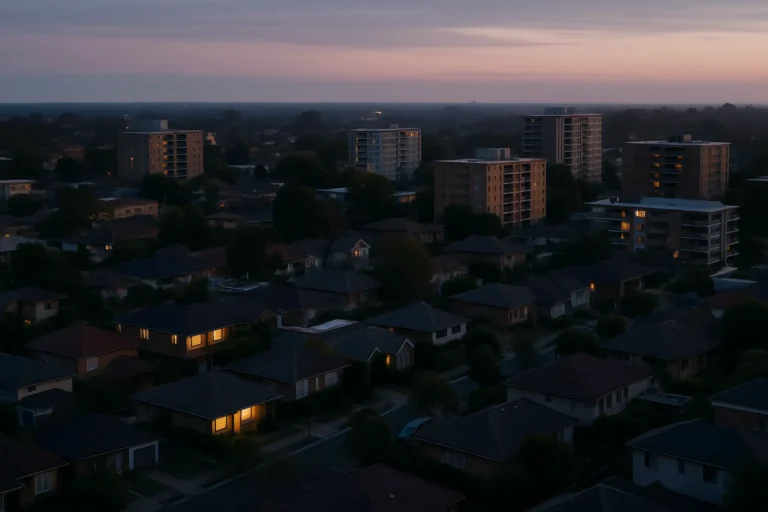
Melbourne’s median house price is expected to end the year in the high $900,000s, according to a forecast reported this week. That would drop the city out of the $1 million club it has hovered around for years. The headline is tidy. The real story sits underneath it.
A median is a single midpoint across tens of thousands of sales. It tells you almost nothing about which households are squeezed. A fall from about $1 million to the high $900,000s is a decline of a few per cent. For a buyer who bought recently with a small deposit, a few per cent can wipe out their entire cushion.
Why the $1 million line is a poor guide to Melbourne house prices
The $1 million mark is psychological, not economic. Lenders do not reprice a loan when a suburb crosses it. Households do not feel richer or poorer at an arbitrary round number.
What matters is the gap between what someone owes and what their home would fetch today. Hit the median and that gap is a statistic. Hit one street and it is a personal decision about whether to keep paying.
The forecast itself rests on rate hikes taking their toll. That is a mechanism worth understanding, and our RBA, interest rates and repayments guide walks through how a cash rate move reaches monthly repayments.
How rate hikes turn into price falls
Higher rates do two things at once. They lift repayments for existing borrowers, and they cut how much new buyers can borrow. Lower borrowing power means lower bids, and lower bids pull prices down at the margin.
This is slow, not sudden. Most borrowers do not sell when repayments rise. They cut spending first, then savings, then consider selling. That is why price falls tend to trail the rate path by months rather than weeks.
Key numbers
- Forecast Melbourne median house price by end of year: high $900,000s
- Direction: down, driven by rate hikes
- Open question: which price tiers carry the most debt against the least equity
Where equity erosion bites hardest
The households most exposed are not the long-term owners in established middle-ring suburbs. They have years of price growth behind them and a large buffer.
The pressure points are narrower:
- Recent buyers who put down a small deposit near the top of the market
- Owners in outer growth corridors, where new-build stock competes with resale homes
- Investors with thin rental yields who rely on capital growth to justify the holding cost
These groups share one trait. A modest price fall pushes their loan close to, or above, the value of the property. That is the setup described in our piece on negative equity and who defaults next.
The catch: negative equity alone does not force a sale. A borrower who can keep making repayments can sit through a downturn. It is the combination of falling values and a squeezed budget that creates distressed selling.
Serviceability is the second filter
Even where equity holds up, cash flow may not. Households that fixed at low rates and are rolling onto higher ones face the sharpest jump in repayments.
A rough rule of thumb: when repayments climb past roughly 30 to 35 per cent of gross household income, discretionary spending gets cut hard. That can feed back into the wider economy, and it also raises the chance that a household lists its home.
None of this is unique to Melbourne. Perth has shown how quickly a hot market can reverse, as we covered in Perth house prices falling at a record pace. Each city has its own mix of leverage, rental yields and buyer types, which is why the same rate move produces different outcomes in Sydney, Melbourne and Perth.
What to watch from here
The median will get the headlines. Three other signals will say more about real stress:
- Auction clearance rates and the share of properties withdrawn or passed in. Our note on what Victoria’s reserve rule hides explains why the headline clearance figure can flatter the market.
- Arrears data by postcode, not just the national number
- Listings volumes. A jump in new listings alongside falling prices is the clearest sign of forced selling
If you hold a mortgage, the useful step is simple. Check how far your loan sits below your home’s likely value, and stress-test your repayments against another rate rise. If the buffer is thin, talk to your lender about options before arrears start, not after.
If you want the weekly signal, subscribe to the free newsletter.
General info, not financial advice.