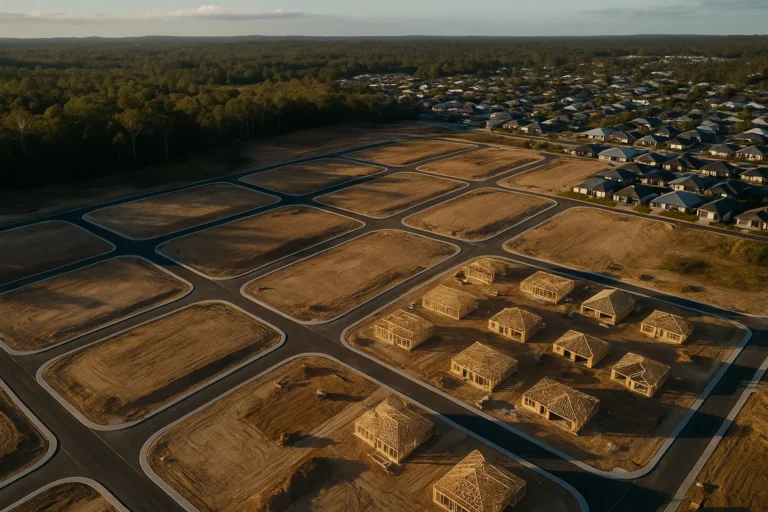
A construction business entering administration is not unusual. What makes this one worth watching is the question nobody in the market can answer cleanly: how much of the debt sits with private credit funds, and how concentrated is that exposure across the sector?
The developer’s construction arm has fallen into administration. The details are thin, no public breakdown of creditor types, no disclosed quantum sitting with non-bank lenders versus traditional financiers. That opacity is the point. Private credit has grown fast in development finance over the past three years, and the market has no reliable map of where the risk actually sits.
Why private credit moved into construction
Banks tightened development lending after the 2019 royal commission. Loan-to-value ratios dropped, presale requirements lifted, and appetite for anything outside the major metros shrank. Private credit funds filled the gap, offering faster approvals and higher leverage in exchange for materially higher rates, typically 10-14 per cent versus 6-8 per cent from banks.
For developers, the trade-off was clear: pay more to keep projects moving. For private credit funds, construction lending offered yield and security, or so the pitch went. Land as collateral, personal guarantees, first-ranking mortgages. The risk looked contained.
The catch
Construction lending is not passive income. It requires active monitoring, drawdown schedules, site inspections, cost blowouts, presale velocity. When a project stalls, recovery is slow and expensive. Selling half-finished apartments into a soft market rarely covers the debt.
Private credit funds do not publish loan books. There is no central register showing how many projects a single fund has financed, or how many funds are backing the same developer across different sites. Concentration risk is invisible until someone defaults.
If this case is isolated, one developer, manageable exposure, it will pass quietly. If it is the first visible crack in a broader pattern of over-leverage and under-reserved risk, the supply pipeline could face more disruption than the headline construction slowdown already implies.
What the numbers show
Australian private credit assets under management have grown from roughly $40 billion in 2020 to over $90 billion in 2025, according to industry estimates. Property and construction finance account for a meaningful share of that growth, though no regulator tracks the breakdown.
Commencements are down 20 per cent year-on-year nationally. That is partly demand-driven, higher rates, tighter serviceability, buyer hesitancy. But it is also supply-side: fewer projects are securing finance at all. If private credit funds are pulling back or writing down exposures, that constraint tightens further.
The question is whether funds are stress-testing against realistic downside scenarios, not just slower sales, but cost overruns, builder insolvency, and forced sales into a weakening market. If they are not, or if they assumed a rate environment that no longer exists, more developers will struggle to refinance or complete projects.
Who carries the second-order risk
Buyers with off-the-plan contracts. Subcontractors with unpaid invoices. Other developers who banked on selling into the same precinct at similar prices. Councils relying on those projects to meet housing targets.
The broader risk is a supply shock masked as a demand story. If enough private credit-backed projects stall, completions fall, vacancy tightens further, and rental pressure builds, even as headlines talk about falling prices and weak buyer sentiment.
Risks to watch
- Further developer administrations in the next 6-12 months, especially mid-tier operators in second-tier cities
- Private credit funds marking down property exposures or pausing new construction lending
- Increased disputes over contract settlements where projects are delayed or altered
- Subcontractor insolvencies if payment chains break
- Steeper discounts on forced sales of incomplete or stalled projects
Two scenarios worth pressure-testing
Base case: this is an isolated case, the developer had project-specific issues, and private credit exposure is manageable. Other projects continue, completions slow modestly, and the supply pipeline adjusts without systemic disruption.
Downside case: private credit funds have material unreported exposure to stretched developers, and tightening credit conditions or falling asset values force more administrations. Completions drop sharply, the supply shortage worsens, and rental pressure intensifies even as prices stay flat or fall modestly.
The gap between those scenarios is visibility. Right now, the market does not have it.
What happens if more follow
If this is the start of a pattern, expect regulators to ask harder questions about private credit leverage and concentration. APRA does not supervise non-bank lenders, but Treasury has flagged private credit as a systemic risk worth monitoring.
For buyers, the practical risk is contract settlement. If your project is financed by a private credit fund and the developer enters administration, your deposit sits with a court-appointed receiver, not in a trust account. Recovery is uncertain and slow.
For investors, the risk is a supply crunch that looks like weak demand. Fewer completions mean tighter rental markets and stronger yields in 18-24 months, but only if you can ride out the price volatility in between.
If you are thinking about off-the-plan contracts right now, check who is financing the project. Ask the developer directly. If they will not answer, that is your answer. If they name a private credit fund, understand that you are taking construction and refinancing risk, not just market risk.
Developer insurance compliance: NSW targets Bathla as stranded-buyer risk spreads
Subscribe to the newsletter for the weekly signal on credit, supply, and what is actually moving the market.
General info, not financial advice.