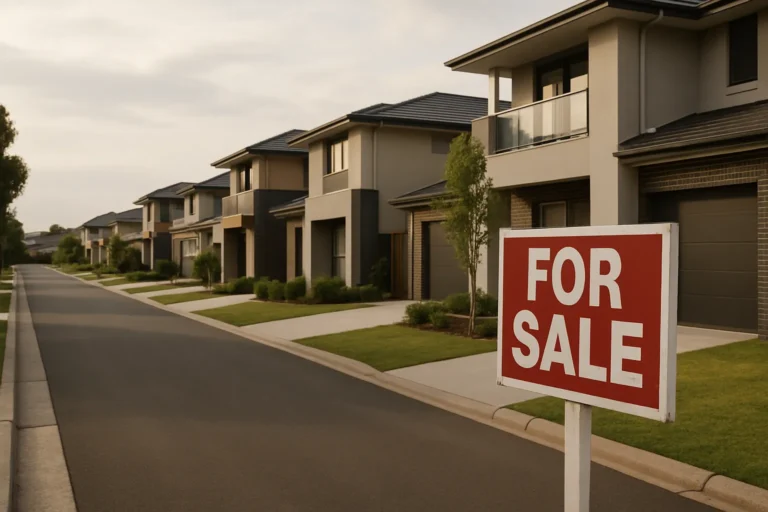
Families chasing the right state school catchment are bidding up property values in specific Sydney pockets, according to fresh market data. The school zone property premium is not new, but the scale and persistence of the gap is reshaping how entire suburbs price, trade and hold value even when the broader market softens.
The question is whether this premium reflects genuine long-term value or simply concentrates risk in a narrow slice of buyers who all need the same thing at the same time.
The premium in dollar terms
A typical school-zone premium sits between 10 and 25 per cent above comparable properties outside the boundary, depending on the school’s reputation and suburb. On a $1.5 million home, that is $150,000 to $375,000 extra upfront.
Over a 30-year mortgage at 6.5 per cent, the interest cost on that premium alone adds between $195,000 and $488,000. Total cost of the premium, principal plus interest, ranges from $345,000 to $863,000, more than the deposit most first-home buyers save.
Those figures assume the premium holds. If it narrows or disappears, the buyer wears the loss twice: once on the purchase price, again on resale.
Why the premium persists
Demand is structural. Families with school-age children cluster purchase decisions around enrolment deadlines, creating predictable waves of competition. Because state school zones are fixed by postcode or street, supply inside the boundary cannot expand to meet demand.
Sellers know this. Agents market the school as the headline feature, often ahead of the property itself. Buyers who miss out move to the next-closest option or wait, keeping turnover low and prices sticky.
The result is a self-reinforcing loop: higher prices attract families who can afford the premium, those families value the school highly, and their willingness to pay sustains the premium for the next cohort.
The price floor it creates
In softer markets, school-zone properties tend to fall less than nearby suburbs outside the catchment. Families with children already enrolled have little reason to sell at a loss, and new buyers still need housing within the boundary regardless of broader rate or sentiment shifts.
This creates what looks like a price floor, but it is conditional. The floor holds only as long as the school remains desirable, zoning rules stay stable, and the supply of families willing to pay the premium does not dry up.
If any of those shifts, the premium can narrow faster than it built up. A boundary redraw, a change in school leadership or performance, or a demographic shift (older population, fewer young families) all weaken the floor.
Pressure points
- Serviceability squeeze: Higher rates mean families stretch further to afford the same catchment, leaving less buffer for rate rises or income shocks
- Resale risk: Buyers inherit the premium but cannot control whether it persists when they sell 7 to 10 years later
- Opportunity cost: The premium paid upfront could fund private school fees, offset mortgage principal, or diversify into an investment property with better yield
- Policy risk: Governments can redraw boundaries, change enrolment rules, or shift funding in ways that alter a school’s appeal without notice
The alternative calculation
Compare the school-zone premium to private school fees. If the premium is $300,000 and private fees run $25,000 per year per child, the break-even is 12 years for one child, six years for two. Add the interest cost of borrowing that $300,000, and private school can cost less over the same period, with no resale risk.
That is not an argument for or against either choice. It is a reminder that the school-zone premium is a financial trade-off, not a certainty.
What could narrow the premium
Three scenarios weaken the floor:
- Demographic shift: If an area ages or young families move further out for affordability, the buyer pool shrinks and the premium compresses
- Boundary changes: Rezoning to balance enrolment spreads demand across more suburbs, reducing concentration in the original catchment
- Supply increase: New housing inside the zone (infill, rezoning, apartment developments) lifts stock and softens competition
None of these are immediate, but all are possible over a mortgage term.
Base case, upside, downside
Base case: Premium holds in well-established catchments with consistent demand, narrows slightly in rate-sensitive outer suburbs where family budgets tighten.
Upside: Zoning stays fixed, school performance lifts further, and low supply keeps competition high, premium widens by another 5 to 10 per cent over five years.
Downside: Rates stay elevated, affordability forces families to compromise on location, and the premium halves within three to five years as distressed sellers exit.
If you are looking at a suburb purely for the school and plan to move once enrolment ends, the downside scenario is the one to pressure-test.
What to do if you are weighing the premium
Start here: calculate the total cost of the premium (purchase price difference plus interest over your expected holding period), then compare that figure to the next-best alternative, whether that is private fees, a different catchment, or waiting.
Model what happens if the premium narrows by half when you sell. If that scenario leaves you underwater or unable to upgrade, the risk is too high.
Check recent sales inside and outside the boundary over the past 12 months. If the gap is widening while the broader market softens, that is a warning sign, it means fewer buyers are willing to pay, and the ones who are may be overstretching.
For a clearer view of how low stock and specific demand drivers can hold values even in softer conditions, see Hobart property market stays firm as rents, low stock offset rate drag.
Finally, if you are confident in the decision, factor the premium into your cashflow buffer. Treat the extra cost as fixed, not discretionary, and ensure you can service the higher mortgage if rates rise another percentage point.
For weekly analysis on what is moving markets and what is noise, subscribe to the newsletter.
General info, not financial advice.