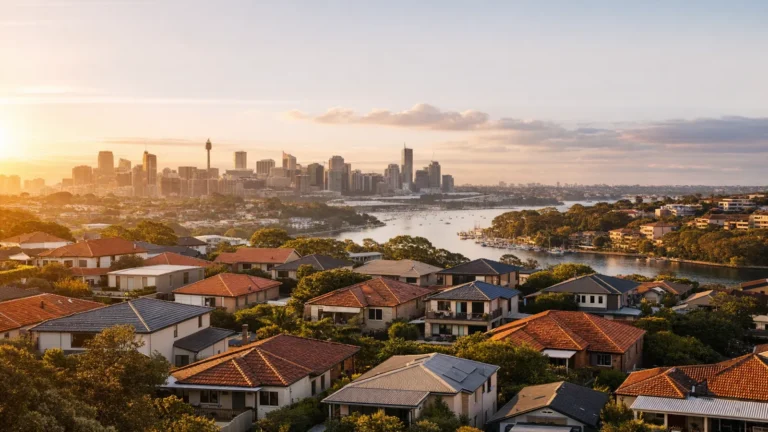
Australia’s housing market still looks strong if you stop at the national number.
That is the easy read. It is also the lazy one.
Cotality’s April chart pack said national dwelling values rose 2.1 per cent over the March quarter, lifting the total value of Australia’s residential market to about $12.6 trillion. But the same update showed Sydney down 0.2 per cent for the quarter and Melbourne down 0.6 per cent, while Perth rose 7.3 per cent, Brisbane 5.1 per cent and Adelaide 3.6 per cent.
That split matters because Sydney and Melbourne are not side shows. They are the heavyweight markets for value, sentiment and credit. When those two lose momentum at the same time, the national story usually gets more fragile than the headline suggests. APReview flagged this earlier inn Sydney and Melbourne Are Flashing a Housing Warning, and the gap now looks harder to dismiss.
What changed, and what still hasn’t
What changed is the leadership.
For most of the last cycle, Sydney and Melbourne were the markets everyone watched first. They pulled in the most attention, set the tone for confidence, and helped shape the national conversation around prices. In early 2026, that leadership has weakened. The stronger price momentum is now in Perth, Brisbane and Adelaide, where affordability started from a less stretched base and supply has stayed tight.
What has not changed is the basic engine of the market.
Housing still runs on borrowing power, supply constraints and household confidence. When rates stay restrictive, or buyers think they might, expensive markets feel the pressure first. That is why the current softening in Sydney and Melbourne looks less like a random wobble and more like a classic late-cycle signal. It does not prove a crash is coming. It does suggest the easy part of the upswing is behind us.
Why the split is showing up now
The simple version is this: stretched markets have less room for error.
Sydney is still Australia’s most expensive city, and Melbourne is hardly cheap. In markets like these, even a modest squeeze on credit can change buyer behaviour quickly. Households that could once stretch for a premium suburb start recalculating. Investors look harder at yield. Upgraders decide to wait. Sellers still anchor to yesterday’s prices. That is how momentum fades before a broad price fall ever becomes obvious.
Now, the part most people miss.
A softer Sydney does not automatically mean cheap Sydney. It can just mean fewer buyers can reach the prices sellers still want. That is a credit story before it becomes a price story. We laid out that mechanism in Why buyers are spooked about 2026 and it’s not prices. When credit flow slows, the next buyer cannot fund the next price as easily. That is usually where the first crack appears.
Perth, by contrast, is still running on different fuel. Relative affordability, constrained supply and stronger local demand have kept pressure on prices there. Brisbane and Adelaide have also held up better, though markets that run hard can cool fast once affordability catches up with them.
Quick take
Australia is not in one clean housing boom anymore. It is in a split cycle: the big, expensive markets are losing speed, while cheaper markets are still carrying momentum.
The bigger risk sits at the margin
There is another reason this matters.
Housing Australia said more than 300,000 Australians have now bought or built a home with support from the federal 5 per cent deposit scheme, and the October 2025 expansion widened access further. That has helped more households buy earlier, but it has also increased the number of borrowers entering with thinner equity buffers.
That does not mean these borrowers are reckless. It means they are more exposed if prices flatten, repayments stay high, or life gets in the way.
APReview covered one side of that in The 5% deposit trap pushing first-home prices even higher. The point was not that low-deposit buyers caused the market turn. It was that policy support can bring forward demand without removing repayment risk. If lower-priced markets get hotter while larger cities slow, stress does not disappear. It just shifts.
Supply is still the floor, but not the short-term driver
Anyone calling an immediate nationwide collapse is probably overstating it.
Australia still has a structural supply problem. Cotality says the total value of the housing market is rising, and the ABS approval figures for February showed a sharp rebound in dwelling approvals, especially in units and townhouses. That matters because undersupply can limit how far prices fall, particularly in cities where rental vacancy is already tight.
But supply is not the same as instant support.
Approvals are not completions, and not every approved project gets built on time or on budget. That is why the February bounce should be read carefully, not celebrated blindly. APReview unpacked that in Dwelling approvals jumped, but Australia’s housing fix still looks shaky. The pipeline looks better than another weak month, but it still looks fragile.
So what does that mean in plain English?
Supply may stop a deep collapse in some markets over time. It does not stop buyers from pulling back right now if finance gets tighter or confidence slips further.
What would change the call from here
The market does not need a disaster to weaken. It just needs enough friction.
A few things could do that over the next 90 days.
Auction weakness would be one. APReview recently noted national clearance rates sliding below 57 per cent, with Sydney around the mid-50s. That is not crash territory on its own, but it is consistent with a market losing urgency.
Another would be a further squeeze on household cashflow through rates, inflation or higher living costs. Expensive cities are usually first to feel that.
The upside case is still possible. If rate pressure eases, employment holds up and listings do not surge, Sydney and Melbourne could drift sideways rather than fall hard. That would look more like a reset than a bust.
The downside case is less dramatic than the headlines suggest, but more annoying for owners: longer selling times, weaker auction results, thinner offers and a stretch of flat-to-lower prices while other markets cool more slowly.
What this means if you’re making a decision now
If you are buying in Sydney or Melbourne, this is not the moment to assume last year’s growth will bail out a stretched purchase.
Focus less on whether you can win the property and more on whether you can comfortably hold it if prices go nowhere for two years.
If you are investing, look city by city, then suburb by suburb. A national boom narrative is not enough anymore. The better question is where borrowing power, supply and local demand still line up.
If you already own, do not confuse a softer quarter with a forced need to panic. But do take it as a reminder to pressure-test your cashflow buffer and refinancing options. I have seen this play out when the mood turns before the data fully catches up: the households with a buffer get patient, and the ones without one get pushed into bad timing.
Bottom line
The national market is still rising.
But that is no longer the whole story.
Sydney and Melbourne are softening while Perth, Brisbane and Adelaide still have momentum. That is what a maturing cycle often looks like: not one dramatic crash call, but a growing divide between markets that can still carry higher prices and markets that are running into the limits of credit, affordability and confidence.
Start here: pressure-test your next property decision against slower growth, tighter borrowing power and a market that is becoming more selective, not more forgiving.
General info, not financial advice.