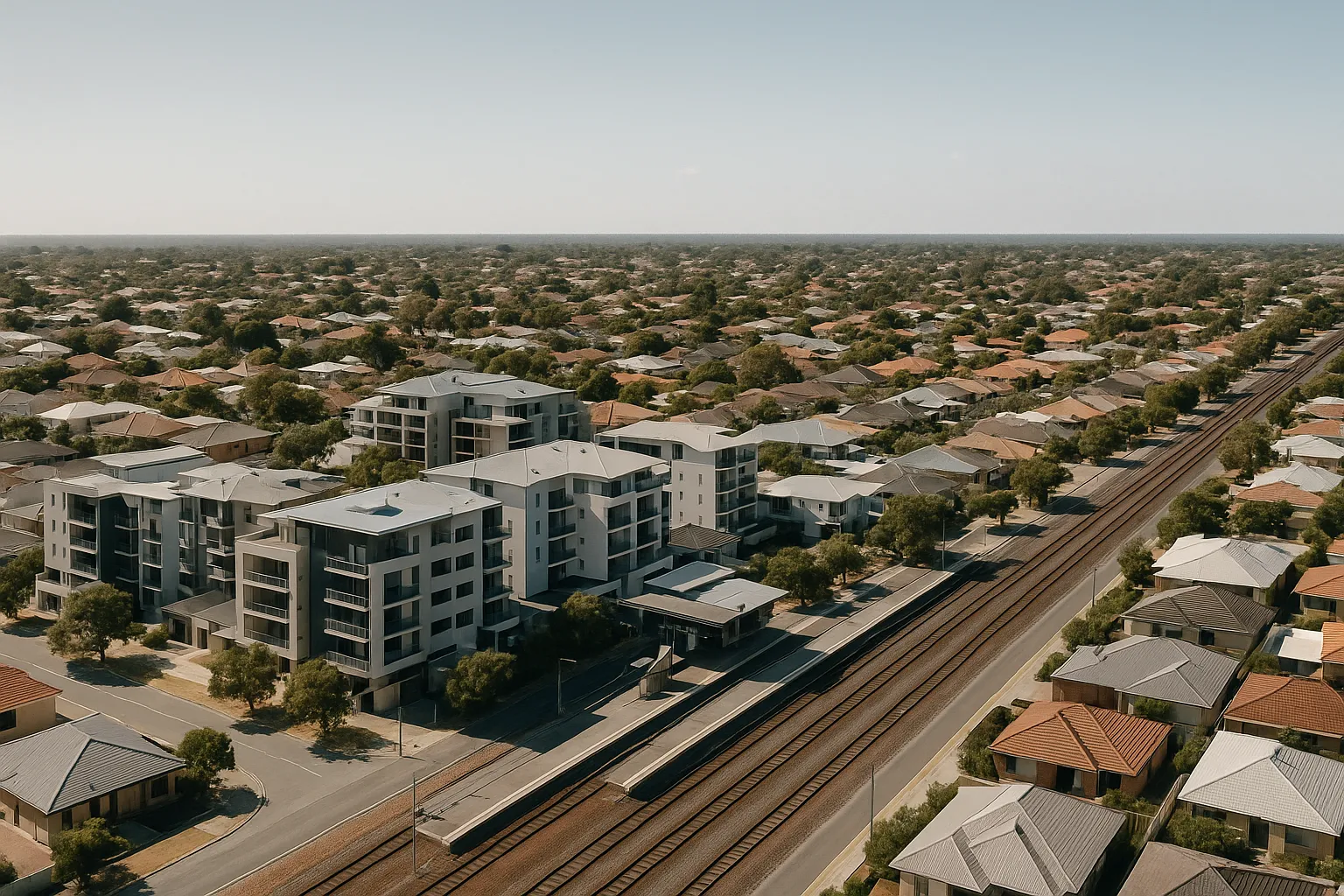
The federal government has committed $29.8 million to overhaul Western Australia’s planning system, aiming to simplify zoning rules, centralise high-density approvals near train stations, and fast-track renewable energy and industrial projects. The funding, part of the National Productivity Fund, comes with a promise: cut red tape, speed up approvals, unlock more housing and commercial development.
The policy direction is sound on paper. WA’s current system uses more than 800 land-use terms and 269 zones across Perth and Peel, a complexity that adds friction to every application. Consolidating those definitions and creating centralised approval pathways for transit-oriented development could remove weeks from timelines and reduce the risk of inconsistent local government interpretations.
But here’s the tension: WA’s approval times are already among the fastest in the country. The state processes most residential development applications within statutory timeframes, and major projects routinely clear planning hurdles faster than equivalents in NSW or Victoria. If planning isn’t the binding constraint, throwing money at it won’t shift the dial on housing supply.
Where the funding goes and what it targets
The $29.8 million breaks into five streams. First, the consolidation of zoning terms and land-use definitions across the Perth Metropolitan and Peel regions, which together account for 85 per cent of all development activity in the state. This removes ambiguity and reduces the likelihood that an application gets delayed because councils interpret the same term differently.
Second, centralised approval authority moves to the WA Planning Commission for higher-density residential and mixed-use projects within 800 metres of train stations. The initial rollout covers ten metropolitan precincts. This shifts decision-making away from local councils, which often face political pressure to resist density, and into the hands of a body with a state-wide housing mandate.
Third, a fast-track pathway for renewable energy and strategic industrial projects, plus the creation of an Office of the Coordinator General to manage large-scale developments. Fourth, a digital portal for subdivision applications, expected to save up to four weeks per lodgement by removing manual paperwork and allowing real-time tracking.
Fifth, funding to encourage modern methods of construction, prefabrication, modular builds, panelised systems, which lift productivity and reduce on-site labour requirements. This last stream is the only one that directly addresses construction capacity rather than planning process.
The real constraints and where they sit
WA’s planning system is not without friction, but it’s not the primary bottleneck. The state’s major constraint is construction capacity: skilled trades, financing for smaller builders, and access to materials at predictable prices. If a developer clears planning in three months instead of five, but then waits six months for a concrete pour or 12 months to lock in a fixed-price build contract, the planning reform delivers little net gain.
The second constraint is land economics. Rezoning land near train stations doesn’t automatically make projects viable if construction costs sit at $3,500 per square metre and end values don’t support that. Centralising approvals reduces political risk, but it doesn’t change the maths for marginal sites.
The third is financing. Non-bank construction lenders have pulled back sharply over the past 18 months, and major banks are applying tighter serviceability rules to development finance. Faster planning approvals don’t help if the project can’t access capital.
The digital portal and zoning consolidation are useful housekeeping. They remove small inefficiencies and lower compliance costs, which matters for smaller projects and infill developments. But they don’t address the structural issues that determine whether housing gets built at scale.
The catch
This package funds process improvements, not capacity. Planning reform can remove delays and reduce uncertainty, which has real value. But WA’s housing supply problem isn’t primarily a planning problem, it’s a construction, labour and finance problem. If those constraints remain binding, faster approvals just mean projects sit in the approved-but-not-commenced pile for longer.
What could shift the outcome
The modern methods of construction funding is the one element that addresses a real constraint. If the state uses it to support demonstration projects, train trades in modular techniques, or underwrite early adoption risk, it could start to lift productivity at the build stage. That’s where the real time and cost savings sit.
The centralised approval pathway near train stations matters if it’s paired with state government investment in enabling infrastructure, roads, sewerage, power upgrades, that makes high-density sites viable. Without that, the pathway just moves the bottleneck from council chambers to infrastructure budgets.
The fast-track industrial and renewable energy pathway could have spillover benefits if it creates a template for streamlined assessment that gets applied more broadly. But that depends on execution and whether the Office of the Coordinator General has genuine authority or becomes another layer.
Scenarios and what changes the trajectory
Base case: the reforms reduce approval times by 10 to 15 per cent for residential projects and remove some duplication for commercial applications. Housing commencements lift modestly, driven by reduced uncertainty rather than faster timelines. The digital portal becomes widely used, the zoning consolidation removes friction at the margins, but construction capacity remains the binding constraint.
Upside: the modern construction methods funding catalyses a shift toward prefabrication and panelised builds, lifting sector productivity by 20 per cent over three years. The centralised transit-oriented pathway unlocks 5,000 to 8,000 dwellings that wouldn’t have cleared local council approval, and state infrastructure investment follows, making those sites viable. Housing supply increases materially.
Downside: the reforms deliver process improvements but no change in output because construction capacity, labour shortages and financing conditions don’t improve. The centralised approval pathway becomes a political battleground, with councils pushing back on loss of authority. Projects get approved faster but don’t commence, and the housing supply outcome stays flat.
What to watch and what matters next
Track the number of projects approved under the centralised transit-oriented pathway and how many actually commence construction within 12 months of approval. If the gap is wide, the constraint is financing or viability, not planning.
Watch whether the modern methods of construction funding leads to measurable adoption, percentage of residential projects using prefabrication or modular techniques, and whether build times and costs fall as a result.
Monitor housing commencement data from the ABS, not just approval figures. Approvals are a leading indicator, but commencements are the measure that matters for supply.
The Office of the Coordinator General’s first 12 months will signal whether it has real authority or is another advisory body. If it clears a major industrial or energy project in six months that would have taken two years under the old system, the model works. If it adds a layer without removing others, it’s theatre.
The funding flows when reforms are delivered, not upfront. That means outcomes depend on execution, not announcements. WA has agreed to implement the reforms, but timelines and scope matter. The digital portal could go live in six months or 18, and the difference changes the impact.
For property investors and developers, the practical implication is this: if you’re holding a site near a train station that’s within the initial ten precincts, the risk of local council rejection has dropped materially. If your project relies on faster planning to make the numbers work, this helps at the margin. If your constraint is build cost, labour, or finance, this doesn’t change the equation.
Upzoning reforms proposed by the Productivity Commission operate on similar logic, remove planning barriers, assume supply follows. The evidence suggests planning reform is necessary but not sufficient. The real question is whether WA pairs this funding with the capacity-building measures that turn approvals into dwellings.
Start here: if you’re tracking WA development opportunities, focus on the ten transit-oriented precincts where centralised approval starts first, and cross-check which ones have state infrastructure commitments already in place. Those are the sites where the reform has the highest chance of translating into actual builds. For the weekly signal on policy shifts and market pressure points, subscribe to the newsletter.
General info, not financial advice.