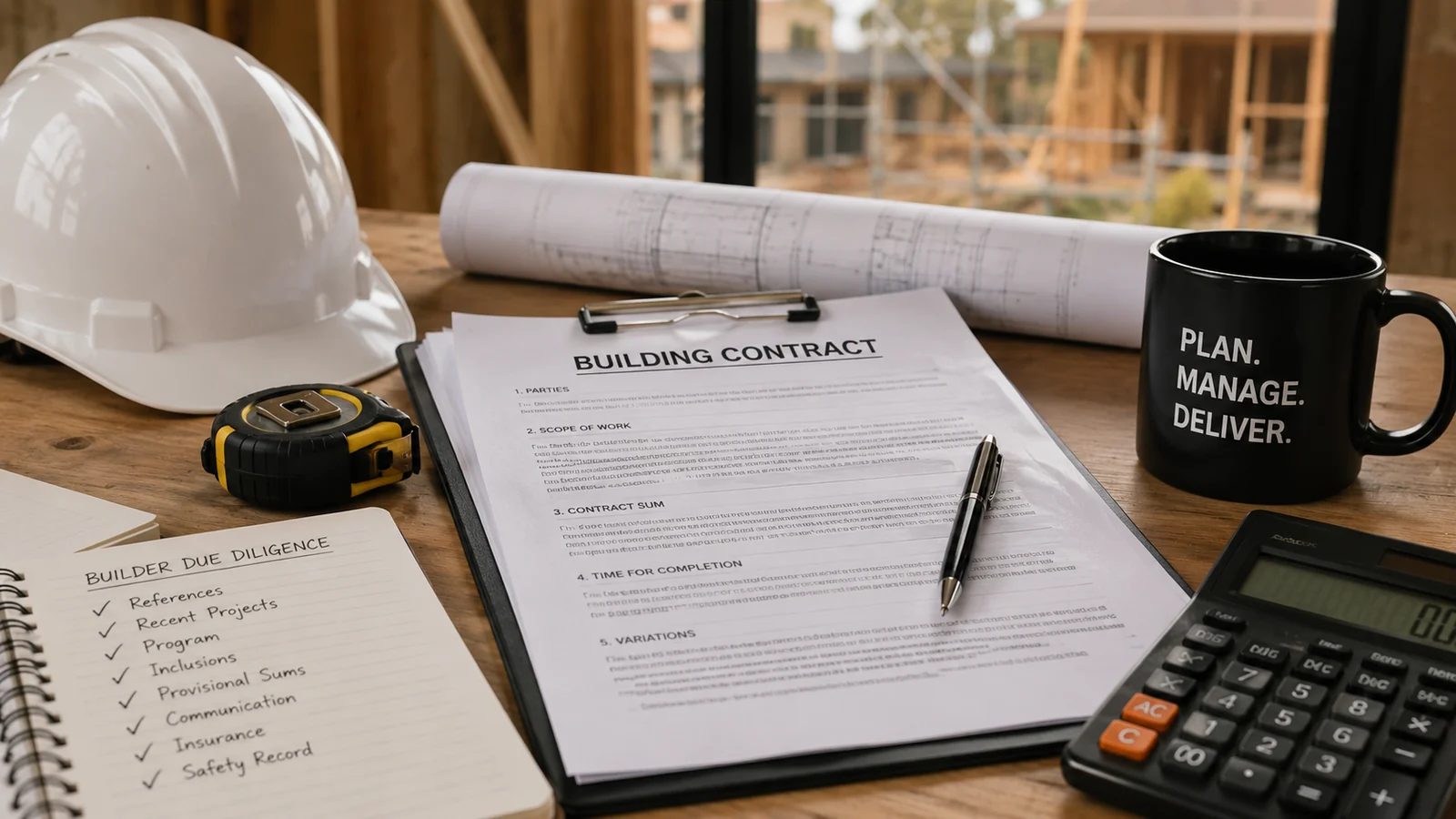
A signed price can still hide allowances, site surprises and costly gaps. The cheapest tender may not be the cheapest build.
For a property developer, signing a construction contract can feel like progress. The site is secured, the design is ready enough to price, and finally the project appears to be moving from spreadsheets to bricks and mortar.
That is also the point where weak assumptions become expensive.
A build contract does not remove risk. It allocates risk. If the drawings are incomplete, allowances are loose or the builder has priced aggressively to win the job, the cost may reappear later as variations, delays or disputes.
This matters more in a construction market already under pressure. Australian Property Review has reported on how building material, freight and concrete costs are feeding back into housing feasibility, while builders have also warned that higher input costs are making new projects harder to deliver.
For small developers, the practical lesson is simple: a low headline tender is not protection. A well-defined scope is.
A fixed price is only as strong as its exclusions
A contract price gets attention because it is easy to compare. One builder quotes $1.92 million. Another quotes $1.84 million. The temptation is to treat the lower number as an $80,000 saving.
But two tenders are only comparable when they include the same work, same materials, same quality and the same allocation of unknown costs.
That is where projects come unstuck.
A builder may have excluded retaining walls, authority requirements, demolition surprises, specialist reports, upgraded finishes or extra excavation. Another may include those costs from the start. The first quote looks cheaper, but only because the risk has been shifted back to the developer.
Specifications matter here. A line saying “timber flooring allowance” is not the same as nominating the product, thickness, finish, installation method and area covered. The same applies to tapware, appliances, glazing, landscaping, drainage and façade treatments.
This is not about trying to trap a builder in paperwork. It is about knowing what is actually being bought.
In plain English
The cheapest contract price is only meaningful after every builder has priced the same scope, materials, allowances and site assumptions.
That distinction has become more important as construction feasibility tightens. When projects are already absorbing dearer labour, finance and inputs, even modest scope gaps can turn an acceptable margin into a weak one.
Provisional sums are not fixed costs
One of the first places to look is the provisional sum schedule.
A provisional sum is an estimate for work that cannot be priced accurately when the contract is signed. It is commonly used where the final cost depends on information still to come, such as excavation, external works or landscaping.
There is nothing automatically improper about a provisional sum. Some uncertainty is unavoidable.
Here’s the catch. A long list of allowances can make a tender look more competitive than it really is.
If one builder fixes a cost and another places a lower allowance against it, the second quote may win on price while leaving the developer exposed when the real work is ordered. By then, the project is under way, finance has been arranged around an earlier budget, and negotiating leverage is much weaker.
Consumer Affairs Victoria advises that, where possible, specifications should be settled before signing so work can be priced rather than left as an allowance. Its guidance also says provisional sum cost estimates should be broken down and supported by cost documentation when actual amounts are known. The rules vary by state and contract type, but the risk principle is relevant across Australia.
Developers should pressure-test each allowance before signing:
- What exactly is included?
- What quantity and unit rate have been assumed?
- What margin or administration fee applies if the cost rises?
- Can the item reasonably be fixed now?
- If not, what evidence will be provided when the final cost arrives?
The aim is not to force every unknown into a fixed figure at any cost. A builder taking on genuine uncertainty will price that risk somewhere. The aim is to decide consciously whether a premium for certainty is better than accepting an open-ended exposure.
The ground can undo a clean spreadsheet
Some risks are difficult to eliminate, even with a careful tender.
A latent condition is a physical site condition that was not reasonably apparent before construction, often involving what sits below the surface. Unexpected rock, poor soil, buried material or groundwater can require different excavation, additional fill, revised footings or more concrete.
Soil testing and engineering work can reduce this risk. They do not always remove it.
That matters because a development feasibility model is usually built on quantities: cubic metres of excavation, concrete volumes, retaining requirements, working days and finance holding costs. Once those quantities change, the effect does not stop at the direct invoice.
More excavation may mean more concrete. More concrete may mean a changed program. A changed program may mean extra interest, holding expenses and a delayed sale or settlement.
This is the second-order effect developers should not miss. A cost variation of $25,000 may not remain a $25,000 problem once time and finance are included.
The contract should make clear who carries site-condition risk, what testing has been relied on, what notice must be given, and how additional cost and time will be demonstrated. For residential development projects, legal advice on the particular state, contract form and ownership structure is worth obtaining before signature.
Treat a very cheap tender as a question, not a win
A substantially cheaper tender can be genuine. A builder may have better subcontractor relationships, a quieter pipeline or a construction method that reduces cost.
But a quote well below the field requires investigation.
The question is not: “Can we afford to walk away from the saving?”
The better question is: “Why is this builder cheaper?”
Put tenders side by side, trade by trade. Compare excavation, concrete, structural steel, timber, glazing, joinery, services, external works, preliminaries and program assumptions. Check whether one price uses substituted products or thinner allowances. Check whether the builder has priced every drawing revision and specification issued during tender.
Also test behaviour, not only numbers.
A tender process offers a preview of how the builder may operate during the job. Slow responses to basic clarifications, vague answers on inclusions, unexplained provisional sums or resistance to providing a breakdown should not be ignored because the total price is attractive.
In construction, poor transparency can be expensive. The bill usually arrives after the builder has possession of the site and the developer has fewer practical alternatives.
Good builder relationships begin with hard questions
Developers sometimes worry that detailed pre-contract questioning will damage the relationship with a builder.
It should do the opposite.
A competent builder should want clear drawings, documented selections and realistic expectations. Ambiguity may help a tender look sharp in the short term, but it is rarely a foundation for a smooth project.
The most useful conversations happen before signing:
How busy is the builder over the proposed construction period? Who will supervise the site? What similar developments have they recently completed? Can references confirm cost control and communication? How are program delays communicated? Which risks are excluded or allowed for rather than fixed?
These questions do not guarantee a perfect build. They establish whether the parties are approaching the project with the same level of discipline.
For developers assessing whether a project still stacks up, builder selection also sits inside a larger feasibility question. Australian Property Review has covered how Sydney apartment supply can be constrained when costs and approvals weaken development economics. A development that only works with the lowest tender and no contingency is not automatically viable. It may simply be fragile.
What to lock down before you sign
The contract review phase is where developers usually have the greatest ability to change the outcome. Once work begins, every correction becomes harder, slower or more costly.
Before committing, the tender should be tested against five practical controls.
First, finalise as much of the scope as reasonably possible. Drawings, finishes, fixtures, product standards and responsibility for supply should not be left to assumptions.
Second, identify every provisional sum and prime cost allowance. Ask what can be fixed and demand a clear basis for items that cannot.
Third, review site risk. Confirm what geotechnical, survey, engineering and service information has been obtained, and how unknown conditions are dealt with under the contract.
Fourth, compare builder prices on the same basis. A spreadsheet that places inclusions, exclusions, allowances, program and proposed substitutes next to each other can reveal more than the tender total.
Fifth, test the builder’s operating style. Communication during tender is not proof of future performance, but weak communication before a contract is signed is rarely comforting.
The goal is not the cheapest number on signing day. The goal is the most reliable cost and delivery outcome at project completion.
A contract should protect the project, not rescue it later
A good construction contract is important. But it cannot repair missing due diligence after the project has started.
Developers who rush to sign in the hope of saving several weeks may instead inherit months of arguments over scope, allowances or unpriced site conditions. Those risks can affect more than profit. They can weaken borrowing buffers, stretch presale commitments, delay the next project and create disputes that consume management time.
None of this means developers should avoid building or distrust builders. It means the commercial relationship should start with clarity.
The strongest contract is usually the one both sides rarely need to argue over, because the expensive questions were dealt with before excavation began.
Start here: before accepting a tender, build a line-by-line comparison of scope, allowances, exclusions, site risks and program assumptions, then have the preferred contract professionally reviewed before signing.