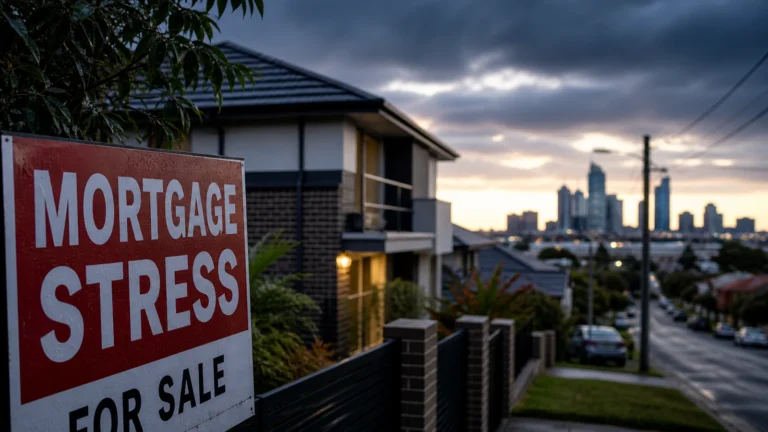
Australians are cutting back, but the real pressure is not just prices. It is the feeling that hard work no longer buys breathing room.
Financial stress Australia is not showing up as one clean headline.
It is showing up at the supermarket checkout. At the petrol bowser. In power bills. In rent renewals. In mortgage repayments that still feel heavy, even after months of waiting for relief.
For property owners, renters and investors, this matters because household pressure does not stay neatly inside the family budget. It flows into arrears risk, borrowing power, rental demand, consumer confidence and the way people make property decisions.
The danger is not just that life is more expensive.
The danger is that many households start making long-term decisions from a short-term stress position.
The real squeeze is in the essentials
There is a difference between cutting back on luxuries and cutting back on basics.
Skipping a restaurant meal is one thing. Trying to keep groceries, petrol and electricity inside the weekly budget is another.
That is why the current cost-of-living squeeze feels so tiring. Much of the pressure sits in non-negotiable spending. Food, fuel, rent, mortgage repayments, insurance and power are not lifestyle extras. They are the base cost of staying housed, mobile and employed.
For property households, the pressure compounds quickly.
A homeowner may have a higher mortgage repayment, higher insurance, higher council rates and higher utility bills at the same time. A renter may face a higher weekly rent while also paying more for transport and groceries. An investor may be dealing with higher debt costs, higher maintenance, higher land tax or weaker cashflow.
None of these pressures needs to be dramatic on its own.
Together, they can drain the buffer.
Australian Property Review has previously covered how mortgage and rental stress are showing up across suburbs in Suburb Stress Map Shows Australia’s Housing Squeeze. The point is simple: household stress is no longer limited to one postcode or one income group.
Why it feels like working harder is not enough
The harder part to measure is psychological.
Many Australians are still employed. Many are still paying their bills. Many are still getting by. But “getting by” can feel very different when every bill lands heavier than expected.
That is where financial fatigue sets in.
Financial fatigue is not the same as being broke. It is the feeling that every decision now requires a calculation. Can we afford the grocery shop? Should we delay the car service? Is the rent increase manageable? Can we still save for a deposit? Should we pause investing? Should we refinance? Should we sell?
For homeowners and investors, that fatigue can distort judgement.
A borrower under pressure may chase the lowest monthly repayment without checking the longer-term cost. An investor may hold a weak asset too long because selling feels like failure. A first-home buyer may stretch too far because they fear being priced out.
Here’s the catch.
When households are tired, they often make decisions to reduce today’s pain, not tomorrow’s risk.
That is understandable. It is also where mistakes happen.
In plain English
Financial stress is not just about income. It is about the gap between fixed costs and breathing room. When that gap narrows, even ordinary bills start to feel like shocks.
Social comparison is making the pressure worse
There is another layer that rarely appears in property data.
Australians are not just comparing their finances with last year. They are comparing their lives with a curated version of everyone else’s.
That matters because property is emotional. Homes, suburbs, renovations, holidays, cars and school zones all sit inside the same comparison loop.
A household can be doing reasonably well on paper and still feel behind if the benchmark is someone else’s highlight reel.
That mindset can be expensive.
It can push people into bigger homes, bigger mortgages, unnecessary renovations or lifestyle spending that weakens their cashflow buffer. It can also make sensible decisions feel small. Paying down debt, building savings, cooking at home, delaying an upgrade or buying a less glamorous property may not look impressive, but those moves often create the resilience people need.
The property market rewards staying power.
That is why the boring habits matter.
The property link most people miss
Financial stress Australia is not only a household budget story. It is also a housing market story.
When household budgets tighten, several second-order effects can follow.
First, borrowing power falls. Lenders look at income, expenses, debt and buffers. If the cost base rises, serviceability becomes harder. Serviceability simply means the lender’s test of whether a borrower can afford the loan, including a margin for rate rises.
Second, renters become more exposed to rent increases. If wages are not keeping pace with housing costs, even modest rent rises can push households towards stress.
Third, investors become more selective. A property that looked acceptable when money was cheaper may look thin once rates, insurance, strata, maintenance and land tax are included.
Fourth, distressed decisions become more likely. Some households delay selling because they hope conditions improve. Others sell too quickly because they cannot rebuild a buffer.
That is why cashflow matters more than the headline price.
Australian Property Review explored this in Property Investing in Australia: First Deal Trap, where the key issue was not just the suburb or purchase price. It was whether the deal still worked after debt, risk and cashflow collided.
Budgeting is not glamorous, but it is the first line of defence
The practical starting point is not complicated.
Most households need a clear view of what is coming in, what is going out, and what is leaking away without much thought.
That means separating spending into three groups:
- Fixed essentials, such as rent, mortgage, insurance, utilities and transport.
- Variable essentials, such as groceries, fuel, health and school costs.
- Discretionary spending, such as subscriptions, takeaway, alcohol, upgrades and impulse purchases.
The goal is not to live like a monk.
The goal is to find the pressure points before the pressure finds you.
A useful rule of thumb: if a recurring cost does not improve your life, protect your income or support your health, question it. Subscriptions, unused memberships, frequent delivery meals and daily convenience spending can quietly become a second rent.
Small cuts will not solve every household budget. But they can create the first $50, $100 or $200 a week of breathing room. For a stressed household, that can be the difference between reacting and planning.
The income side deserves equal attention
There is a limit to cutting costs.
At some point, the better question becomes: can income rise?
That may mean overtime, a second job, contract work, weekend work, freelancing, a small business, tutoring, bookkeeping, trade work, repairs, gardening, cleaning, delivery work or selling a skill online.
Not every household has the same capacity. Parents, carers, shift workers and people with health issues may have fewer options. That matters.
But for those who do have capacity, extra income can change the equation faster than cutting coffees.
The mindset shift is important. A second income stream is not a sign of failure. It can be a way to regain control.
For investors, the same logic applies at asset level. If a property is under pressure, the question is not only “will prices rise?” It is also “can the income, debt structure or cost base be improved?”
That could mean reviewing rent against the market, renegotiating insurance, checking loan structure, assessing repairs that improve tenant retention, or comparing whether the property still earns its place in the portfolio.
For some landlords, an interest-only loan may ease short-term cashflow. But it is not free money. It is a timing trade-off, because the debt does not reduce during the interest-only period.
Stress changes the way people read the market
A financially tired household is more vulnerable to headlines.
Rate-cut hopes can feel like a rescue plan. A rent rise can feel like a personal attack. A falling auction clearance rate can look like a buying window. A rising suburb can look like proof that waiting was a mistake.
The better approach is slower.
Ask what changed, what did not, and what would need to happen next.
If rates fall, repayments may ease, but insurance, rates, groceries and rents may still remain high. If oil prices rise, transport and building costs can stay under pressure. Australian Property Review has covered that link before in Oil Shock and Australia’s Property Reckoning.
If property prices rise, owners may feel wealthier on paper. But paper gains do not pay the power bill unless the household has cashflow.
That is the part many people miss.
Wealth and liquidity are not the same thing.
A household can own a valuable asset and still feel financially stretched every month.
What could derail the recovery in household confidence
The base case is that households slowly adjust. They cut waste, refinance where possible, seek extra income, delay discretionary spending and rebuild buffers.
But several risks could keep pressure elevated.
The first is sticky inflation. If food, fuel, insurance and services costs remain high, rate relief may not translate into real breathing room.
The second is rent pressure. If vacancy remains tight, renters may continue to absorb higher housing costs even if the broader market slows.
The third is weak wage growth relative to essential costs. A pay rise does not help much if it is swallowed by rent, tax, insurance and groceries.
The fourth is policy uncertainty. Changes to tax, lending rules or investor incentives can shift behaviour quickly, especially when investors are already nervous about cashflow.
The fifth is household exhaustion itself. If people delay decisions too long, small problems can become forced choices.
That is why investors and homeowners should pressure-test decisions before they become urgent.
The practical take for property owners, renters and investors
If you are feeling financially stretched, start with one simple exercise.
Build a 90-day household pressure test.
Write down your current monthly income, fixed costs, variable costs, minimum repayments and savings buffer. Then test three scenarios:
Base case: costs stay roughly where they are.
Downside case: rent, repayments, insurance or living costs rise by another 5 to 10 per cent.
Upside case: income rises, rates fall or one major cost is removed.
The question is not which scenario is guaranteed. None is.
The question is whether your household or investment position survives the downside case without panic.
For a renter, that may mean preparing before the next lease renewal. For a homeowner, it may mean reviewing the loan before stress builds. For an investor, it may mean checking whether the property still works after realistic costs, not optimistic assumptions.
Australian Property Review has also looked at cashflow discipline in Commercial vs Residential Property Investing, where the broader lesson applies across asset types: leverage can build wealth, but it also magnifies pressure when income or costs move the wrong way.
Bottom line
Financial stress Australia is not just a mood. It is a market signal.
When households feel exhausted, spending changes. Borrowing behaviour changes. Rental decisions change. Investor appetite changes. The housing market does not move separately from household cashflow. It is built on it.
The answer is not panic. It is control.
Start here: write down your true monthly position, cut one recurring leak, and pressure-test your next property decision before the market forces the decision for you.
If you want the weekly signal, subscribe to the free Australian Property Review newsletter.
General info, not financial advice.