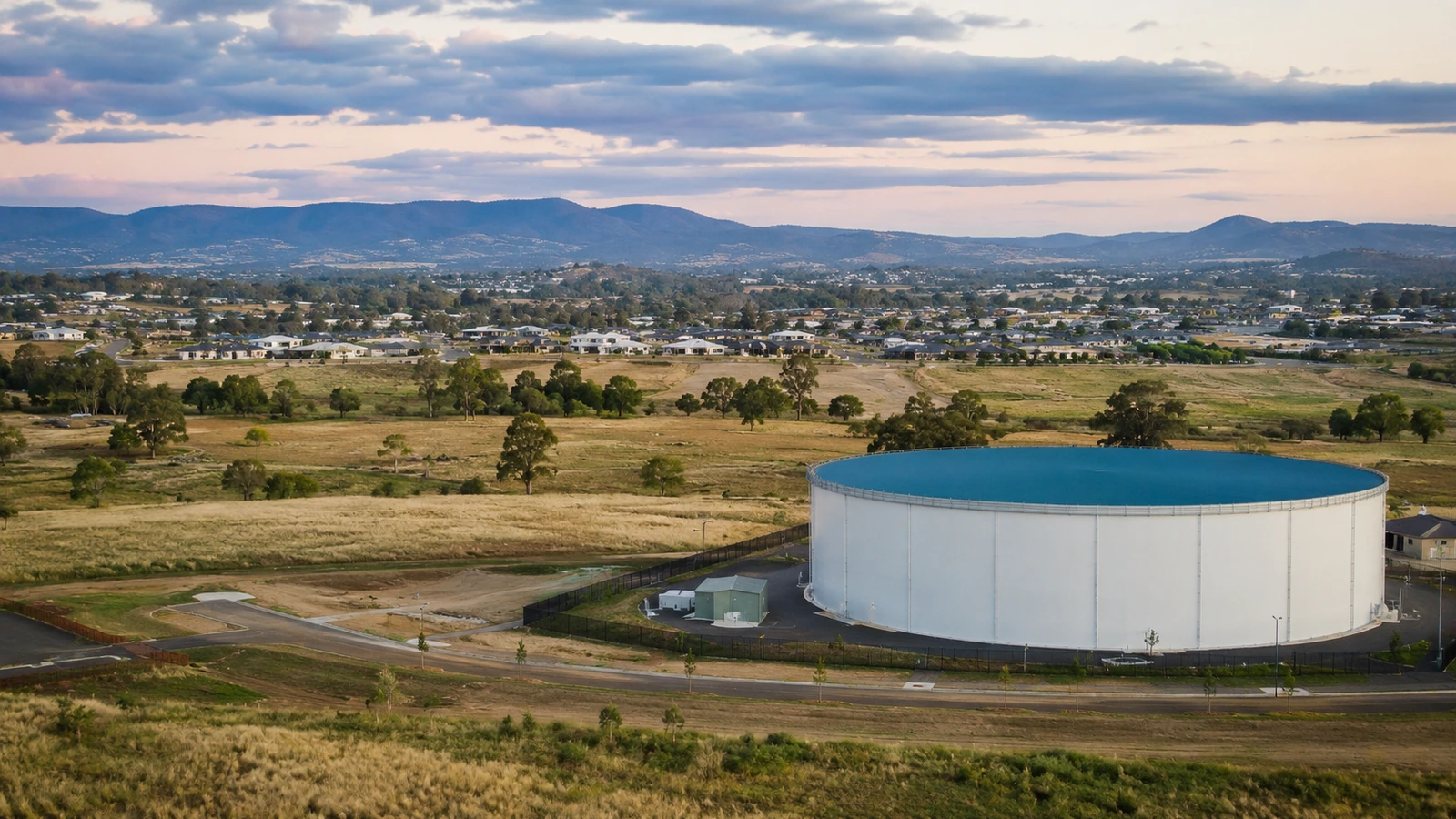
Toowoomba housing supply is now tied to a piece of infrastructure most buyers will never inspect: a water treatment plant.
Toowoomba Regional Council is seeking $150 million from Queensland’s Residential Activation Fund to help deliver the proposed Southern Water Treatment Plant at Westbrook. The broader project is expected to cost about $200 million, with council funding covering a further share.
On paper, this is a water and sewerage story.
In practice, it is a housing, growth and transport story.
The council argues the plant could help unlock the potential for about 33,000 new dwellings across growth corridors including Westbrook, Cotswold Hills, Drayton, Meringandan West and Highfields. That number matters because regional housing markets are no longer just lifestyle stories. They are becoming infrastructure tests.
A city can have population growth, buyer demand and developable land. But if the trunk infrastructure is not there, the homes do not arrive on time.
Why a water plant has become a housing story
The housing debate often focuses on planning approvals, interest rates and construction costs.
Those matter.
But Toowoomba’s proposal points to a quieter constraint: essential infrastructure.
Before a new estate can move from paddock to subdivision, developers need roads, water, sewerage, stormwater and power. These are not optional extras. They are the systems that make housing possible.
The Queensland Government’s Residential Activation Fund was designed for exactly this problem. It aims to bring forward infrastructure that unlocks residential land sooner, particularly where councils and developers are facing big upfront costs.
That is why the Toowoomba bid is important.
The city is not simply asking for a housing grant. It is asking the state to help remove a bottleneck that could slow the next stage of growth.
Here’s the catch.
A funding approval would not mean 33,000 homes appear quickly. It would mean a major constraint is reduced. Planning, builder capacity, finance, buyer demand and delivery timelines would still matter.
But without the plant, the southern and western growth corridors face a much harder path.
The numbers that matter
The headline figure is 33,000 potential new dwellings.
That sits beside a funding request of $150 million, plus about $45 million in council funding. The project has also been linked to an estimated $134 million in construction-phase economic benefit and close to 170 jobs.
Those are big numbers, but the more useful question is what they imply.
If Toowoomba wants to compete for people, workers, investment and future transport funding, it has to show it can scale. Housing approvals and completions are part of that story.
This is where infrastructure becomes political.
Local advocates have been pushing for faster and more reliable passenger rail between Toowoomba and Brisbane. The argument becomes stronger if Toowoomba can show it is not just a regional centre asking for connectivity, but a city actively absorbing growth.
That does not guarantee rail funding.
It does change the conversation.
A region with stronger housing delivery can make a more credible case that better transport would serve population growth, employment access and long-term economic links with South East Queensland.
The part most buyers may miss
For buyers and investors, the first reaction may be simple: more homes means more supply.
That is true, but incomplete.
Supply works differently depending on timing, location and product type. A large pipeline can ease pressure over time, but it can also create local competition if too much similar stock arrives in one pocket at once.
For Toowoomba, the likely impact would not be one clean city-wide result.
Some areas could benefit from better services, stronger population growth and improved confidence. Others could face more competition if new land releases lift buyer choice faster than demand absorbs it.
That is why investors need to separate the regional story from the suburb story.
A stronger Toowoomba growth narrative does not automatically make every estate or townhouse a good investment. It means the region may have a clearer infrastructure pathway than it did before.
That is a useful signal, not a shortcut.
Australian Property Review has covered this same national pattern before: approved supply does not always become real supply when infrastructure, costs and finance get in the way. Read more: Frasers Property Adds 3800 Homes to Development Pipeline.
In plain English
A new water treatment plant will not solve Toowoomba’s housing challenge by itself.
But it could remove one of the biggest blockers to new housing in growth areas.
That matters because homes are not built on demand alone. They need pipes, roads, approvals, workers, capital and buyers. Miss one piece, and the pipeline slows.
What changed and what did not
What changed is the level of seriousness around the Southern Water Treatment Plant.
The project is now part of the second round of the Residential Activation Fund process, with council making the case that state support could bring forward housing, jobs and economic activity.
What did not change is the delivery risk.
Funding is not yet the same as construction. Construction is not the same as completed homes. Completed homes are not the same as affordable homes.
That chain matters.
For first-home buyers, more land supply could eventually improve choice, especially if new dwellings come through at price points households can actually finance.
For investors, the story is more mixed. A growing regional centre can support long-term rental demand, but new supply can cap rent growth in specific pockets if vacancy rises or if too many similar homes hit the market together.
For homeowners, the upside is broader. More infrastructure can support better services, stronger local amenities and a larger economic base. The trade-off is that fast growth can also strain roads, schools and local services if delivery is uneven.
Why the rail angle matters
The passenger rail argument is not just about convenience.
It is about whether Toowoomba becomes more deeply connected to Brisbane’s labour market, education network, health services and investment flows.
If Toowoomba can show stronger housing growth, the case for rail becomes easier to frame as a population and productivity issue, not just a local wish list item.
That is the second-order effect.
A water plant may help unlock homes. More homes may strengthen the population base. A stronger population base may sharpen the case for better transport. Better transport may then support more growth.
That cycle can work.
It can also stall if one link breaks.
The most obvious risks are funding rejection, cost escalation, delayed construction, weak buyer demand, skills shortages and slower-than-expected housing delivery.
There is also a broader policy risk. Governments are under pressure to announce housing supply measures quickly. But the market will judge delivery, not announcements.
Australian Property Review recently looked at how regional markets can outperform in parts of the cycle, but only when local fundamentals support the move. Read more: Secondary Cities Could Beat the Capitals in Australia’s Property Cycle.
The investor read
The practical investor question is not, “Will Toowoomba grow?”
It is, “Where does growth improve the risk-adjusted return, and where does new supply create competition?”
A simple rule of thumb: infrastructure that removes a genuine bottleneck is usually more valuable than infrastructure that simply follows hype.
For Toowoomba, the water plant appears to sit in the first category. It targets a real constraint: the capacity to service new growth areas.
But investors still need to pressure-test three things.
First, check whether the suburb is gaining infrastructure before or after prices have already moved.
Second, compare planned new stock with rental demand. A strong regional story does not protect an investor from buying into a pocket with too much similar supply.
Third, watch the timing. If homes are delivered slowly, supply pressure may remain. If delivery accelerates quickly, some local markets could become more competitive.
For buyers tracking the national picture, this also fits into the wider housing affordability problem. Australia does not just need more targets. It needs more completed homes in places where people can live, work and finance a purchase. Read more: Australia Housing Affordability Hits Harder Reality.
What could derail the upside
The base case is that funding approval would improve Toowoomba’s housing pipeline, but the benefit would arrive over years, not months.
The upside case is stronger. If the project proceeds smoothly, it could help unlock major growth fronts, support regional migration and improve Toowoomba’s argument for passenger rail.
The downside case is also clear. If costs rise, funding falls short or delivery drags, the city could remain caught between strong demand and slow infrastructure.
That is the uncomfortable part of housing policy.
The easy announcement is “more homes”. The hard part is sequencing the infrastructure so the homes can actually be built.
Bottom line
Toowoomba’s water plant bid is bigger than a utility upgrade.
It is a test of whether Queensland’s housing policy can turn land potential into real dwellings, and whether regional cities can build the infrastructure case for the next wave of transport investment.
For buyers, investors and local homeowners, the practical next step is simple: watch the funding decision, then track where actual serviced land is released.
Announcements move sentiment.
Serviced land moves housing supply.
If you want the weekly signal, subscribe to the free Australian Property Review newsletter: newsletter.apreview.com.au
General info, not financial advice.