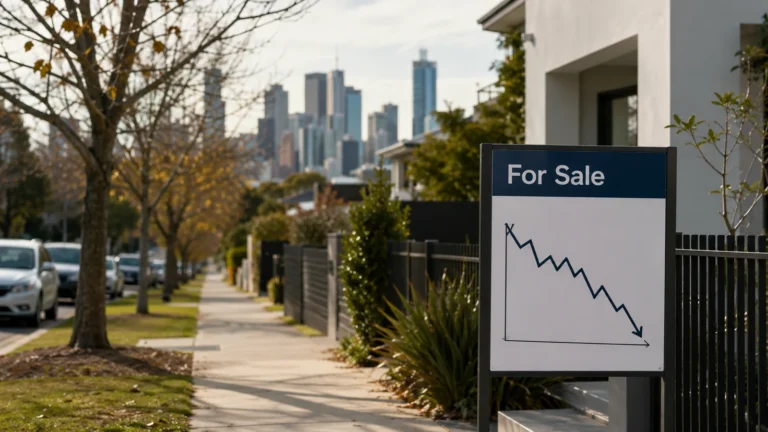
Price falls don’t land evenly. The national dwelling value index might show a modest retreat, but zoom into the electorates Labor holds by less than 5% and the picture sharpens: house prices in marginal seats are declining faster than the metro average, and that electoral arithmetic is already reshaping the policy conversation in Canberra.
When treasury models a rate decision or a first-home deposit scheme, they work from aggregates. When cabinet discusses housing policy six months out from an election, they work from postcode-level pain.
The geography of the retreat
Marginal seat price movements track differently because marginal seats tend to sit in the outer suburbs and regional commuter belts where affordability stretched hardest during the post-pandemic surge. These are the postcodes that saw the biggest percentage gains from late 2020 to early 2023, often 30–50% in two years, and now face the steepest corrections as serviceability tightens and buyers pull back.
The mechanics: higher mortgage rates hit harder when loan-to-income ratios were already at the top of the serviceability buffer. Outer-metro buyers typically borrowed closer to their maximum capacity because entry prices were lower but commuting costs and interest rate sensitivity were higher. A 25 basis point rise that removes $15,000 of borrowing power in the inner ring can remove $25,000 in the outer ring, because the borrower started with less income headroom.
That creates a feedback loop. Fewer buyers qualify at last year’s asking prices, so vendors adjust downward or hold. Holding works when rates are falling; when they’re flat to rising, listings pile up and clearance rates slide. The outer suburbs see this cycle play out faster and harder than the prestige postcodes, and marginal seats are overwhelmingly outer-metro or regional.
Why politicians care more than economists
Economists frame housing corrections as necessary adjustments after unsustainable price growth. Voters in a seat the government holds by 3% frame it as losing equity they were counting on to upgrade, help a child into the market, or fund retirement.
The political risk isn’t just falling prices, it’s falling prices combined with rising cost of living and a perception the government prioritised inflation control over household wealth. That’s a messaging problem when the opposition can point to specific streets where values have dropped 8–12% in twelve months.
Labor’s marginal seat footprint skews outer-metro in Sydney, Melbourne and Brisbane, plus a cluster of regional centres that boomed during the work-from-home migration and are now correcting as remote work policies tighten and城市 jobs pull people back. These seats swung to Labor in 2022 on a platform that included housing affordability and cost-of-living relief. If those voters feel poorer and more locked out than they did two years ago, the swing can reverse.
The catch
Intervention that props up prices solves the political problem for existing owners in marginal seats but worsens affordability for renters and first-home buyers in the same electorates, who are also swing voters. There’s no policy lever that satisfies both groups simultaneously.
The scenarios and their trade-offs
Base case: government announces targeted support (expanded first-home schemes, state-federal co-investment models, or build-to-rent tax breaks) in the next federal budget to signal action without directly propping up prices. Marginal impact on values, meaningful impact on sentiment. Risk: measures take 12–18 months to flow through, election is sooner.
Upside for owners: RBA cuts twice in the next six months as inflation moderates, serviceability improves, buyer confidence returns, outer-metro prices stabilise then lift gently. Labor holds marginal seats on the back of falling mortgage repayments. Risk: inflation doesn’t cooperate, cuts don’t arrive, prices keep sliding.
Downside: downturn deepens, unemployment ticks up, forced sales increase in over-leveraged outer suburbs, price falls accelerate into double digits in some marginal postcodes. Government either intervenes heavily (politically costly, fiscally tight) or wears the backlash. Opposition wins seats on a housing recovery platform.
What it means if you own or rent in these postcodes
If you’re holding property in an outer-metro or regional marginal seat, the next six months are a window to pressure-test your position. Can you service the loan if rates stay flat for another year? If prices fall another 5%, does that change your upgrade timeline or borrowing capacity for the next purchase? The political noise will be loud, but the financial fundamentals, your serviceability buffer and your holding horizon, matter more than the election cycle.
If you’re renting and saving in one of these areas, the correction improves your entry math but only if your borrowing capacity hasn’t shrunk faster than prices have fallen. Borrowing capacity is down $70k in some scenarios even as prices retreat, because lenders tightened buffers and rates stayed high. Check what you can actually borrow today, not what you could borrow eighteen months ago.
Red flags over the next four months
Watch for: federal budget measures explicitly targeting outer-metro first-home buyers or build-to-rent incentives in marginal seat postcodes (signals intervention is coming). Increased listings without corresponding clearance rate improvement in these areas (sellers testing the market, not finding bids). Any RBA commentary explicitly acknowledging regional divergence in price movements (rare, but if it appears, it validates the political pressure building). State governments in NSW, Victoria or Queensland fast-tracking planning approvals or rezoning in marginal seat boundaries (de-risking land supply to ease voter anger, but takes years to flow through).
The electoral geography of this downturn makes it different from a symmetric national correction. The seats that swung the last election are the ones feeling the price falls hardest, and that concentrates political risk in a way aggregate data doesn’t capture. Whether that forces policy intervention, rate cuts, or simply reshapes the campaign messaging depends on how deep the falls go and how long they persist.
For your next decision: if you’re in one of these postcodes, model the scenario where prices stay flat for two years, not the scenario where they recover in six months. The political calendar might demand action, but the transmission lag between policy announcement and actual price impact is long. Subscribe to Australian Property Review’s newsletter for the weekly signal on rates, policy and what’s shifting in the marginal seat property markets.
General info, not financial advice.