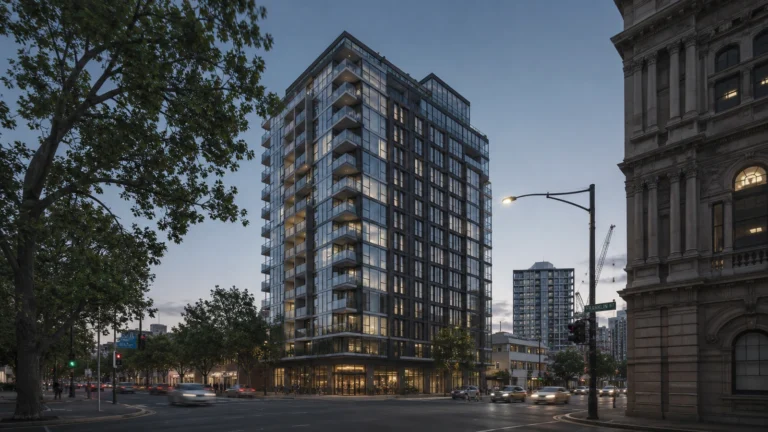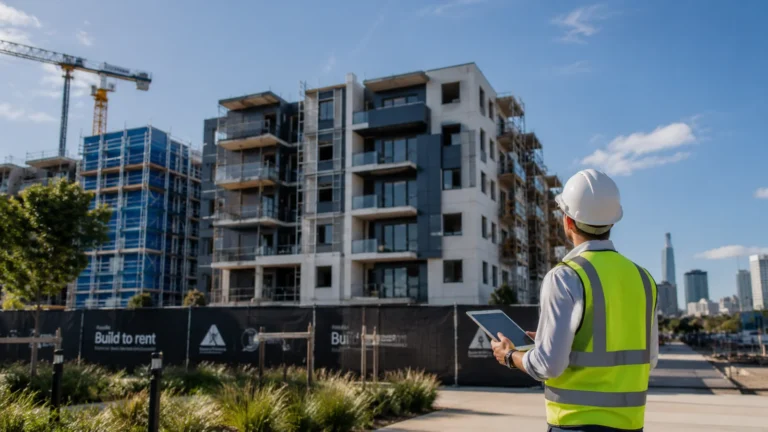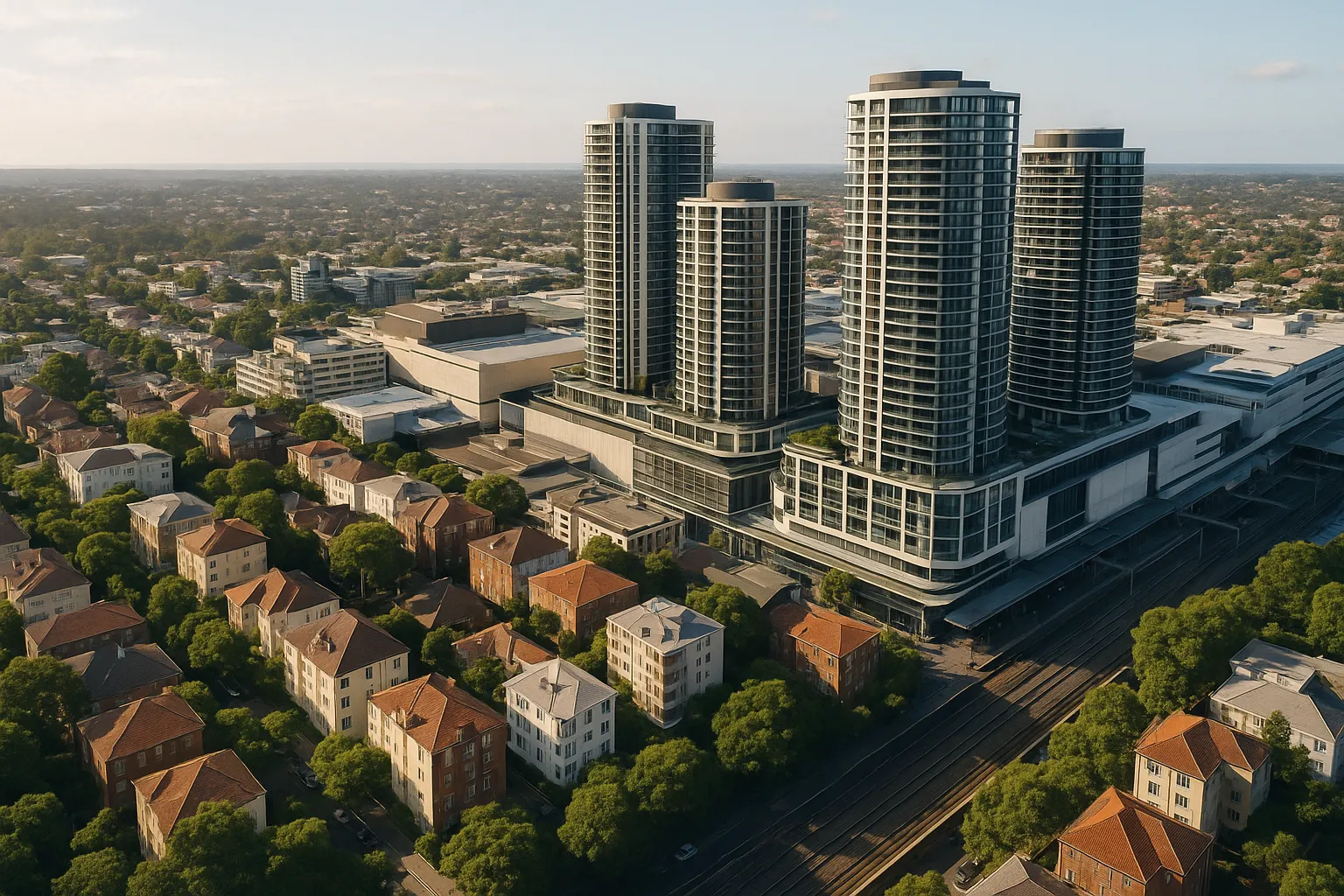
Bondi Junction apartments are back at the centre of Sydney’s housing debate, and this time the argument is not just about more homes.
It is about how high Sydney is willing to build near major transport, what developers must give back in return, and whether build-to-rent can move from policy slogan to real supply.
Apt.Residential is pushing a major redevelopment around Oxford Street Mall that could eventually deliver 1,042 build-to-rent apartments across three towers. The reported plan includes a 47-storey tower, a 40-storey tower and a third tower still being worked through in design.
The developer is also proposing a large new public square and a substantial transport-access upgrade around Bondi Junction’s rail and bus interchange.
That is the headline.
The harder question is whether the public benefit is strong enough to justify the scale.
The proposal is big because the location is hard to ignore
Bondi Junction is one of Sydney’s most obvious places to test higher-density housing.
It has heavy rail. It has major bus links. It has Westfield, jobs, schools, hospitals nearby, beaches within reach and established demand from renters who want access to the eastern suburbs without buying into one of Australia’s most expensive housing markets.
In plain English: if Sydney cannot add more apartments beside a major transport hub, it becomes much harder to argue that the city is serious about supply.
The proposed Bondi Junction apartments would sit around Oxford Street Mall, a precinct that many locals know is busy, useful and tired at the same time. The mall already has foot traffic. It does not yet have the civic centre feel that planning documents often promise.
That is what the developer is trying to sell: not just towers, but a reset of the centre.
The plan, as reported, includes:
- 1,042 build-to-rent apartments across three towers
- a tallest tower of about 47 storeys
- a second tower of about 40 storeys
- a third tower still in design
- 10 per cent affordable housing
- an 1,100 square metre town square-style public space
- a claimed $160 million public infrastructure package
- improved access to Bondi Junction’s transport interchange
The NSW Planning Portal currently lists the first stage at 410–420 Oxford Street as a State Significant Development project. It describes a staged build-to-rent proposal involving a 46-storey building with 345 dwellings, affordable housing, commercial tenancies and a future pedestrian link to Bondi Junction Station.
That matters because this is not an approved project. It is a proposal moving through a planning process.
Build-to-rent changes the politics, but not the planning test
Build-to-rent is often presented as a cleaner answer to Australia’s housing shortage.
Instead of selling apartments one by one, a single owner keeps the building and rents the homes out over time. The model can offer longer-term rental supply, professional management and a more institutional approach to housing.
That does not make the model automatically good or bad.
It changes the trade-off.
For renters, the upside is more dedicated rental stock in a well-connected suburb. For government, the upside is supply that does not rely entirely on mum-and-dad investors. For the developer and its financial backers, the upside is long-term income rather than one-off sales.
Here’s the catch.
Build-to-rent still has to stack up commercially. High land values, construction costs, interest rates, planning delays and affordable housing requirements all feed into feasibility. If the numbers become too tight, projects slow, shrink or stall.
That is why this Bondi Junction proposal is important beyond one suburb. It is a test of whether high-density rental housing can work in expensive inner and middle-ring Sydney locations where demand is strong but local resistance can be stronger.
Australian Property Review has covered the broader supply problem in Frasers Property Adds 3,800 Homes to Development Pipeline and the feasibility catch in Melbourne build-to-rent deal exposes the supply catch.
The same issue sits underneath Bondi Junction: everyone wants more housing in theory, but the details decide whether it gets built.
The 30-storey question will be the flashpoint
Waverley Council’s broader Bondi Junction planning work has pointed towards more homes and a stronger town centre. But the reported height guidance around Oxford Street Mall is closer to 30 storeys.
A tower pushing into the high-40s is a different conversation.
That does not mean it cannot be approved. Planning systems can allow extra height where a project delivers enough public benefit. But this is where the debate becomes less about “homes versus no homes” and more about value exchange.
If the community is being asked to accept a much taller skyline, what does it receive in return?
The developer’s answer appears to be rental supply, affordable housing, public space, transport access and construction jobs.
Critics are likely to ask different questions:
- Is 10 per cent affordable housing enough for a project of this scale?
- Will the public square feel genuinely public or mainly serve the towers?
- Will transport upgrades reduce pressure or just support more density?
- Will local streets, schools and services absorb the extra population?
- Will the towers improve Oxford Street Mall or overwhelm it?
- What happens to small retailers during demolition and construction?
None of those questions kills the project on its own. But together, they shape the approval risk.
The affordable housing number is useful, but modest
A 10 per cent affordable housing allocation would mean about 104 homes if applied across the full 1,042-apartment plan.
That is not nothing.
In a suburb where private rents are high and ownership is out of reach for many workers, any dedicated affordable housing matters.
But it also means around 90 per cent of the homes would still sit in the market-rental system. They may improve supply, and extra supply can help reduce pressure at the margin, but it would be a stretch to call this an affordability fix by itself.
The more realistic reading is this: the project could add rental options in a high-demand location, while giving government a politically useful affordable housing component.
That is different from solving rental stress across the eastern suburbs.
Now, the part most people miss: affordability is not only about rent levels. It is also about location.
A renter paying more to live near Bondi Junction Station may save time and transport costs compared with living further out. For some households, that trade-off works. For others, it does not.
The practical test is whether these apartments serve a broader rental market or mainly cater to higher-income renters who already have choices.
Public space is the sweetener, but delivery matters
The proposed town square is likely to be central to the sales pitch.
Bondi Junction has plenty of movement but not enough pause. People pass through to shop, commute, work or change buses. A better civic space could improve the centre if it is well designed, shaded, active and easy to access.
But public space attached to private development can go wrong.
The risk is a space that looks good in renders but feels windy, shadowed, over-managed or disconnected from daily life. A true public square needs more than paving, seating and a few food tenancies. It needs sunlight, edges that work, clear public access and a reason for locals to use it when they are not shopping or commuting.
That is where Waverley Council and the NSW Government need to be hard-nosed.
If extra height is being traded for public benefit, the benefit should be measurable, enforceable and delivered early enough to matter.
Quick take
Bondi Junction is the type of place where Sydney should be adding more homes, but that does not mean every tower proposal deserves a free pass. The key test is whether the public gets enough housing, affordable rental stock, transport improvement and usable public space to justify the extra height.
What changes for investors and homeowners nearby
For property owners around Bondi Junction, the second-order effects are more interesting than the headline height.
More than 1,000 new rental apartments could change the local rental market, but not in a simple way.
In the short term, construction can create disruption. Noise, traffic changes, retail turnover and pedestrian access issues can affect the feel of a precinct for years.
Once complete, new rental supply could give tenants more choice, especially if the apartments are well managed and close to transport. That may put some pressure on older apartments with weaker layouts, tired common areas or poor energy performance.
But location still matters.
Bondi Junction has a deep rental pool because it sits between the CBD, beaches, hospitals, universities, retail jobs and professional employment. New supply may not push rents down sharply if demand remains strong. It may instead split the market more clearly between premium managed rental stock and older private rentals.
For investors, the rule of thumb is simple: do not assume all new supply is bad for existing apartments. But do check what your property is competing against.
A dated one-bedroom apartment with high strata fees may feel the pressure more than a well-located, well-presented apartment with parking, light, storage or a stronger floor plan.
Australian Property Review has made a similar point in Property market crash: buying window or bigger fall ahead? Buyers and investors should pressure-test the asset, not just the headline.
The planning timeline is the real story now
The proposal still has hurdles.
Community consultation, environmental assessment, council response, state planning review and design changes could all reshape the project before any major construction begins. Even if approval is granted, financing, construction costs and market conditions still matter.
That is why readers should treat the current numbers as a live proposal, not a finished outcome.
The base case is that Bondi Junction gets more density over time. The exact form, height and public benefit package remain uncertain.
The upside case is that the project forces a serious renewal of Oxford Street Mall, adds meaningful rental supply and improves access to one of Sydney’s most important transport hubs.
The downside case is that the process becomes a fight over height, the affordable housing component looks too thin, public benefits are watered down, and delivery takes longer than promised.
For now, the project has done one thing clearly: it has put Bondi Junction at the centre of Sydney’s density debate.
What happens next
The next step is not to decide whether the towers are good or bad based on height alone.
The better question is what Sydney gets for saying yes.
If the answer is more rental homes, enforceable affordable housing, a genuinely public square and better transport access, the proposal will have a stronger case.
If the answer is mostly private rental towers with a civic upgrade attached, expect pushback.
Start here: watch the planning documents, not just the renders. The final conditions, affordable housing terms, staging and public-space controls will matter more than the launch pitch.
For independent property analysis without the spin, subscribe to the free Australian Property Review newsletter.