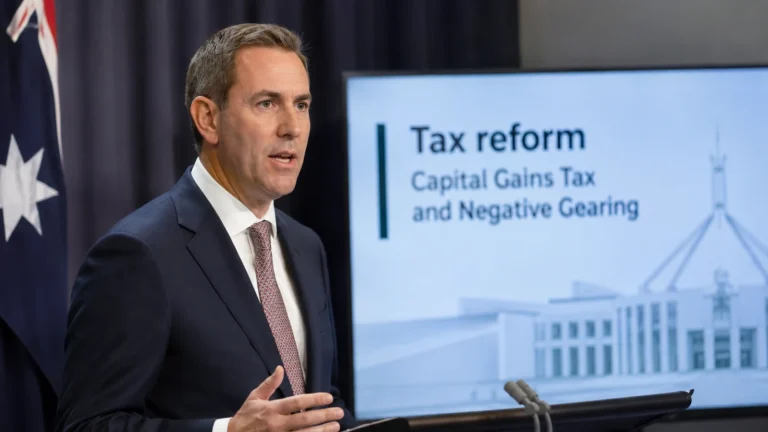
Labor has softened parts of its proposed CGT changes, but the bigger issue for property investors has not disappeared.
The government is now offering wider exemptions for small businesses, a carve-out for some start-ups and relief for testamentary trusts. That matters politically. It also matters for families, founders and business owners who feared the original budget package would punish long-term risk-taking.
But for property investors, the practical question is sharper.
If the government is already rewriting parts of the package before the bill clears the Senate, how much confidence can investors place in the final version?
That is the part most people miss. A backdown does not remove uncertainty. Sometimes it confirms it.
What has actually changed
The government has moved to soften the tax package after criticism from business groups, the opposition and parts of the investment community.
The key change is the small business threshold. Businesses with annual turnover up to $10 million are expected to remain eligible for existing small business CGT concessions. The previous threshold was $2 million.
That is not a minor tweak. It brings many more business owners into the safer zone and reduces the chance that a sale of a small business is caught by the harsher version of the capital gains tax overhaul.
The government has also flagged protection for founders of genuinely innovative start-ups, early investors and some employees paid through equity. The concern there was simple. If a founder starts with a very low cost base, an inflation-linked CGT system may give little protection compared with the current 50 per cent discount.
Testamentary trusts are also being treated differently. These are trusts created through a will, often used to manage income for beneficiaries after someone dies. The government has now said they will be carved out of the proposed 30 per cent minimum tax on discretionary trusts, subject to further consultation.
So what changed?
Small business, start-ups and testamentary trusts have been given breathing space.
What did not change?
The broader direction of the tax reform is still alive.
Why property investors should still pay attention
Property investors may look at a small business CGT concession and think this is someone else’s problem.
That would be too narrow.
Tax policy rarely stays in one lane. The same budget package sits around capital gains tax, negative gearing, discretionary trusts and the treatment of different asset classes. Even if one part is softened, the signal to investors is that after-tax returns are now a live policy target.
Australian Property Review has already covered why CGT changes can hit the exit decision for property investors. Negative gearing changes the cost of holding an asset. CGT changes the amount an investor keeps when they sell.
That distinction matters.
A landlord can absorb a bad year if rent rises, rates fall or the property is held for long enough. A weaker CGT outcome is different. It can change the reward for taking years of debt, maintenance costs, vacancy risk and market volatility.
Here’s the catch. If the sale becomes less attractive, some investors may not sell. They may hold longer, delay portfolio changes, or avoid restructuring even when the asset no longer fits their strategy.
That is not always good for the housing market. A tax rule designed to raise revenue can also reduce turnover.
Quick take:
The backdown helps small business owners and some trust users. It does not give property investors a clean answer. Until the final bill is settled, investors should model the current rules and the proposed rules before buying, selling or restructuring.
The Senate is now the real market signal
The next pressure point is not the press conference. It is the Senate.
The Coalition remains opposed to the reforms. That leaves the government needing a deal with the Greens or crossbenchers.
That matters because the final package may not look exactly like the announcement. The government has already shown it is willing to carve out politically sensitive groups. The Greens may push in the other direction, particularly around housing affordability, investor tax concessions and revenue.
For investors, that means the policy risk has shifted from “what did the budget say?” to “what deal gets the numbers?”
Australian Property Review has previously explained this problem in Negative gearing reform: Greens raise price of Labor deal. The issue is not only whether the government wants reform. It is what the government has to trade away to pass it.
That is where the second-order effects begin.
If investor concessions are narrowed further, established property may become less appealing to some buyers. If new builds keep better tax treatment, capital may shift towards new housing. That could support supply, but only if projects can actually be delivered.
Planning delays, construction costs, builder capacity and financing conditions still matter. Tax incentives do not pour concrete.
What the CGT changes mean in plain English
Capital gains tax is paid when an asset is sold for more than its cost base. The cost base is generally what you paid, plus eligible costs.
Under the current system, individuals and trusts that hold an asset for more than 12 months can usually access a 50 per cent CGT discount. In simple terms, only half the eligible gain is taxed.
The proposed reform would move towards an inflation-linked model for some assets. Instead of applying a flat 50 per cent discount, the system would adjust the cost base for inflation.
That may sound fair. If inflation has eaten part of the gain, why tax it as if it were a real profit?
But the outcome depends on the numbers.
If inflation is high and the asset’s real gain is modest, indexation may help. If the asset has risen strongly over time, the current 50 per cent discount may still be more valuable.
That is why investors should not assume one system is always better. It depends on the purchase price, holding period, inflation path, income position and sale timing.
Australian Property Review has explored this in The Missing CGT Rule That Could Sting Property Investors, particularly where a large gain is taxed in one financial year.
The property investor problem is timing
Most property investors do not sell every year. They make a few large decisions over decades.
That creates a timing problem.
A family may hold an investment property for 15 years, then sell because of retirement, divorce, debt reduction, school fees, estate planning or a move into a better asset. The tax bill arrives in one year, even though the gain built up over many years.
That is why CGT policy can bite harder than it first appears. The headline rate is only one part of the story. The timing of the gain, the investor’s other income and the absence of averaging can matter just as much.
A simple rule of thumb helps.
If a property only works because the tax treatment stays exactly as it is, the margin is thin.
That does not mean the investment is wrong. It means the investor needs a larger cashflow buffer and a clearer exit plan.
Who wins and who is still exposed
The latest concessions create obvious winners.
Small business owners between the old $2 million threshold and the new $10 million threshold are in a better position than they were before. Founders and early start-up investors may also avoid a tax outcome that would have made equity risk less attractive. Families using genuine testamentary trusts have more comfort than they had after the budget.
But property investors are not in the same position.
They are still waiting for the final shape of the package. They still face uncertainty around negative gearing settings, CGT treatment and how trusts will be treated. They also need to watch how banks respond, because lenders can adjust serviceability settings before investors feel the full effect of legislation.
Serviceability is the lender’s test of whether a borrower can afford a loan under stressed assumptions. If tax settings reduce after-tax cashflow, borrowing power can tighten.
Australian Property Review has covered that bank channel in Negative gearing bank changes hit investor loans.
What could derail the reform
There are four main pressure points.
First, the Senate could demand further changes. That may water down the reform or make it more aggressive in areas linked to housing.
Second, consultation could expose design problems. Tax systems are full of edge cases. Trusts, small businesses, farms, family companies and property structures do not always fit clean political slogans.
Third, investor behaviour may shift before the law starts. Buyers may delay purchases. Sellers may bring forward sales. Accountants may recommend restructuring. Banks may change assumptions.
Fourth, the housing market may be weaker by the time the final rules are clear. If prices cool, rental pressure stays high and construction remains constrained, the politics of investor tax reform may become harder.
The base case is that the government keeps pushing for a revised package, but with more carve-outs than originally planned.
The upside case for investors is a clearer, narrower reform that protects ordinary structures and avoids punishing long-term asset holders.
The downside case is a messy compromise that leaves investors with more complexity, less certainty and higher advice costs.
The practical take for investors
The mistake now would be reacting to headlines alone.
A backdown is not the same as a settled law. A concession for small business is not the same as a concession for every property investor. A Senate negotiation is not the same as a final tax outcome.
If you own investment property, hold assets through a trust, run a small business, or expect to sell an asset in the next few years, this is the moment to pressure-test your position.
Start with three questions.
Would the asset still make sense if the CGT outcome were weaker?
Would your borrowing power change if negative gearing treatment became less useful?
Would your ownership structure still be suitable if trust tax rules changed?
For more background, read Australian Property Review’s earlier analysis on budget tax concessions and the investor trap and budget tax shock for property, shares and trusts.
The next step is simple: ask your accountant or licensed adviser to model your current position under both the existing rules and the proposed future rules before you sell, restructure or buy again.
For independent property analysis each week, subscribe to the free Australian Property Review newsletter
General info, not financial advice.