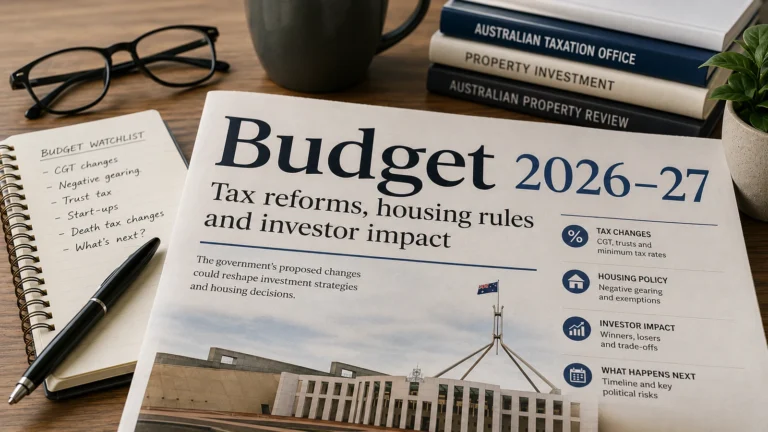
Labor’s proposed trust tax changes are moving from abstract budget policy into a very real planning problem for property investors, family businesses and estate structures.
The political pressure point this week is charity giving. Religious and community groups have warned that the government’s proposed 30 per cent tax on discretionary trust distribution income could reduce donations from 2028. Assistant Minister for Charities and Treasury Andrew Leigh has confirmed the government is considering a carve-out for some discretionary trust distributions to not-for-profit entities, though the detail is not settled.
At the same time, the High Court has handed taxpayers a major win in Commissioner of Taxation v Bendel, ruling that a beneficiary’s unpaid present entitlement from a trust is not automatically a loan for Division 7A purposes. That matters because Division 7A can turn certain private company benefits into deemed dividends for tax purposes.
Here’s the catch. The Bendel ruling may clean up one long-running trust tax fight, but it does not remove the bigger policy risk now facing discretionary trusts.
What changed this week
Two things happened at once.
First, the government signalled that it may soften part of the proposed trust tax package where charities and not-for-profits are affected. The concern is simple: if a trust has to pay 30 per cent tax before money reaches a charity, less money may be available to donate.
Second, the High Court rejected the Australian Taxation Office’s long-held position in Bendel. In plain English, unpaid trust income owed to a corporate beneficiary is not, by that fact alone, treated as a loan under Division 7A.
That is a serious win for taxpayers who use trust and company structures.
But it is not a green light to ignore the broader trust tax changes.
The government’s proposed reforms still include a minimum 30 per cent tax on discretionary trust income from 1 July 2028, alongside broader changes to capital gains tax and negative gearing. Those measures are still subject to legislation and parliamentary scrutiny.
Australian Property Review has already covered how the budget’s tax package could affect investors in Budget Tax Shock Hits Property, Shares and Trusts and why concessions may not remove the uncertainty in Budget Tax Concessions: The Investor Trap.
Why property investors should care
Many property investors think of trusts as something for wealthy families or business owners.
That is only partly true.
Discretionary trusts are commonly used for asset protection, estate planning, business ownership and family wealth management. Some investors also use trusts to hold property, shares or related business assets.
The proposed trust tax changes matter because they may change the after-tax return from those structures.
For a property investor, the practical questions are not just legal. They are cashflow questions:
Can the structure still distribute income efficiently?
Does the trust still make sense after a 30 per cent minimum tax?
Will capital gains be taxed differently on sale?
Could refinancing, debt recycling or succession planning become more expensive?
What happens if property income is retained, distributed or moved through a corporate beneficiary?
That is why Bendel matters, but only as part of the story.
The High Court has given clarity on one technical issue. The government may still legislate a broader minimum tax that changes the economics from 2028.
In plain English:
Bendel may reduce one ATO pressure point around unpaid trust entitlements. Labor’s proposed trust tax changes could still impose a new 30 per cent floor on discretionary trust income from 2028. One is a court ruling. The other is a policy fight.
The Bendel ruling, without the tax jargon
The Bendel case centred on unpaid present entitlements.
That phrase sounds worse than it is.
An unpaid present entitlement is when a trust makes a beneficiary presently entitled to income, but the cash is not actually paid out at that time. For years, the ATO treated certain unpaid entitlements owed to private companies as loans for Division 7A purposes.
That mattered because Division 7A is designed to stop private companies from passing value to shareholders or associates without proper tax being paid.
The High Court has now said the ATO’s interpretation went too far. The passive retention of trust funds is not automatically the same as a loan.
For advisers and investors, this gives more certainty for past trust distributions and year-end planning.
But certainty does not mean simplicity.
The ATO and Treasury may respond. Parliament can also change the law. That is the part investors should not miss.
The charity carve-out shows where the politics gets difficult
The charity issue is politically awkward for the government.
The trust tax changes are being sold as a fairness measure. The broad argument is that discretionary trusts allow income to be allocated in ways that can reduce tax for high-income households.
But charities and not-for-profits are now warning of a second-order effect. If trusts are taxed before distributions reach community groups, the reform may raise revenue by reducing donations.
That is why the government is considering an exemption for some discretionary trust distributions to not-for-profit entities. Charitable trusts are already carved out, but the debate is about ordinary discretionary trusts that make donations or distributions to tax-exempt bodies.
For property investors, the lesson is broader than charity giving.
Once a tax change hits trusts, the effects do not stay inside tax law. They flow into estate planning, succession, investment timing, debt strategy and business decisions.
What has not changed
The main reform is not law yet.
A bill dealing with the trust tax changes has not been finalised in the same way investors would need before making hard decisions. The government’s broader tax package is still moving through scrutiny and may change before 2028.
That matters.
Investors should avoid two mistakes.
The first mistake is assuming Bendel means the trust tax risk is gone.
It does not.
The second mistake is restructuring too early without knowing the final legislation.
That could trigger unnecessary costs, stamp duty problems, CGT issues or financing complications.
This is especially relevant for investors who hold property in a trust, plan to pass assets through a family structure, or use a company beneficiary as part of a broader tax strategy.
For more on the investor side of the budget changes, read Australian Property Review’s earlier analysis: Property Investor Tax Shield Before Budget.
The practical impact from 2028
If the 30 per cent minimum tax proceeds as proposed, discretionary trusts may lose part of their flexibility.
That does not mean every trust becomes useless. It means the numbers change.
A trust may still be useful for asset protection, succession or family control. But if the tax advantage falls, investors will need to pressure-test whether the structure still earns its keep.
A simple rule of thumb: if the trust exists mainly for tax flexibility, review it hard. If it exists for asset protection or succession, review it carefully, but do not assume the answer is to unwind it.
The base case is that some carve-outs are likely where the political cost is obvious, such as charities, some not-for-profits or vulnerable estate planning cases.
The downside case is that the government keeps the reform broad and investors face more complex tax outcomes from 2028.
The upside case is that consultation narrows the rules before they start.
What to do before June 30
This is not a “panic and restructure” moment.
It is a “get the file in order” moment.
If you use a discretionary trust, ask your accountant or tax adviser for three things before making any major property decision:
- A review of unpaid present entitlements and company beneficiary arrangements after Bendel.
- A 2028 scenario showing what a 30 per cent minimum trust tax would do to annual cashflow.
- A sale scenario showing how the proposed CGT changes could affect an exit.
For property investors, the most useful question is not “is my trust still legal?”
It is: “Does this structure still make sense if the tax assumptions change?”
That answer will depend on debt, income, beneficiaries, capital gains, asset protection needs and how long you plan to hold the property.
Bottom line
Bendel gives taxpayers a win, but Labor’s trust tax changes still leave investors with a live policy risk.
The smart move is not to chase headlines. It is to get your structure reviewed before the rules are locked in, then model the 2028 impact under conservative assumptions.
Start here: ask your adviser for a written trust structure review that includes Bendel, Division 7A, CGT, and the proposed 30 per cent minimum tax.
Subscribe to the free Australian Property Review newsletter for clear property policy updates
General info, not financial advice.