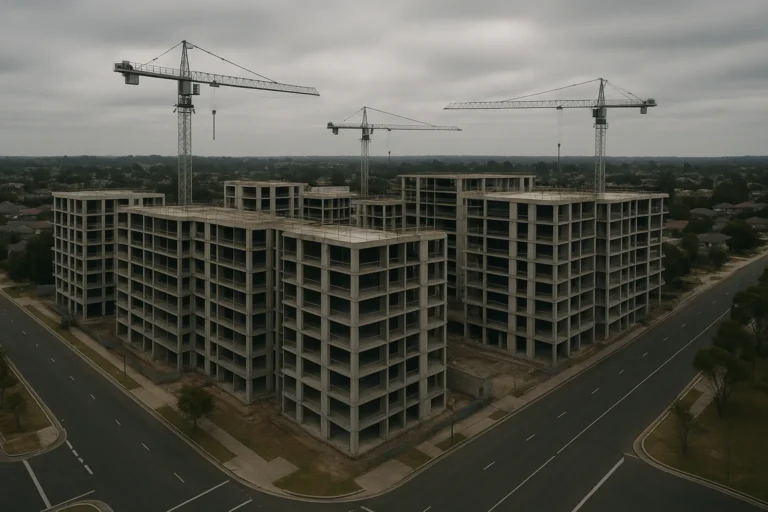
A private credit lender is moving to sell more than 100 properties and land parcels after a major residential developer went into administration. The disposal is happening faster than the usual receivership timeline, and the pricing structure offers a window into how funds calculate loss when projects stall mid-cycle.
This isn’t a fire sale in the traditional sense, the lender controls the pace and the reserve, but it’s also not a patient hold-and-finish strategy. The middle ground reveals the trade-offs private credit faces when collateral is part-built or raw land in softening precincts.
How accelerated disposal works
When a developer defaults and a private lender holds first security, the lender can choose to appoint receivers, finish the projects, or sell the assets as-is. Finishing requires more capital and time; selling quickly crystallises the loss but frees up balance sheet and returns some cash to the fund.
Accelerated disposal typically means the lender sets a floor price based on its own loan book valuation, then tests the market in tranches, high-quality stock first, marginal parcels later. Buyers get a discount to replacement cost but not necessarily to current land values, because the lender’s goal is recovery rate, not market share.
The speed matters for two reasons. First, holding costs: rates, insurance, maintenance on dozens of properties add up, and private credit funds often have quarterly redemption windows that reward liquidity. Second, valuation risk: if the precinct softens further or construction costs rise, the gap between debt and asset value widens.
What the pricing reveals about recovery assumptions
Private credit funds typically lend at 60-70% loan-to-value on development sites, with the assumption that even a stressed sale recovers 80-90 cents in the dollar. That assumption holds if land values are stable and the project was feasible when underwritten.
When a lender moves to dispose quickly rather than finish, it signals one of three things: the projects weren’t viable at current costs, the fund needs liquidity more than it needs to maximise recovery, or the precinct outlook has shifted enough that waiting adds risk.
For this portfolio, the mix includes completed homes, homes under construction, and raw subdivided lots. Completed homes should sell close to retail, minus a small discount for bulk and timeline certainty. Homes under construction carry completion risk and funding gaps, buyers either need to finish them or factor in the cost of mothballing and restarting. Raw land is the hardest to price: it’s worth what the next developer will pay, and that depends on their view of demand, approvals, and whether they can execute cheaper than the previous owner.
If completed homes sell at 5-10% below comparable retail and raw land moves at 20-30% below peak, the lender likely recovers 75-85 cents per dollar lent. If discounts widen beyond that, it suggests either the original LVR was optimistic or the market has moved faster than the loan book reflects.
The buyer’s market question
Forced asset sales do create opportunity, but it’s segment-specific. Builders and investors looking for completed or near-completed stock in established precincts get the best risk-adjusted entry, minimal execution risk, known demand, and a discount that compensates for buying in bulk or off-market.
Raw land is a different calculation. The discount looks attractive, but the same factors that stalled the original developer, approvals, infrastructure timing, construction costs, presale thresholds, still apply. Unless those constraints have eased or you have access to cheaper capital and execution, the deal isn’t materially better than buying at market.
For private credit investors watching from the sidelines, the pricing provides a real-time mark on what similar portfolios might fetch if other developers hit trouble. If this sale clears smoothly at modest discounts, it supports the view that recovery rates hold even in softer markets. If it drags or requires deeper cuts, it’s a signal that loan book valuations across the sector may need revision.
What could stall the disposal
Three risks slow or complicate accelerated sales. First, title and approval complexity: if some parcels have incomplete subdivisions, disputed easements, or conditional planning permits, they can’t settle quickly and end up dragging the whole process.
Second, buyer financing: if most buyers need development finance and credit conditions have tightened since the original developer borrowed, fewer bidders qualify and the pricing floor drops.
Third, covenant and fund structure: some private credit funds have covenants that limit how much they can sell below book value in a single quarter without triggering revaluation across the portfolio. That can force the lender to either slow the sale or negotiate with unitholders.
The catch
The real risk isn’t the sale itself, it’s what happens if several private credit funds need to dispose at the same time. One portfolio moving in an orderly way at 10-15% discounts is absorbed by the market. Three or four funds selling similar assets into the same precincts compress pricing faster and force broader revaluations.
What this means for other exposed funds
Private credit has grown fast in Australian residential development over the past five years, with funds stepping in as banks tightened serviceability and presale requirements. Most of that capital went into projects that assumed mid-single-digit price growth, stable construction costs, and normal presale timelines.
When those assumptions break, and they have in some precincts, the question is whether funds hold and finish, or sell and move on. The answer depends on fund size, redemption pressure, and how many other exposures are under stress.
For investors in unlisted property or private credit funds with development exposure, the key metric is weighted average LVR across the development book. If it’s sitting at 65% and recent comparable sales suggest asset values are down 10-15%, there’s still a buffer. If LVR has crept to 75% or loans were underwritten at peak pricing, the buffer is thin and disposal risk rises.
Key numbers
- Private credit lends at 60-70% LVR on development sites
- Forced sales typically recover 75-85 cents per dollar lent if executed well
- Completed homes may sell at 5-10% discount to retail in bulk transactions
- Raw land in softening precincts can trade 20-30% below peak depending on approvals and infrastructure
Practical take for investors and buyers
If you’re a builder or investor with liquidity and execution capability, forced asset sales offer a real entry point, especially for completed or near-completed homes in precincts with proven demand. The discount compensates for buying in bulk and committing quickly, but the fundamental demand case still needs to stack up.
If you’re an investor in a private credit fund with development exposure, ask three questions: what’s the weighted average LVR across the development book, how many projects are under stress, and what’s the fund’s disposal track record. Funds that have sold distressed assets before and recovered 80 cents or better have credibility; funds without a track record are harder to assess.
If you’re considering raw land in these sales, compare the net cost after discount to buying at current market with normal settlement terms. The headline discount often disappears once you factor in the risks of bulk purchase, uncertain approvals, and higher cost of capital.
Read more about private credit due diligence and regulatory scrutiny. For a deeper look at how falling asset values test recovery assumptions, see this analysis of development finance risk.
To track forced sales, regulatory developments and private credit risks as they unfold, subscribe to the Australian Property Review newsletter.
General info, not financial advice.