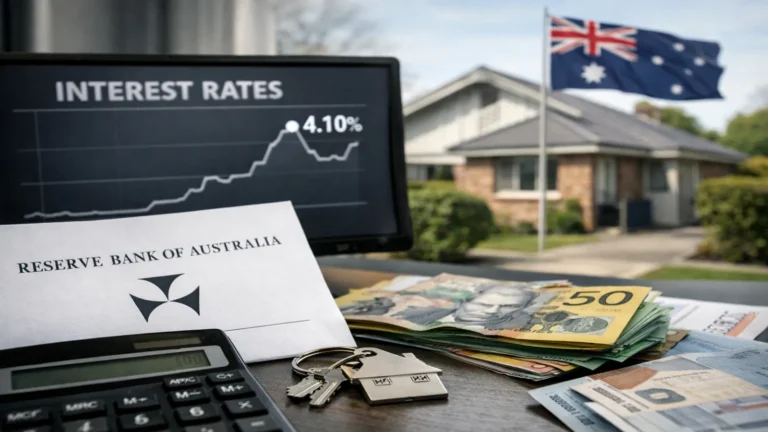
The Reserve Bank meets next week with another cash rate rise widely priced in, the fourth this year. But the sharpest criticism ahead of the decision isn’t about whether rates should go up. It’s about whether the right lever is doing all the work while the bigger inflation driver, government spending, operates outside the RBA’s reach.
Mortgage holders have already absorbed $4,212 a year in extra repayments since this rate cycle began, according to Compare the Market. That figure lands on roughly a third of households. Meanwhile, government expenditure is running at its highest peacetime level since 1986, and state infrastructure pipelines continue to expand without the same interest-rate sensitivity that private borrowers face.
The tension isn’t new, but it’s sharpening. When monetary policy is the only tool being adjusted and fiscal policy stays expansionary, the burden of controlling inflation falls disproportionately on the households and small businesses most exposed to variable debt.
The mechanics: why rates hit unevenly
Interest rates work by raising the cost of borrowing, which slows consumption and investment. In theory, that cools demand across the economy and brings inflation back toward target. In practice, the transmission is uneven.
Mortgage holders on variable rates, about 35% of households, feel the impact immediately through higher repayments. Renters feel it indirectly if landlords pass on higher debt costs, though that transmission is slower and less certain. Outright owners and those on long fixed terms see no direct change to their cashflow, and government spending decisions are largely insulated from the cash rate because public debt is typically issued at longer maturities and refinanced over time, not repriced monthly like a variable mortgage.
That means the RBA’s lever is sharp where it reaches and blunt where it doesn’t. If inflation is being driven by broad demand, households, business investment, and public expenditure all running hot, then raising rates will only suppress the slice of demand that’s rate-sensitive. The rest continues.
Government spending and inflation: the channel that matters
Fiscal policy affects inflation through straightforward channels. When government spending increases, whether on infrastructure, services, or transfers, it injects demand into the economy. If that demand outpaces supply, prices rise. If it competes for the same labour, materials, and capacity that the private sector needs, it bids up costs.
Right now, state infrastructure pipelines are substantial. Federal budget settings remain expansionary relative to the pre-pandemic baseline. That’s a policy choice, and it has a demand effect. The argument from critics is that if fiscal policy is adding to inflation, then tightening monetary policy harder to compensate means mortgage holders are paying twice: once for the inflation itself, and again through higher repayments designed to offset fiscal expansion they didn’t cause.
The counter-argument is that much of that spending is supply-side, transport, housing, energy, and will eventually ease capacity constraints. The timing question is whether “eventually” arrives before rate rises have done lasting damage to household balance sheets.
The catch
- Average mortgage holder’s repayments: up $4,212 per year since the rate cycle began
- Government spending as a share of GDP: highest peacetime level since 1986
- Share of households directly exposed to RBA rate moves: roughly one-third (those with variable mortgages)
- State infrastructure spend: largely insulated from cash rate changes due to long-term debt structures
The policy split and who controls what
The RBA sets the cash rate. It cannot set the budget, direct infrastructure timing, or alter fiscal settings. Those sit with federal and state governments. The central bank’s mandate is price stability and full employment, and its tool is the cost of borrowing.
If inflation is being driven in part by fiscal expansion, the RBA has two choices: accept higher inflation, or tighten monetary policy enough to offset the fiscal impulse. The second option means raising rates further than would otherwise be necessary, and the cost of that adjustment falls on the rate-sensitive slice of the economy.
That asymmetry is the source of the tension. Mortgage holders are absorbing the adjustment for a problem they did not exclusively create. The policy lever being pulled is the one that reaches them, not the one that reaches government treasuries.
What could change the equation
A few scenarios shift the balance:
-
Fiscal consolidation: If government spending moderates, either through spending cuts or slower growth in outlays, the demand impulse eases and the RBA may not need to raise rates as high or hold them there as long. The political cost of that consolidation is the trade-off.
-
Supply-side delivery: If infrastructure spending delivers capacity increases that actually ease bottlenecks, more housing, better transport, cheaper energy, then the fiscal expansion becomes deflationary over time rather than inflationary. The lag is the risk.
-
Inflation falls anyway: If global commodity prices keep retreating and domestic wages moderate, inflation may return to target without further rate rises, regardless of fiscal settings. In that case, the debate becomes academic.
-
Explicit coordination: Governments could signal fiscal restraint ahead of RBA meetings, giving the central bank more confidence that demand will be managed without further rate rises. That requires political will and cross-government agreement, which is rare outside crises.
For mortgage holders: the practical response
If you’re on a variable rate and another rise lands next week, here’s the immediate checklist:
-
Recast your buffer: Add the new repayment to your budget and confirm you still have three months of expenses liquid. If you’re close to the edge, contact your lender now, hardship provisions exist and are easier to access before you miss a payment.
-
Fixed-rate window: If you’re rolling off a fixed term in the next six months, compare current fixed rates against the forward curve. Locking in certainty may cost more than staying variable, but it caps your exposure if the RBA moves again.
-
Offset and redraw: Every dollar in your offset account is a dollar you’re not paying interest on. If you have savings sitting in a transaction account earning 0.5%, move it.
-
Refinance check: If you haven’t reviewed your rate in two years, compare your current margin against new-customer offers. Lenders are competing harder now, and a 0.2–0.3% margin cut compounds over the life of the loan.
For a deeper look at how falling property values intersect with rising rates, see our analysis of negative equity exposure among recent first home buyers. If you’re weighing whether to expand your portfolio in this environment, our breakdown of second-property trade-offs covers the yield and timing questions that matter.
The unanswered question
The core issue remains: if fiscal policy is contributing to inflation, should the central bank name that dynamic explicitly, or is doing so beyond its remit?
The RBA’s statements have become more direct about the inflation drivers it sees, services inflation, tight labour markets, consumption resilience, but they stop short of attributing a specific share to government spending. That may be appropriate institutional restraint, or it may leave households carrying the cost of a policy misalignment they cannot vote to change.
The next RBA meeting will clarify whether the board sees enough progress on inflation to pause, or whether another 25 basis points is necessary to keep demand in check. If the latter, mortgage holders will pay the bill. Whether governments adjust fiscal settings in response will determine how many more bills follow.
Subscribe to the newsletter for the weekly signal on rates, credit, and what shifts next.
General info, not financial advice.