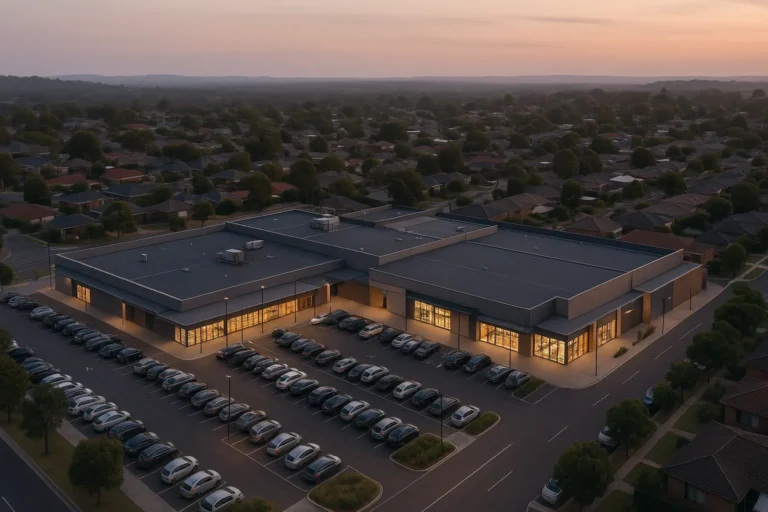
Blackstone has found a buyer for the final asset in a three-year, $3 billion shopping centre selldown across Australia. The transaction closes out one of the most visible institutional exits from retail property in recent memory, and the fact it’s taken this long to offload the portfolio, plus the reported pricing discount to pre-pandemic valuations, tells you more about the sector’s health than any press release will.
This wasn’t a distressed fire sale. It was methodical derisking by a fund that saw the structural headwinds, rising interest rates, soft consumer spending, the shift to online retail, and decided to redeploy capital elsewhere. The catch: finding buyers willing to pay anywhere near book value proved harder than expected, even for well-located centres with stable tenant rolls.
Why institutional capital walked away
Retail property delivered predictable income for decades, but the risk-return equation flipped after 2020. E-commerce penetration accelerated during lockdowns and didn’t reverse. Discretionary spending growth slowed as households absorbed higher mortgage repayments and living costs. Tenant failures spiked in categories like homewares and fashion, leaving landlords to backfill space at lower rents or fund fitouts to attract replacements.
At the same time, the cost of holding these assets rose. Debt that was cheap to refinance in 2021 repriced sharply as the RBA hiked rates from 0.1 per cent to 4.35 per cent over 18 months. For leveraged funds, that squeeze hit cashflow directly, even if occupancy held steady, net income after debt service fell, sometimes into negative territory.
Blackstone’s exit reflects a calculated choice: accept a valuation haircut now rather than ride out a recovery that may not arrive, or may take longer than the fund’s investment horizon allows.
The buyers who stepped in
The fact Blackstone found buyers for every asset in the portfolio signals someone sees value, just not at the prices institutional players were comfortable with five years ago. The buyers are likely a mix of private investors, smaller funds, and opportunistic capital willing to take a longer view or operate at lower leverage.
For these buyers, the thesis is simple: yields at current pricing are attractive relative to other defensive assets, and if consumer spending stabilises or interest rates trend lower over the next cycle, capital values could recover. The risk is that foot traffic continues to decline, forcing landlords into expensive remixes or redevelopments to keep centres relevant.
Transaction evidence from the past 18 months shows retail assets trading at 10–15 per cent discounts to their last independent valuations, sometimes more for second-tier locations. Buyers are underwriting higher vacancy assumptions and shorter lease terms than they would have in 2019, which compresses what they’re willing to pay today.
Key numbers
- $3 billion: total value of Blackstone’s Australian shopping centre selldown
- 10–15%: typical valuation discount for retail assets compared to pre-pandemic levels
- 0.1% to 4.35%: RBA cash rate range over the past four years, driving debt repricing
- Structural shift: e-commerce penetration accelerated and hasn’t reversed post-lockdown
The dividing line between winners and losers
Not all retail property is moving the same way. Neighbourhood and convenience centres anchored by supermarkets and essential services are holding value better than large-format malls reliant on discretionary spending. Landlords with the balance sheet to fund tenant improvements, activate vacant space, or add mixed-use components are outperforming those running passive, yield-focused strategies.
The market is splitting into two camps: assets where the landlord can influence foot traffic and tenant mix, and assets where the centre is a passive rent collector hoping the catchment stays stable. The former are finding buyers at narrower discounts. The latter are where pricing has reset hardest.
For investors weighing exposure to retail property now, the question isn’t whether the sector is “cheap” in absolute terms, it’s whether the specific asset has the location, tenant mix, and capital backing to adapt as consumer behaviour continues to shift.
Three scenarios over the next 12–18 months
Base case: retail property values stabilise at current levels as interest rates plateau or ease slightly, but no meaningful recovery in pricing until consumer spending picks up or landlords successfully reposition assets. Yields stay elevated relative to office or industrial.
Upside case: inflation falls faster than expected, the RBA cuts rates meaningfully, and household spending rebounds. Buyers who entered at current pricing see capital gains as transaction volumes pick up and the discount to book value narrows.
Downside case: consumer spending stays weak, more retailers fail, and landlords face rising vacancy or costly tenant inducements. Assets in weaker locations see further valuation declines, and buyers who underestimated the capital required to maintain occupancy face negative cashflow.
If you’re considering retail property exposure
Start with one question: does this asset require active management to hold value, and does the owner have the capability and capital to deliver it? If the answer to either part is no, the yield might look attractive today but the risk of further capital loss is material.
Look at tenant mix, lease expiry schedules, and catchment demographics. Avoid centres where a single anchor tenant (department store, cinema) is under structural pressure and represents a large share of foot traffic. Check whether the landlord has recent capex plans, if they’re running it passively, that’s a red flag in this environment.
For direct property investors, retail is a specialist play now, not a defensive income asset. For those holding REITs with retail exposure, understand which bucket the fund’s assets sit in, necessity retail with strong landlord engagement, or discretionary-heavy centres riding out a structural decline.
Subscribe to the newsletter for weekly breakdowns of institutional capital moves and what they mean for property investors.
General info, not financial advice.