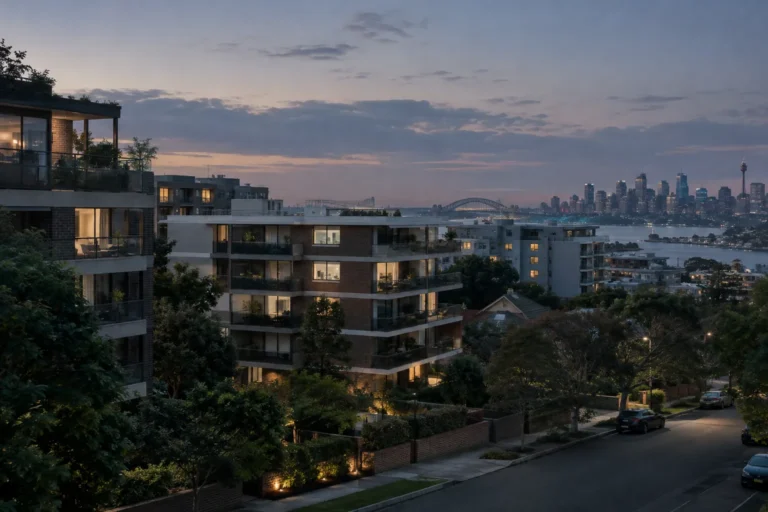
Sydney rents falling sounds like good news for tenants. It may be something more awkward: a sign that the city’s renters have simply run out of income to give.
The early reports of a dip in Sydney asking rents are worth taking seriously. But the cause matters more than the headline. A rent decline can come from two very different places, and they point to very different futures.
Two ways rents can fall
The first is genuine relief. More homes come onto the market, vacancy rises, and landlords compete for tenants by cutting prices. That is a healthy supply response.
The second is a demand ceiling. Rents rise faster than wages for long enough that tenants cannot absorb another increase. They respond by changing behaviour rather than paying more. Landlords then find that the next tenant in the queue cannot afford the asking price either.
The data available so far does not prove which of these is at work. What we can say is that the shortage has not been fixed. Dwelling completions have lagged population growth for years, and the pipeline remains thin. Our look at home building starts and the thinning pipeline shows why supply relief on a large scale is not yet visible.
What affordability-constrained demand looks like
When tenants hit their limit, the market does not clear the way a textbook says it should. People adapt in ways that rarely show up in a rent index:
- Sharing a home with more adults, or moving back in with family
- Leaving Sydney for cheaper regional or interstate markets
- Delaying household formation, such as moving out or starting a family
- Taking smaller or lower-quality dwellings
None of these reduce the underlying need for housing. They hide it. Fewer separate households means weaker measured demand, which can flatten rents without anyone getting a better deal. That is why a falling rent number and an unresolved shortage can sit side by side.
Rents versus incomes
The cleanest test is rent as a share of income. Rents have risen sharply across the cycle while wage growth has trailed. Once rent takes a large slice of a household’s pay, there is little left to absorb rate rises, grocery costs or a surprise bill.
That squeeze is not confined to renters. Mortgaged households face a similar pinch, as we covered in suburban rate rise pain in Sydney and Melbourne. Both groups are drawing from the same constrained pool of income. When the pool is tapped out, price growth in any housing segment slows.
The investor yield question
For investors, softer rents hit the number that matters most: gross yield. Sydney already runs thin yields relative to its prices, so even a modest rent dip can compress the margin between income and borrowing costs.
The key point is which scenario you are in:
- Supply-led dip: rents ease because there are more homes. Vacancy rises, but the shortage is genuinely easing. Yields may soften while capital growth prospects stay intact.
- Affordability-led dip: rents ease because tenants cannot pay more. Vacancy may not rise much, because demand is hidden rather than gone. Yields soften with no structural fix behind them, and rent growth could stall for a while.
The second case is harder for investors to price, because the shortage remains but the ability to monetise it has hit a limit.
Key numbers
- Watch rent-to-income ratios, not just median asking rents
- Track vacancy rates across several months, not a single reading
- Compare dwelling completions against household formation
- Monitor yields against current mortgage rates
The catch for the shortage story
It is tempting to read a rent dip as proof the housing shortage is easing. That reading carries a risk. If the dip reflects tenants hitting a ceiling, then the shortage is being masked by households squeezing into fewer homes or leaving the city.
That is not relief. It is a market rationing access by price. The people pushed out do not vanish from the housing system. They reappear as demand in other places, which is part of the story behind Queensland migration and property prices.
What would change the picture
Three developments would shift the reading:
- A sustained rise in vacancy rates, which would point toward real supply or weaker demand
- Faster wage growth, which would lift the ceiling and let rents rise again
- A pickup in completions that actually keeps pace with population growth
Until at least one of these shows up clearly, treat a single soft rent reading with caution. For a deeper grounding in how vacancy and tenant behaviour interact, see our guide to rents, vacancy and tenants.
Where this leaves renters and investors
Renters may find a little more negotiating room in the short term, but a structural fix is not in sight. Investors should stress-test their numbers against flat or slightly lower rents, not assume the recent surge simply resumes.
The practical move is to look at your own rent-to-income or yield-to-rate gap and ask how much buffer you really have if rents stay flat for a year. If you want the weekly signal on rents, rates and policy, subscribe to the newsletter.
General info, not financial advice.