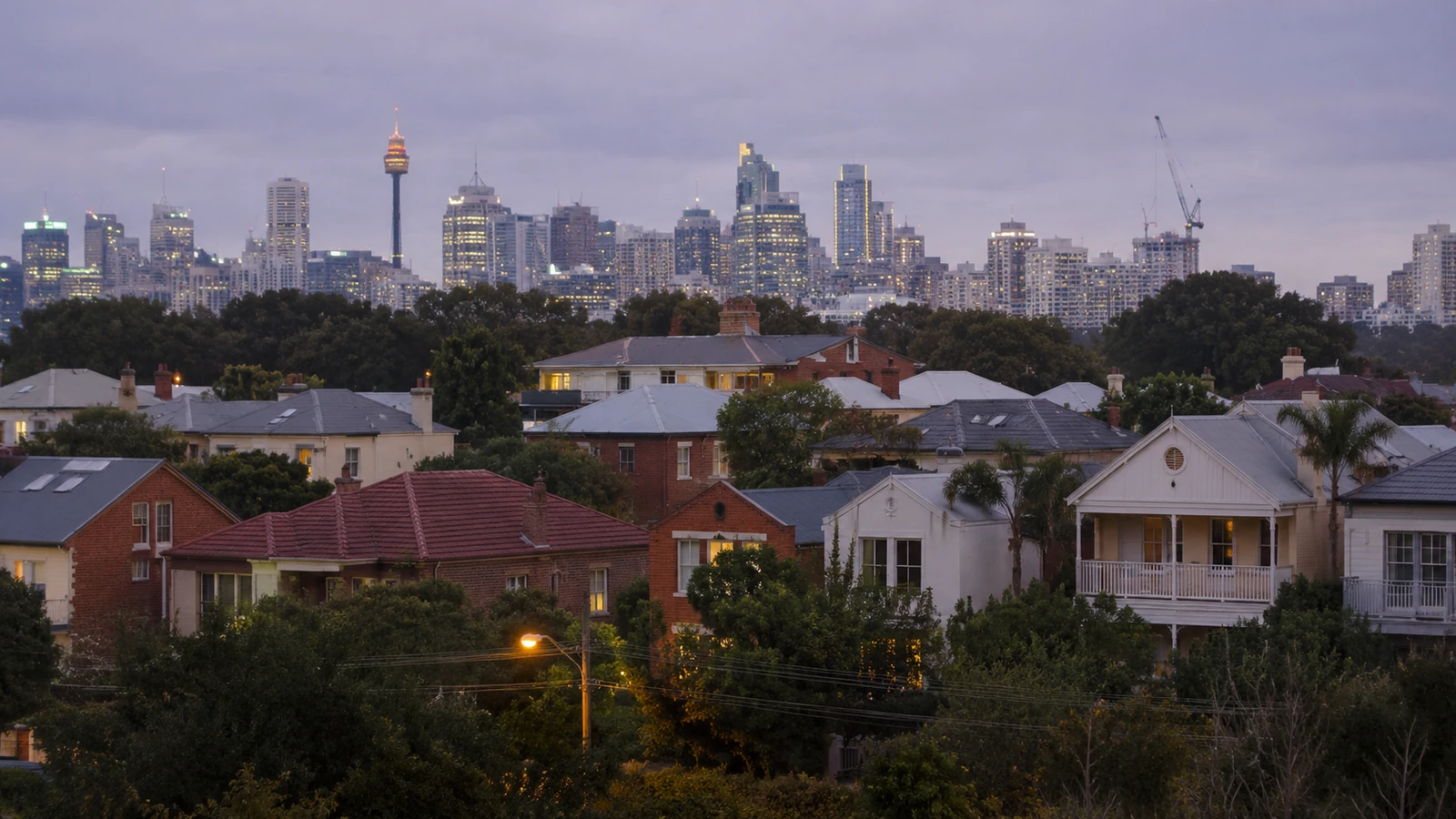
The housing market outlook 2026 has shifted from cautious optimism to something more uncomfortable: flat prices, weaker momentum and investors stepping back.
Commonwealth Bank economists now expect national dwelling prices to be broadly flat through 2026. That is a material downgrade from the bank’s earlier expectations for growth.
The headline sounds simple. Prices stop rising.
But the real story is more layered.
This is not just about one policy change, one auction weekend or one bank forecast. It is about a market that was already losing speed, then got hit by a mix of higher interest rates, softer sentiment, tighter borrowing conditions and proposed tax changes.
For buyers and investors, the key question is not whether the market is “good” or “bad”.
It is whether the deal still works when growth is no longer doing the heavy lifting.
The forecast cut matters because momentum was already fading
CBA’s economists now expect national home prices to be flat in 2026, down from earlier forecasts for growth.
That change matters because it confirms what many buyers, agents and lenders have already been seeing on the ground: the market is not running with the same force it had in late 2025.
Auction clearance rates have softened. Homes are taking longer to sell. Sales activity has lost pace. Price growth has slowed across most capital cities, with Sydney and Melbourne looking more exposed than stronger-running markets such as Perth, Brisbane and Adelaide.
This does not automatically mean a crash.
But it does mean the easy part of the cycle may be over.
In a rising market, buyers often forgive weak yields, thin buffers and aggressive assumptions. When prices flatten, those same weaknesses become harder to ignore.
Australian Property Review has made a similar point in its recent coverage of auction clearance rates warning sellers. A softer auction market does not mean buyers vanish. It often means they stop chasing.
That is a very different market to negotiate in.
What changed and what did not
The obvious change is the forecast.
CBA has moved from expecting price growth in 2026 to expecting flat national dwelling prices. The bank also sees weaker investor lending ahead, with new investor loan volumes expected to fall sharply compared with late 2025.
The less obvious change is confidence.
Buyers do not only respond to repayments. They respond to uncertainty. If they think prices may go sideways, tax settings may shift, or borrowing power may tighten further, many delay the decision.
That delay matters. Housing markets do not need every buyer to disappear. They only need enough buyers to pause for competition to thin out.
What has not changed is the deeper structure of Australia’s housing market.
Supply is still constrained in many areas. Population growth still supports underlying demand. Rental pressure still makes housing a live issue for households and investors. And over time, interest rates remain one of the biggest drivers of borrowing power.
So the 2026 outlook is not a clean bearish story.
It is a pressure-test.
In plain English
Flat prices mean buyers may have more room to negotiate, but not necessarily more room to borrow.
That is the part many people miss.
A cheaper listing price helps only if the bank still approves the loan, repayments remain manageable and the property’s rent or household income can carry the debt.
For investors, the real question is not “will prices rise next year?”
It is this: can the asset survive a year or two of weaker growth, higher costs and tighter lending?
Why investors are the pressure point
CBA expects investor lending to slow sharply in 2026.
That matters because investors often add liquidity to the market. They compete for established dwellings, support demand in rental-heavy suburbs and help set prices in areas where owner-occupier demand is thinner.
When investors step back, the impact is not evenly spread.
High-yield markets may hold up better if rents remain strong and vacancy stays tight. But low-yield markets that rely heavily on capital growth can become more vulnerable. If the rent does not cover enough of the holding cost, investors need confidence in future price growth to justify the shortfall.
Here’s the catch.
A flat price forecast changes the maths more than it changes the mood. A property that made sense with 5 per cent expected capital growth may look very different if the base case becomes zero.
That is especially true for investors using equity from an existing home. As Australian Property Review explained in using home equity to invest, equity can help fund a purchase, but it does not remove repayment risk. In many cases, it increases the amount of debt that needs to perform.
Rates are still doing the heavy lifting
Policy debate gets attention, but interest rates remain the main channel for property demand.
Higher rates reduce borrowing capacity. They lift repayments. They make banks more cautious. They also change buyer psychology because households know they have less room for error.
That is why a market can weaken even before forced selling becomes widespread.
Most owners do not need to sell. But marginal buyers can still lose firepower. A household that could borrow $1 million in one rate environment may be approved for much less in another.
That flows straight into auction bidding, private treaty offers and suburb demand.
For more background on this, see Australian Property Review’s explainer on APRA debt-to-income limits. Credit settings can cool the market even when the cash rate itself is not moving.
Now, the part most people miss: price growth is not only about demand. It is about funded demand.
A buyer can want the house. The question is whether the bank agrees.
Sydney and Melbourne look more exposed
CBA’s note points to weaker conditions in Sydney and Melbourne, particularly in higher-priced areas.
That makes sense.
Expensive markets are more sensitive to borrowing capacity because buyers need larger loans relative to income. When rates rise or lending conditions tighten, the same income supports less debt. That puts pressure on the top end first, then works its way into nearby markets.
This does not mean every Sydney or Melbourne suburb moves the same way.
Relative affordability still matters. Some outer and middle-ring areas can keep drawing demand if buyers are priced out of inner locations. Australian Property Review covered this pattern in Western Sydney buyers fighting for every home, where demand was still alive because buyers were adjusting location rather than leaving the market completely.
But the direction is clear.
Higher-priced markets have less room for sloppy assumptions.
The second-order effect: sellers may be slower to accept reality
A flat market can be harder to read than a falling one.
In a sharp downturn, vendors know the market has moved. In a flat or patchy market, many sellers still anchor to last year’s price.
That creates a gap.
Buyers become more cautious. Sellers hold out. Agents work harder to close the difference. Listings sit longer. Discounting becomes more common, but often only after weeks of weak interest.
This is where auction clearance rates and days on market matter more than median prices.
Median prices are backward-looking. They tell you what settled. Auction results, vendor discounting and time on market tell you how the negotiation is changing now.
For buyers, that can create opportunity. For sellers, it can create frustration.
For investors, it means patience may become more valuable than speed.
What could derail the flat-price case
The base case is now weaker, but it is not locked in.
An upside case would need a few things to go right.
Inflation would need to cool enough for rate relief to come back into view. Wages would need to hold up without forcing the Reserve Bank into a tougher stance. Rental yields would need to improve enough to tempt investors back. And buyer confidence would need to stabilise.
A downside case is also possible.
If inflation stays sticky, the RBA keeps rates higher for longer, unemployment rises, or tax uncertainty weighs harder on investors, demand could weaken more than expected. In that scenario, flat prices could become modest falls in more exposed suburbs.
The biggest risk is not one headline.
It is the combination: high debt, weaker confidence, policy uncertainty and less borrowing power at the same time.
What buyers and investors should do now
The practical move is simple: update the numbers before updating the search.
Do not rely on a borrowing figure from three months ago. Do not assume last year’s rent will cover this year’s costs. Do not treat a bank forecast as a buy or sell signal by itself.
Start with three checks.
First, ask your broker or lender for current borrowing capacity using today’s rates and assessment buffers.
Second, pressure-test repayments at a higher rate than your actual loan rate. This gives you a margin if the market or your income changes.
Third, for investment properties, calculate cashflow after insurance, strata, maintenance, land tax, property management, vacancy and repairs. The headline rent is not the real return.
A simple rule of thumb: if the deal only works when prices rise quickly, it is not a defensive deal.
Bottom line
The housing market outlook 2026 is no longer about easy growth.
CBA’s downgrade points to a market where prices may go sideways, investor lending may slow and buyers may become more selective. That does not mean every market falls. It does mean the margin for error is smaller.
For homeowners, this is a reminder not to price off last year’s momentum.
For buyers, it may create more room to negotiate, but only if borrowing capacity holds.
For investors, the test is sharper: cashflow, yield, debt and vacancy risk matter more when capital growth is no longer assumed.
Start here: update your borrowing capacity and run the deal on flat-growth assumptions before making an offer.
For more independent property analysis, subscribe to the free Australian Property Review newsletter
General info, not financial advice.