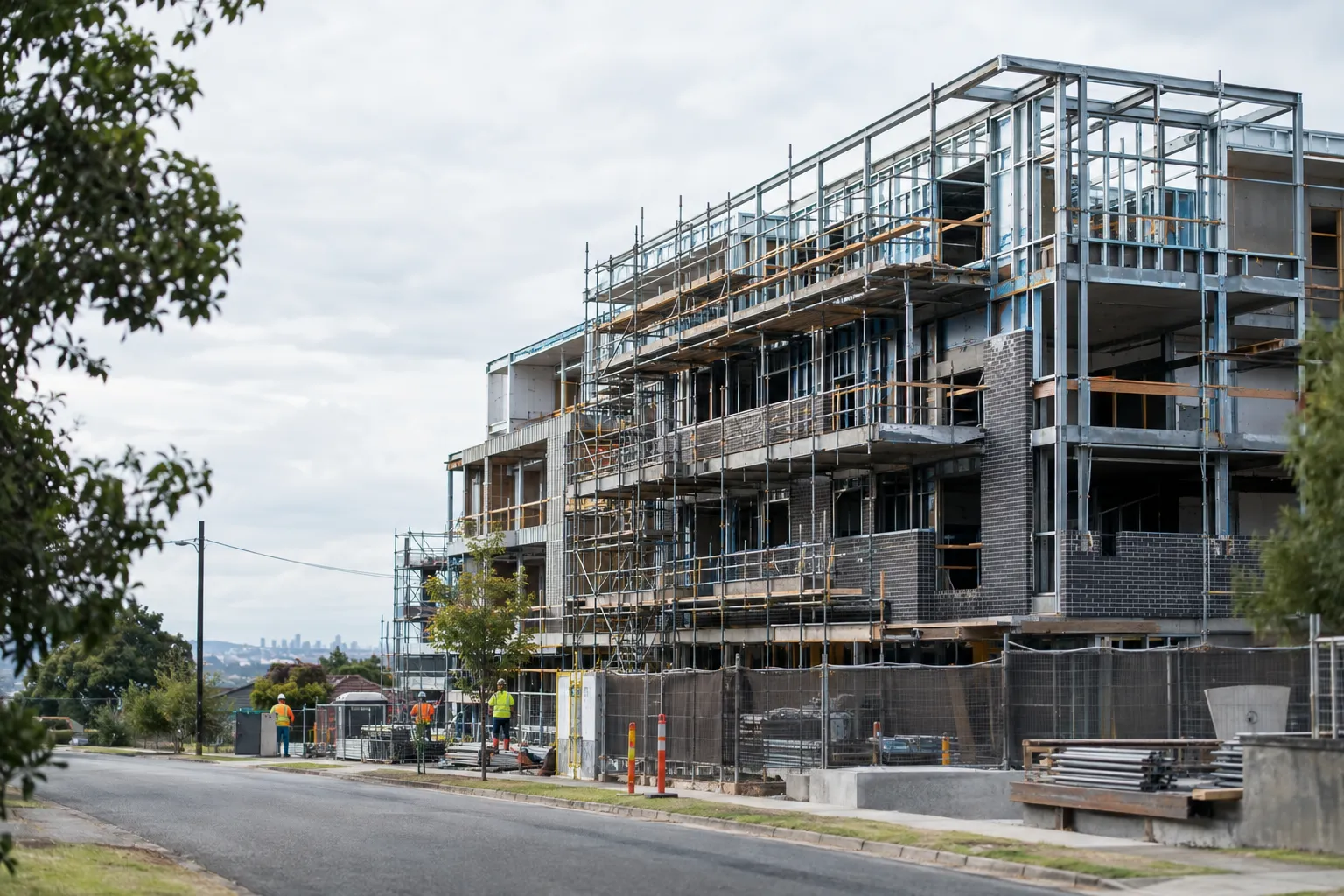
A tax change aimed at family trusts is now being argued as a housing supply problem. Five peak industry bodies, covering general business, small business, home building, master builders and property, have jointly urged Senators to hold off on the proposed overhaul of discretionary trust taxation. The bill has already cleared the lower house, and a final vote is expected in the last sitting weeks of the year.
The discretionary trust tax housing supply debate is really about one question: does a revenue measure change what small builders and developers can afford to start? Here is how the argument runs, and where it is contested.
What the proposal does to a trust-run business
The industry groups say around 350,000 small family firms operate through discretionary trusts. Under the proposal, each would face three paths:
- Pay a 30% minimum tax on all trust income.
- Move to a fixed-distribution arrangement, where even an accidental deviation could trigger 47% tax on a year’s earnings.
- Switch to a different structure, which the groups say costs tens of thousands of dollars each.
The government plans the minimum tax from 1 July 2028, with wider rollover relief from 1 July 2027. So there is a lead time. The question is whether projects being planned now are priced for a tax regime that lands partway through their life.
How a tax on trusts reaches a building site
Small developers and builders often hold projects in trusts. That is a choice about flexibility: profits can be distributed to different family members in different years, depending on circumstances. A minimum tax narrows that flexibility.
The chain from there is straightforward, if not certain:
- Lower after-tax returns on a project reduce the margin a developer needs to clear before committing.
- Marginal projects, the ones that only just stack up, are the first to be shelved or delayed.
- Fewer starts today means a thinner pipeline of completions later.
- Where projects do proceed, higher costs tend to be passed into prices or rents.
The groups cite a survey in which 60% of smaller developers expect timing or viability effects from the change, and 37% of those expect a project to be cancelled. That is a survey of an interested group, so treat it as a signal about sentiment rather than a forecast of lost homes. It still points at the part of the market most exposed: smaller operators without the balance sheet to absorb a new tax line.
This lands on a pipeline that already has other pressures. Our look at the construction pipeline and a thin order book shows how little slack some builders have, and the fall in investor home loans raises the question of who funds new stock if developers also pull back.
The compliance cost numbers do not agree
The biggest gap in this debate is the estimated cost of complying. An accounting body put advice costs at $2.0 billion to $2.8 billion up front, plus $221 million to $595 million a year. Treasury’s figure is $48 million.
That is not a rounding difference. One side is describing a broad restructuring of hundreds of thousands of businesses. The other assumes most will have little to do. Which estimate is closer matters for how many small builders decide the paperwork and advice are not worth the trouble.
What the government says in reply
The government’s position is that more than 90% of small businesses are unaffected. It also points to Treasury analysis finding families who use trusts pay roughly four percentage points less tax than comparable families who do not. On that view, the measure is about fairness and integrity, and a minimum tax closes a gap rather than creating a new burden.
Both things can be true at once. A measure can be fair in design and still change the economics of a thin-margin project. The industry groups do not argue for no action. They favour a narrower integrity approach aimed at the arrangements that worry policymakers, rather than a broad minimum applied to every trust.
Where the supply risk is real and where it is not
The risk is concentrated, not universal. Large developers with institutional capital and corporate structures face a different tax picture. The exposure sits with smaller builders and developers who rely on trusts, work on tight margins, and have little room to carry extra cost.
Two caveats keep this in proportion:
- The start date is 2028, so projects with long lead times may already be priced with the change in mind.
- The cancellation figure comes from a survey of expectations, not observed behaviour.
What would give a clearer read is evidence of actual decisions: pre-sales being pulled, land deals falling over, or approvals not converting to starts. Those show up in building approvals and lending data well before they show up in completions.
What readers can check
If you work in or around small-scale development, find out how your projects are held and what a 30% minimum would do to your modelled return. If you are a buyer or investor following supply, watch approvals and starts data over the next few quarters rather than relying on survey headlines. For tax treatment of property more broadly, our negative gearing, CGT and investor tax guide is a useful reference.
If you want the weekly signal on policy that moves the property market, subscribe to the newsletter.
General info, not financial advice.